
Table of Contents
- What Are Natural and Synthetic Peptides?
- How Natural Peptides Are Produced
- How Synthetic Peptides Are Manufactured
- Structural Differences
- Biological Functions
- Advantages of Natural Peptides
- Advantages of Synthetic Peptides
- Research and Laboratory Applications
- Challenges and Limitations
- Future of Peptide Science
- Frequently Asked Questions
- Conclusion
PART 1
What Are Natural vs Synthetic Peptides?
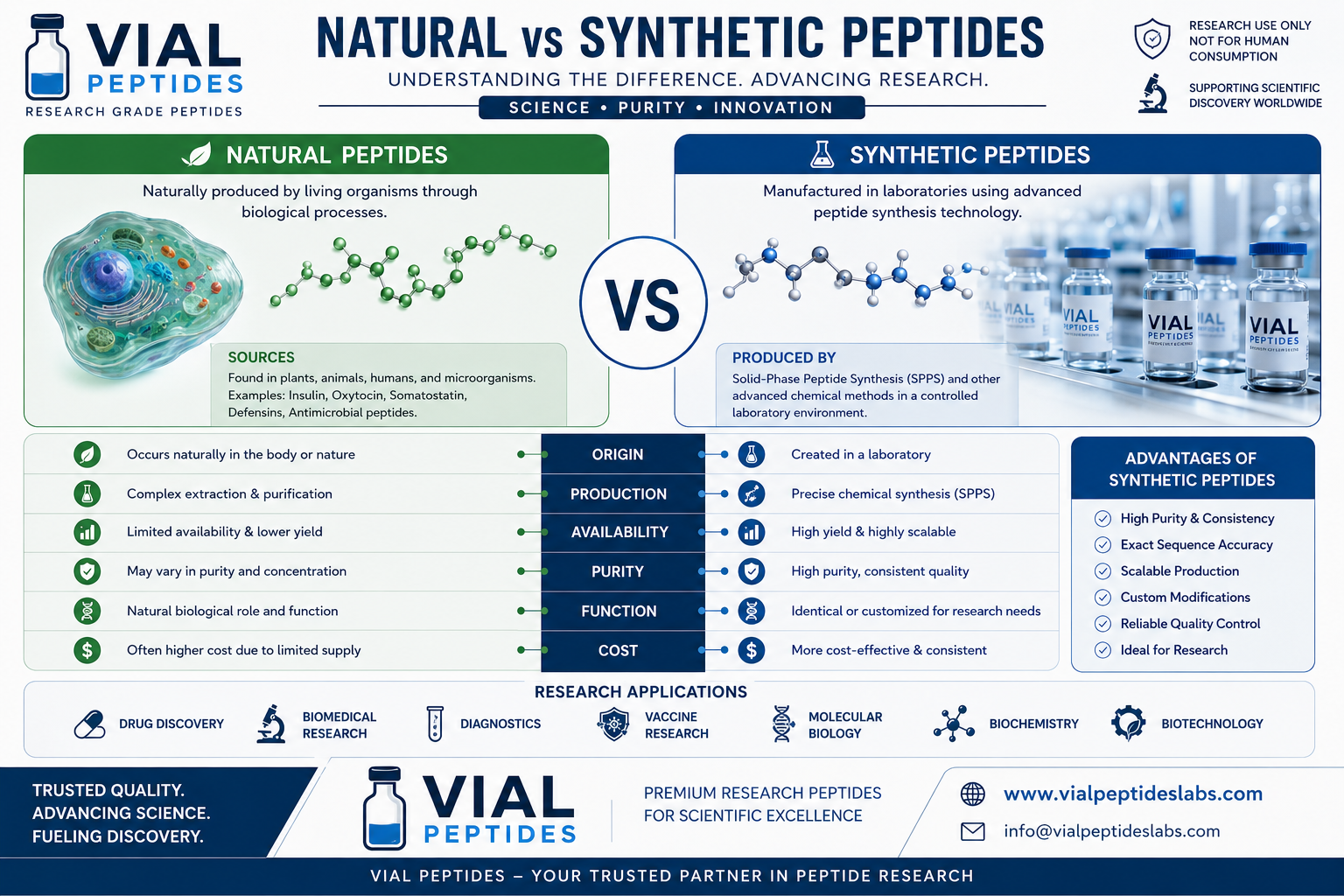
Natural and synthetic peptides share the same fundamental building blocks—amino acids connected by peptide bonds—but differ significantly in how they are produced and utilized. Understanding these differences is essential for researchers, students, biotechnology professionals, and anyone exploring peptide science.
Natural peptides are produced by living organisms through normal biological processes. Every cell in the body contains machinery capable of assembling amino acids into peptides according to genetic instructions encoded in DNA. These naturally occurring molecules participate in countless physiological processes, including cell signaling, immune regulation, metabolism, growth, tissue repair, neurotransmission, and hormone regulation.
Examples of naturally occurring peptides include insulin, glucagon, oxytocin, vasopressin, atrial natriuretic peptide, and numerous antimicrobial peptides produced by plants, animals, and microorganisms. These molecules have evolved over millions of years to perform highly specialized biological functions with remarkable precision.
Synthetic peptides, by contrast, are produced in laboratories using carefully controlled chemical manufacturing techniques. Scientists replicate naturally occurring amino acid sequences or design entirely new peptide sequences to investigate biological pathways, develop diagnostic tools, or explore innovative therapeutic concepts. Modern peptide synthesis allows researchers to construct peptides with exceptional purity, consistency, and sequence accuracy.
One of the greatest advantages of synthetic peptides is flexibility. Researchers can modify amino acid sequences, introduce non-natural amino acids, cyclize peptide chains, or incorporate chemical groups that improve stability or alter biological behavior. These capabilities make synthetic peptides invaluable tools across biotechnology, pharmaceutical research, molecular biology, and analytical chemistry.
Although natural and synthetic peptides originate from different production methods, they can be chemically identical when synthesized correctly. A laboratory-manufactured peptide designed to match a naturally occurring sequence will possess the same amino acid order and molecular structure, allowing scientists to study biological mechanisms under highly controlled conditions.
As peptide science continues to advance, synthetic manufacturing has become indispensable for producing research-grade materials in quantities and purities that would be difficult or impossible to obtain directly from natural sources.
Understanding Natural Peptides
Natural peptides are continuously synthesized within living organisms through ribosomal protein synthesis followed by enzymatic processing. Genes provide the instructions for assembling amino acids into precursor proteins, which specialized enzymes subsequently cleave into functional peptide molecules.
These peptides function as biological messengers, enabling communication between cells, tissues, and organs. Their activities regulate numerous physiological systems, including:
- Hormonal signaling
- Nervous system communication
- Immune defense
- Inflammatory responses
- Cellular growth
- Tissue maintenance
- Metabolic regulation
Natural peptides are found throughout virtually every form of life, from bacteria and fungi to plants, animals, and humans. Their widespread presence highlights their evolutionary importance and fundamental role in biology.
Understanding Synthetic Peptides
Synthetic peptides are manufactured using techniques such as solid-phase peptide synthesis (SPPS). During this process, amino acids are sequentially added to a growing chain while attached to an insoluble resin, allowing precise control over sequence assembly.
Following synthesis, peptides undergo purification and analytical characterization to verify sequence identity and chemical purity. Laboratory methods such as high-performance liquid chromatography (HPLC) and mass spectrometry are commonly used to assess research-grade quality.
Because synthetic production is highly controlled, researchers can consistently generate peptides with defined characteristics suitable for experimental applications. This reproducibility is one of the primary reasons synthetic peptides have become indispensable in modern biomedical research.
Part 2: Key Differences Natural vs Synthetic Peptides
Although natural and synthetic peptides may share identical amino acid sequences, they differ significantly in their origin, production methods, customization potential, quality control, scalability, and research applications. Understanding these differences is essential for researchers, biotechnology professionals, and students studying peptide science.
Origin and Production
The most fundamental difference between natural and synthetic peptides is how they are produced.
Natural Peptides
Natural peptides are synthesized by living organisms through biological processes. Cells use genetic information stored in DNA to assemble amino acids into proteins or precursor molecules, which are then processed by enzymes to produce functional peptides.
Natural peptides are found in virtually every living organism and are involved in numerous physiological processes, including:
- Cell signaling
- Hormone regulation
- Immune responses
- Nervous system communication
- Tissue repair
- Metabolic regulation
- Antimicrobial defense
Because they are produced by biological systems, the amount of a specific natural peptide may vary depending on factors such as age, genetics, health status, environmental conditions, and cellular activity.
Synthetic Peptides
Synthetic peptides are manufactured in laboratories using highly controlled chemical methods. The most widely used technique is Solid-Phase Peptide Synthesis (SPPS), which allows amino acids to be added one at a time in a predetermined sequence.
Unlike natural production, chemical synthesis does not rely on living cells. Scientists can produce peptides with exceptional precision while controlling every stage of the manufacturing process.
This level of control makes synthetic peptides particularly valuable for laboratory research, where reproducibility and consistency are essential.
Structural Similarities
One common misconception is that synthetic peptides are fundamentally different molecules from natural peptides.
In reality, a synthetic peptide designed to match a naturally occurring sequence can be chemically identical.
If the amino acid sequence is reproduced accurately, both molecules share the same:
- Molecular weight
- Amino acid sequence
- Chemical composition
- Peptide bonds
- Three-dimensional folding (when applicable)
- Biological recognition by target receptors
The primary difference lies in how the peptide was produced, not necessarily in its chemical structure.
Manufacturing Precision
Modern peptide synthesis offers an extraordinary level of precision.
Researchers can manufacture peptides that contain:
- Exact amino acid sequences
- Defined chain lengths
- Specific terminal modifications
- Non-natural amino acids
- Fluorescent labels
- Stable isotope labels
- Cyclized structures
- PEGylated modifications
- Lipid-conjugated peptides
These modifications enable scientists to investigate biological pathways, receptor interactions, imaging techniques, and molecular mechanisms with greater accuracy.
Natural peptides generally cannot be customized in this manner because they are produced according to biological genetic instructions.
Purity and Quality Control
One of the greatest advantages of synthetic peptide production is the ability to maintain rigorous quality standards.Natural vs Synthetic Peptides
Following synthesis, research peptides typically undergo multiple analytical procedures, including:Natural vs Synthetic Peptides
- High-Performance Liquid Chromatography (HPLC)
- Mass Spectrometry (MS)
- Amino Acid Analysis
- Sequence Verification
- Identity Testing
- Purity Assessment
These analytical techniques help confirm that the synthesized peptide matches the intended molecular design.
Natural peptides extracted directly from biological tissues often require extensive purification because they exist alongside thousands of other proteins, enzymes, lipids, nucleic acids, and cellular components.
Scalability
Producing natural peptides can be challenging.Natural vs Synthetic Peptides
Many naturally occurring peptides are present only in extremely small quantities within tissues or biological fluids.Natural vs Synthetic Peptides
Obtaining sufficient amounts may require:Natural vs Synthetic Peptides
- Large biological samples
- Complex extraction methods
- Multiple purification stages
- Significant processing time
Synthetic peptide manufacturing offers a more scalable solution.
Once a synthesis protocol has been optimized, laboratories can repeatedly manufacture the same peptide with high consistency and reproducibility.
This scalability has made synthetic peptides indispensable in biotechnology, diagnostics, and pharmaceutical research.
Stability
Natural peptides are designed to function within living organisms and are often rapidly broken down by enzymes after completing their biological roles.
This rapid degradation helps regulate normal physiological processes but can limit their usefulness in research if prolonged stability is required.
Scientists can improve the stability of synthetic peptides through various chemical strategies, such as:
- Cyclization
- Amino acid substitution
- Terminal modifications
- PEGylation
- Lipid conjugation
- Incorporation of non-natural amino acids
These modifications can increase resistance to enzymatic degradation while preserving the peptide’s intended characteristics for laboratory investigations.
Customization Capabilities
Perhaps the greatest advantage of synthetic peptides is customization.
Researchers are not limited to naturally occurring sequences.
Instead, they can design peptides specifically for experimental objectives, including:
- Receptor-binding studies
- Enzyme substrate analysis
- Antibody production
- Molecular imaging
- Diagnostic assay development
- Biomarker discovery
- Protein interaction studies
- Structural biology research
This flexibility has significantly expanded the role of peptides in modern life sciences and continues to drive innovation across multiple research disciplines.
Cost Considerations
Natural peptide isolation can be expensive due to the labor-intensive extraction and purification processes required.
Costs often increase when peptides are present in very low concentrations or when specialized biological materials are needed.
Synthetic peptide production has become increasingly cost-effective as manufacturing technologies have advanced.
Automated peptide synthesizers, improved purification techniques, and optimized production workflows now allow many research peptides to be produced efficiently while maintaining high quality standards.
However, the overall cost of synthesis may still vary depending on factors such as:
- Peptide length
- Sequence complexity
- Required purity level
- Chemical modifications
- Production scale
Why Synthetic Peptides Dominate Modern Research
Today, the majority of peptides used in scientific laboratories are synthesized rather than isolated from natural sources.
Synthetic production offers several advantages:
- High reproducibility
- Excellent sequence accuracy
- Reliable purity testing
- Batch-to-batch consistency
- Easier large-scale production
- Extensive customization options
- Efficient manufacturing timelines
These characteristics make synthetic peptides essential tools in molecular biology, biotechnology, pharmaceutical discovery, analytical chemistry, immunology, and many other areas of biomedical research.
As peptide synthesis technologies continue to evolve, researchers can investigate increasingly complex biological questions while developing innovative solutions for future scientific and medical challenges.
Part 3: Applications, Future Developments, FAQs, and Conclusion
Natural and synthetic peptides each play essential roles in biological science, biotechnology, and pharmaceutical research. While natural peptides provide insight into how living organisms regulate countless physiological processes, synthetic peptides enable scientists to reproduce, modify, and study these molecules with exceptional precision. Together, they continue to drive innovation across research disciplines and contribute to a deeper understanding of molecular biology.
Applications of Natural and Synthetic Peptides
Although their origins differ, both natural and synthetic peptides are widely used across scientific and industrial fields.
Biomedical Research
Peptides are indispensable tools for studying cellular communication, receptor interactions, protein function, immune responses, and metabolic pathways. Researchers use synthetic peptides to investigate biological mechanisms under controlled laboratory conditions, while naturally occurring peptides often serve as reference molecules for comparison.
Drug Discovery
Many peptide-based drug candidates are inspired by naturally occurring peptides. Researchers may synthesize identical or modified peptide sequences to explore their properties, improve stability, or better understand how they interact with biological targets during the early stages of pharmaceutical research.
Diagnostic Development
Synthetic peptides are commonly incorporated into laboratory assays and diagnostic platforms. They can serve as highly specific molecular probes, helping scientists detect antibodies, proteins, or biomarkers associated with various biological conditions in research settings.
Vaccine Research
Scientists frequently use synthetic peptides to study immune recognition and antigen-antibody interactions. Carefully designed peptide fragments allow researchers to investigate immune responses without requiring the complete protein, making them valuable tools in vaccine-related research and immunology.
Biotechnology
Peptides contribute to numerous biotechnology applications, including:
- Protein interaction studies
- Enzyme characterization
- Biosensor development
- Molecular imaging
- Cell signaling research
- Biomarker discovery
- Structural biology
Their versatility continues to expand as new analytical technologies emerge.
Choosing Between Natural and Synthetic Peptides
The appropriate choice depends on the goals of a particular research project.
Natural peptides are often selected when scientists wish to investigate molecules exactly as they occur within living organisms or to understand their physiological roles.
Synthetic peptides are preferred when experiments require:
- Precise amino acid sequences
- High batch-to-batch consistency
- Specific chemical modifications
- Larger quantities
- Defined purity levels
- Custom molecular designs
For many laboratory applications, synthetic peptides offer greater flexibility while maintaining close structural similarity to their naturally occurring counterparts.
The Future of Peptide Science
Peptide science continues to evolve rapidly, driven by advances in chemistry, biotechnology, computational biology, and analytical instrumentation.
Several emerging trends are shaping the future of peptide research:
Artificial Intelligence in Peptide Design
Machine learning and artificial intelligence are increasingly being used to predict peptide structures, optimize amino acid sequences, and identify promising candidates for research. These technologies help scientists evaluate large datasets more efficiently and accelerate early-stage discovery.
Improved Peptide Synthesis
Modern synthesis techniques continue to become faster, more accurate, and more efficient. Innovations in automated manufacturing, purification methods, and analytical testing are improving the quality and accessibility of research peptides.
Novel Chemical Modifications
Researchers are exploring new ways to enhance peptide stability, selectivity, and molecular interactions through advanced chemical modifications. These developments expand the range of applications available for laboratory investigations.
Personalized Medicine Research
As genomic and proteomic technologies advance, peptides are being studied as part of broader efforts to understand individual biological differences. Ongoing research continues to investigate how peptide-based approaches may contribute to future precision medicine strategies.
Expanding Research Applications
Scientists are discovering new uses for peptides in fields such as regenerative biology, neuroscience, immunology, molecular diagnostics, agricultural biotechnology, and biomaterials science. Continued innovation is expected to broaden the role of peptides across many areas of research.
Frequently Asked Questions
Are natural peptides better than synthetic peptides?
Neither is inherently better. Natural peptides occur within living organisms, while synthetic peptides are manufactured under controlled laboratory conditions. Each has distinct advantages depending on the research objective.
Can synthetic peptides be identical to natural peptides?
Yes. When synthesized correctly, a synthetic peptide can have the same amino acid sequence and chemical structure as its naturally occurring counterpart.
Why are synthetic peptides widely used in research?
Synthetic peptides provide consistent quality, defined purity, reproducibility, scalability, and the ability to customize sequences for specific scientific investigations.
How are synthetic peptides produced?
Most are manufactured using Solid-Phase Peptide Synthesis (SPPS), a process that sequentially joins amino acids into a desired peptide sequence before purification and quality testing.
What analytical methods verify peptide quality?
Research laboratories commonly use techniques such as High-Performance Liquid Chromatography (HPLC), Mass Spectrometry (MS), amino acid analysis, and sequence verification to confirm peptide identity and purity.
Do natural and synthetic peptides have the same structure?
If they share the same amino acid sequence, they can possess the same molecular structure. Differences generally relate to production methods or intentional chemical modifications.
Why do researchers modify synthetic peptides?
Chemical modifications may improve stability, facilitate detection, or enable researchers to investigate specific molecular interactions and biological mechanisms.
Can synthetic peptides be customized?
Yes. Scientists can alter amino acid sequences, introduce non-natural amino acids, add labels, or make other modifications to meet specific experimental requirements.
Why are peptides important in biotechnology?
Peptides are widely used in molecular biology, immunology, structural biology, diagnostics, analytical chemistry, and many other scientific disciplines because of their versatility and specificity.
What is the difference between peptide synthesis and natural peptide production?
Natural peptides are produced by living cells through biological processes, whereas synthetic peptides are assembled chemically in laboratories using controlled manufacturing techniques.
Conclusion
Natural and synthetic peptides are closely related molecules that share the same amino acid building blocks but differ in how they are produced and applied. Natural peptides are generated within living organisms and play essential roles in cellular communication, metabolism, immune regulation, and countless other biological functions. Synthetic peptides are created through advanced chemical synthesis, allowing researchers to reproduce natural sequences or design entirely new molecules with exceptional precision.
The ability to manufacture high-quality synthetic peptides has transformed modern scientific research by providing reliable, customizable, and reproducible materials for molecular biology, biotechnology, diagnostics, and pharmaceutical discovery. As peptide synthesis technologies continue to advance, researchers will gain even greater opportunities to explore biological systems and develop innovative scientific solutions.
Whether studying naturally occurring signaling molecules or designing custom research tools, understanding the similarities and differences between natural and synthetic peptides is fundamental to appreciating their growing importance in modern life sciences.
Suggested Internal Links for Vial Peptides
To strengthen topical authority and improve site navigation, link this article to related content such as:
- What Are Peptides?
- Peptide Structure Explained
- Amino Acids and Peptides
- Peptide Bonds Explained
- Peptides vs. Proteins
- How Peptides Are Synthesized
- Peptide Purity Explained
- Understanding HPLC Testing
- Lyophilized Peptides Explained
- Research Peptides Guide
Image Alt Text Suggestions
- Natural vs Synthetic Peptides comparison infographic
- Natural peptide production inside living cells
- Solid-phase peptide synthesis laboratory process
- Comparison chart of natural and synthetic peptide characteristics
- Research peptide manufacturing and quality control illustration
This completes a comprehensive, SEO-focused article suitable as a cornerstone resource for Vial Peptides, with strong internal linking opportunities to help build topical authority across your peptide knowledge base.