
What Are Peptides? A Complete Guide to Peptide Science
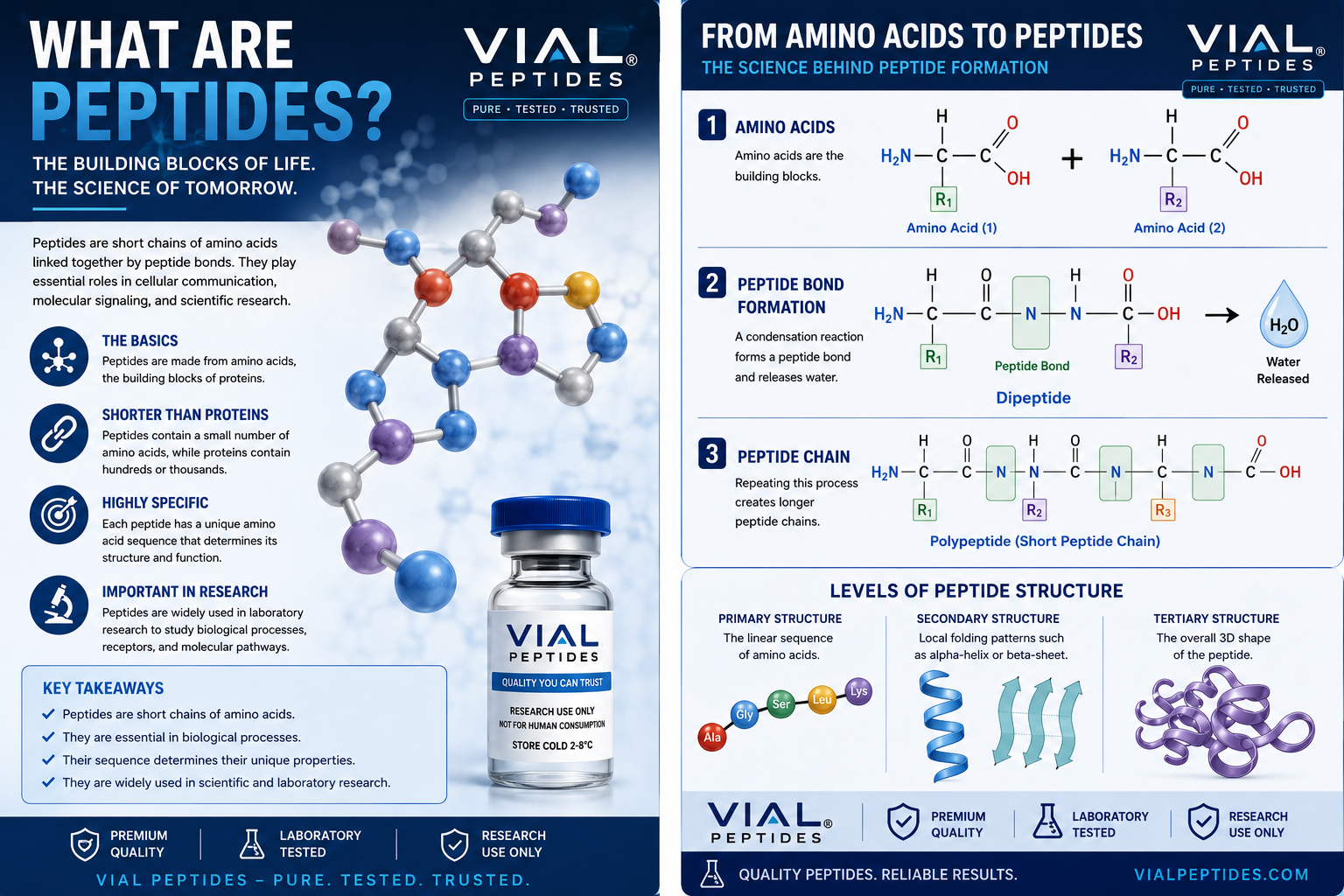
Peptides are among the most fascinating molecules studied in modern biological science. Although they are much smaller than proteins, peptides play an essential role in cellular communication, molecular biology, biotechnology, and pharmaceutical research. Their unique structure and remarkable specificity have made them an important focus for scientists investigating biological systems and developing new research tools.
If you’ve ever wondered what peptides re, the answer begins with amino acids. Peptides are short chains of amino acids linked together by peptide bonds. While this definition sounds simple, peptides are incredibly diverse. Thousands of naturally occurring and synthetic peptides exist, each possessing its own amino acid sequence, molecular characteristics, and biological properties.
Today, peptides are investigated by universities, biotechnology companies, pharmaceutical laboratories, and research institutions around the world. Scientists continue to study how peptides interact with receptors, how they participate in cellular signaling, and how manufacturing techniques can produce highly purified research materials for laboratory investigations.
This guide explains everything you need to know about peptides—from their basic structure and formation to their manufacturing, purification, laboratory testing, and importance in scientific research.
The Building Blocks of Peptides
Every peptide begins with amino acids.
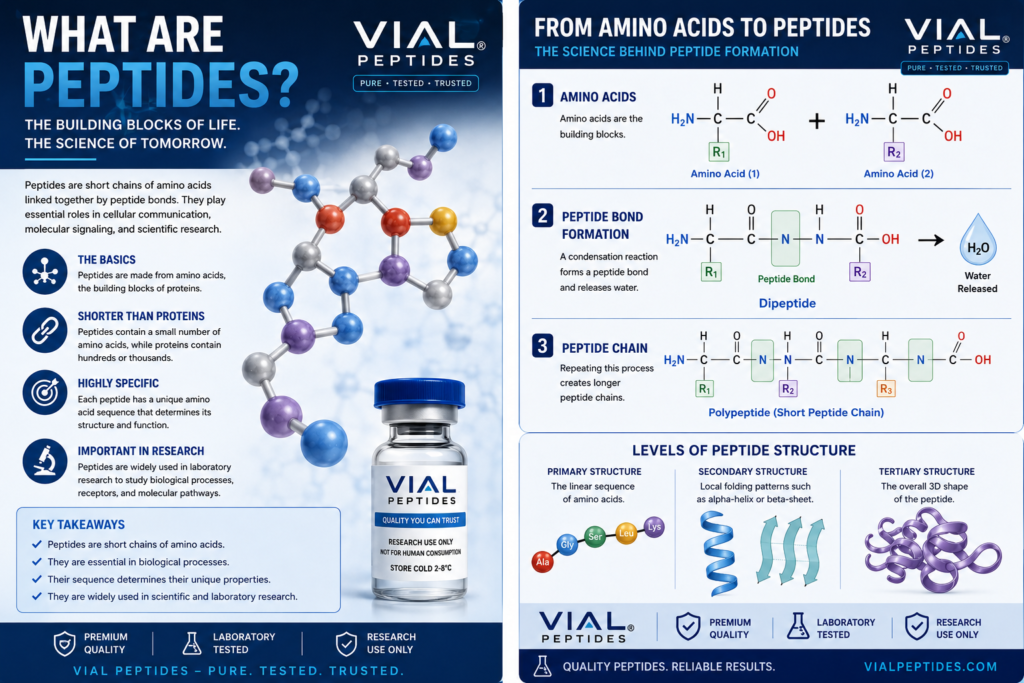
Amino acids are organic molecules often referred to as the building blocks of life because they combine to form peptides and proteins. Living organisms use twenty standard amino acids to construct thousands of different biological molecules.
Each amino acid has a similar basic structure consisting of:
- An amino group
- A carboxyl group
- A hydrogen atom
- A unique side chain (R group)
The side chain is what makes each amino acid different. Some amino acids are positively charged, others are negatively charged, while some are hydrophobic or hydrophilic. These differences influence how peptides fold, interact with other molecules, and behave during laboratory analysis.
Scientists carefully study amino acid properties because even a single change in sequence can alter the characteristics of an entire peptide.
How Peptides Are Formed
Peptides are created when amino acids join together through chemical reactions known as condensation reactions.
During this process, the carboxyl group of one amino acid reacts with the amino group of another. A molecule of water is released, and a strong covalent bond called a peptide bond is formed.
This process repeats until the desired amino acid sequence has been assembled.
For example:
- Two amino acids form a dipeptide.
- Three amino acids form a tripeptide.
- Chains containing several amino acids are called oligopeptides.
- Longer chains are generally referred to as polypeptides.
Although peptides vary in length, they are typically much smaller than proteins.
Peptides vs. Proteins: What Is the Difference?
One of the most common questions in peptide science is how peptides differ from proteins.
Both peptides and proteins are made from amino acids connected by peptide bonds. The primary difference lies in their size and complexity.
Peptides generally contain a relatively small number of amino acids arranged in short chains. Proteins, on the other hand, consist of much longer amino acid chains that fold into highly complex three-dimensional structures.
Because peptides are smaller, researchers often find them easier to synthesize, analyze, and study under controlled laboratory conditions.
Their relatively simple structure also allows scientists to investigate highly specific molecular interactions with remarkable precision.
Why Amino Acid Sequence Matters
A peptide’s amino acid sequence determines almost everything about its molecular characteristics.
The sequence influences:
- Molecular weight
- Electrical charge
- Solubility
- Stability
- Three-dimensional shape
- Receptor recognition
- Chemical behavior
Scientists frequently compare amino acid sequences to letters in a sentence.
Changing one letter may completely alter the meaning of a sentence.
Likewise, replacing a single amino acid may significantly change the characteristics of an entire peptide.
This remarkable level of precision explains why peptide manufacturing requires exceptional attention to detail.
Natural Peptides and Synthetic Peptides
Peptides generally fall into two broad categories.
Natural Peptides
Natural peptides are produced by living organisms as part of normal biological processes.
Researchers investigate naturally occurring peptides to better understand biological communication, molecular signaling, and cellular regulation.
Many naturally occurring peptides function as signaling molecules that help coordinate communication between cells.
Synthetic Peptides
Synthetic peptides are manufactured in controlled laboratory environments.
Scientists produce synthetic peptides to investigate specific amino acid sequences under carefully controlled research conditions.
Modern peptide manufacturing techniques allow researchers to construct highly precise peptide molecules while maintaining strict quality control throughout the production process.
The ability to manufacture peptides with defined amino acid sequences has significantly expanded scientific research opportunities.
Why Scientists Study Peptides
Peptides have become an important area of scientific investigation because they participate in numerous biological processes.
Researchers continue to explore peptide chemistry in fields such as:
- Molecular biology
- Biochemistry
- Biotechnology
- Analytical chemistry
- Pharmaceutical science
- Structural biology
- Protein chemistry
- Cell biology
Their relatively small size and highly specific molecular interactions make peptides valuable research materials for laboratory investigations.
Scientists are particularly interested in understanding how peptide structure influences molecular recognition and cellular communication.
Understanding Peptide Structure
Although peptides are smaller than proteins, their structure remains remarkably sophisticated.
Scientists generally describe peptide structure using several organizational levels.
Primary Structure
The primary structure refers to the exact order of amino acids within the peptide chain.
This sequence forms the foundation of every peptide.
Secondary Structure
As peptide chains grow longer, sections may begin forming organized arrangements such as alpha-helices or beta-sheet-like structures.
These structural characteristics influence molecular stability and biological behavior.
Three-Dimensional Shape
The overall three-dimensional arrangement of a peptide determines how it interacts with surrounding molecules.
Researchers devote significant attention to structural biology because molecular shape often determines receptor recognition and peptide function.
Peptide Bonds: The Foundation of Every Peptide
Peptide bonds are among the strongest and most important chemical bonds found in biological systems.
Each peptide bond connects two amino acids into a continuous molecular chain.
Although individual peptide bonds appear simple, thousands of them contribute to the remarkable diversity of peptides found throughout nature.
Scientists investigate peptide bond formation, stability, and chemical properties as part of peptide synthesis and analytical chemistry.
Understanding peptide bonds provides valuable insight into both peptide manufacturing and molecular biology.
Why Peptides Are Important in Scientific Research
Peptides have become indispensable tools in modern laboratories because of their precision and versatility.
Researchers use peptides to study molecular interactions, investigate biological pathways, develop analytical methods, and improve scientific understanding of cellular communication.
Unlike larger biological molecules, peptides can often be synthesized with exceptional precision, allowing scientists to investigate individual amino acid sequences under carefully controlled laboratory conditions.
This level of control makes peptides particularly valuable for biochemical and molecular research.
Research Peptides and Laboratory Studies
Research peptides are manufactured specifically for scientific investigation.
Scientists use laboratory-tested peptides to examine molecular interactions, evaluate analytical methods, investigate receptor recognition, and study biological processes under controlled experimental conditions.
Because reliable scientific data depends on dependable research materials, researchers place significant importance on peptide purity, analytical testing, and manufacturing consistency.
High-quality research peptides help reduce unnecessary experimental variation while improving confidence in laboratory observations.
How Peptides Communicate with Cells
One of the reasons peptides are so important in scientific research is their role in cellular communication. Cells are constantly exchanging information with one another to coordinate biological processes. Rather than using spoken language, cells communicate through highly specialized chemical messengers, and peptides are among the most significant of these molecules.
Every cell contains receptors capable of recognizing specific molecular structures. When the correct peptide encounters its matching receptor, the two molecules interact, initiating a series of biochemical events inside the cell.
Researchers study these interactions because they help explain how cells detect signals, process information, and respond to changes within their environment. Understanding these communication pathways has become one of the most active areas of molecular biology and peptide science.
Peptide Receptors: Nature’s Molecular Recognition System
A receptor is a specialized protein designed to recognize particular molecules. Each receptor possesses a unique three-dimensional structure that allows it to interact with specific peptides.
Scientists often compare this interaction to a lock and key. The receptor represents the lock, while the peptide acts as the key. Only peptides with the correct molecular characteristics can successfully bind to a receptor.
Although receptor biology is far more complex than this simple analogy, it helps explain why peptides demonstrate remarkable specificity during laboratory studies.
This specificity allows researchers to investigate individual biological pathways with greater precision than many larger biological molecules.
What Happens After Peptide Binding?
Binding to a receptor is only the beginning.
Once a peptide successfully attaches to its receptor, the receptor often changes shape slightly. Scientists refer to this structural adjustment as a conformational change.
This change activates additional molecules inside the cell, creating what researchers call a signaling cascade.
One molecular event triggers another.
Proteins activate enzymes.
Enzymes influence additional proteins.
Eventually, a single peptide interaction may initiate an extensive communication network throughout the cell.
Researchers investigate these signaling pathways to better understand cellular biology, molecular regulation, and biochemical communication.
Why Peptide Specificity Matters
Not every peptide interacts with every receptor.
The amino acid sequence determines:
- Molecular shape
- Electrical charge
- Hydrophobic properties
- Chemical behavior
- Receptor compatibility
Even changing a single amino acid may significantly alter receptor recognition.
For this reason, peptide manufacturing requires exceptional precision.
Researchers depend on accurately synthesized peptides because even small structural differences may influence laboratory observations.
The Science Behind Peptide Manufacturing
Producing high-quality research peptides requires advanced chemistry, specialized equipment, and rigorous quality control.
Modern laboratories primarily manufacture peptides using a technique known as Solid-Phase Peptide Synthesis (SPPS).
Developed by Nobel Prize-winning chemist Robert Bruce Merrifield, SPPS revolutionized peptide production by allowing scientists to construct peptides one amino acid at a time while maintaining remarkable accuracy.
Today, SPPS remains the gold standard for manufacturing research peptides.
Solid-Phase Peptide Synthesis Explained
The manufacturing process begins by attaching the first amino acid to a solid resin.
Scientists then repeat a carefully controlled cycle.
Each cycle involves:
- Removing temporary protecting groups.
- Adding the next amino acid.
- Forming a peptide bond.
- Washing away unwanted chemicals.
- Preparing the chain for the next amino acid.
This process continues until the desired amino acid sequence has been completed.
Because hundreds of individual chemical reactions may occur during synthesis, every production step must be carefully monitored.
Why Peptide Purification Is Necessary
After synthesis, the peptide mixture is not perfectly pure.
Small amounts of incomplete peptide chains, chemical by-products, and other impurities remain.
Scientists therefore perform purification before analytical testing.
The most widely used purification technique is Reverse-Phase High-Performance Liquid Chromatography (RP-HPLC).
This method separates molecules according to their chemical characteristics, allowing researchers to isolate the desired peptide from unwanted materials.
Purification is one of the most important stages of peptide manufacturing because it directly influences product quality.
High-Performance Liquid Chromatography (HPLC)
HPLC is considered one of the most reliable analytical techniques for evaluating peptide purity.
During HPLC analysis, peptides travel through a specialized chromatography column.
Different molecules move at different speeds depending on their chemical properties.
As they exit the column, a detector records individual peaks that represent different compounds within the sample.
Scientists analyze these chromatograms to estimate purity and identify possible impurities.
The larger the main peptide peak relative to other peaks, the higher the overall purity of the sample.
Because of its precision and reproducibility, HPLC has become an industry standard for peptide quality evaluation.
Mass Spectrometry: Confirming Molecular Identity
Purity alone does not guarantee that the correct peptide has been synthesized.
Researchers also verify molecular identity using Mass Spectrometry (MS).
Mass spectrometers accurately measure the molecular weight of peptides by converting molecules into charged particles and analyzing their mass-to-charge ratios.
Scientists compare the measured molecular weight with the theoretical value calculated from the amino acid sequence.
Matching results provide strong evidence that the intended peptide has been successfully manufactured.
Mass Spectrometry and HPLC are commonly used together because they provide complementary information about peptide quality.
Certificate of Analysis (COA)
Following laboratory testing, manufacturers often issue a Certificate of Analysis (COA).
This document summarizes important information about the production batch.
Typical COA information includes:
- Product identification
- Batch number
- Purity results
- HPLC chromatogram
- Molecular weight
- Analytical methods
- Manufacturing date
- Storage recommendations
Researchers frequently review Certificates of Analysis before selecting materials for laboratory investigations.
Transparent documentation helps improve confidence in product quality.
Quality Control Throughout Manufacturing
Quality is not evaluated only after production.
Instead, quality control begins before synthesis starts and continues throughout every manufacturing stage.
Manufacturers monitor:
- Raw material quality
- Amino acid verification
- Reaction efficiency
- Purification performance
- Analytical testing
- Documentation accuracy
- Packaging integrity
- Storage conditions
Every stage contributes to the consistency researchers expect from premium laboratory-tested peptides.
Batch-to-Batch Consistency
Scientific research often requires experiments to be repeated months or even years apart.
Researchers therefore depend on consistent manufacturing.
Batch consistency helps ensure future production lots maintain comparable quality, purity, and molecular identity.
Reliable manufacturing procedures reduce unnecessary variation between production batches while improving laboratory reproducibility.
This consistency represents one of the defining characteristics of trusted peptide manufacturers.
Peptide Stability
Peptides are carefully manufactured, but their quality must also be preserved after production.
Several environmental factors may gradually influence peptide stability, including:
- Temperature
- Moisture
- Oxygen
- Light exposure
- Oxidation
- Repeated freeze-thaw cycles
Following recommended storage procedures helps preserve peptide integrity throughout laboratory storage.
Scientists continue to investigate peptide stability because storage conditions can influence long-term product quality.
Why Researchers Choose Laboratory-Tested Peptides
Reliable scientific investigations begin with reliable materials.
Researchers frequently evaluate suppliers based on:
- Manufacturing standards
- Purity testing
- HPLC analysis
- Mass Spectrometry verification
- Quality assurance procedures
- Batch consistency
- Transparent documentation
- Certificates of Analysis
Choosing laboratory-tested peptides helps reduce uncertainty while improving confidence in analytical research.
Different Types of Research Peptides
Peptide science encompasses thousands of molecules, each with a unique amino acid sequence and molecular characteristics. Researchers classify peptides in several ways, including their structure, origin, biological properties, and intended research applications.
Some of the most commonly studied research peptides include:
BPC-157
BPC-157 is one of the most recognized peptides in laboratory research. Scientists continue to investigate its molecular structure, stability, and receptor interactions to better understand its biochemical characteristics.
TB-500
TB-500 is another peptide that has attracted considerable scientific interest. Researchers examine its amino acid sequence and molecular behavior in controlled laboratory environments.
GHK-Cu
GHK-Cu is a naturally occurring copper-binding peptide studied for its unique molecular structure and biochemical properties.
CJC-1295
CJC-1295 is frequently investigated because of its well-defined peptide sequence and receptor-binding characteristics.
Ipamorelin
Ipamorelin is another important research peptide that scientists study for its selective molecular interactions.
Hexarelin
Hexarelin continues to be investigated in peptide chemistry because of its unique amino acid composition and receptor specificity.
Tesamorelin
Tesamorelin is widely recognized in peptide research for its molecular characteristics and analytical interest.
Although these peptides differ in structure, researchers apply the same rigorous manufacturing, purification, and analytical testing standards when producing high-quality research materials.
Common Misconceptions About Peptides
As peptides have become more widely discussed, several misconceptions have emerged. Understanding the science helps separate fact from fiction.
Misconception 1: Peptides and Proteins Are the Same
Although peptides and proteins are both made from amino acids, they differ significantly in size and structural complexity. Peptides are generally much shorter amino acid chains.
Misconception 2: Every Peptide Behaves the Same Way
Each peptide possesses its own amino acid sequence, molecular structure, and receptor interactions. Researchers evaluate every peptide individually because molecular behavior varies considerably.
Misconception 3: Purity Is Not Important
Purity is one of the most important characteristics of research peptides. Impurities may introduce additional variables into laboratory experiments, making accurate analytical testing essential.
Misconception 4: Manufacturing Ends After Synthesis
Peptide manufacturing includes many additional stages beyond synthesis, including purification, analytical testing, documentation, packaging, storage evaluation, and quality assurance.
Misconception 5: Certificates of Analysis Are Optional
Researchers frequently rely on Certificates of Analysis to review analytical results, verify manufacturing batches, and evaluate product quality before beginning laboratory investigations.
Why High-Quality Manufacturing Matters
Scientific research depends on consistency.
Reliable manufacturing procedures help ensure that peptide batches maintain comparable purity, molecular identity, and analytical quality.
Manufacturers committed to quality typically emphasize:
- Carefully selected raw materials
- Controlled synthesis procedures
- Advanced purification
- HPLC purity analysis
- Mass Spectrometry verification
- Comprehensive quality assurance
- Transparent documentation
- Secure packaging
These procedures help provide researchers with dependable materials suitable for laboratory investigations.
The Future of Peptide Science
Peptide science continues to evolve rapidly.
Researchers are developing improved synthesis technologies, more sensitive analytical instruments, and advanced computational tools capable of predicting peptide behavior before laboratory testing even begins.
Artificial intelligence, molecular modeling, structural biology, and automation are transforming peptide manufacturing while improving efficiency and analytical precision.
As biotechnology continues to expand, peptides will remain an important focus within:
- Molecular biology
- Pharmaceutical research
- Biotechnology
- Structural biology
- Analytical chemistry
- Protein engineering
- Synthetic biology
Continued advances in peptide manufacturing and laboratory testing are expected to improve product quality while expanding scientific understanding of molecular communication.
Frequently Asked Questions
What are peptide?
Peptides are short chains of amino acids connected through peptide bonds. They are fundamental molecules studied in biology, chemistry, and biotechnology.
How are peptides formed?
Peptides form when amino acids join together through peptide bonds during chemical reactions or laboratory synthesis.
What is the difference between peptides and proteins?
Proteins generally contain much longer amino acid chains and more complex three-dimensional structures than peptides.
Why are peptides important?
Researchers study peptides because they play important roles in molecular communication, cellular signaling, and biological research.
What are research peptides?
Research peptides are manufactured specifically for laboratory investigations and scientific research.
How are peptides manufactured?
Most research peptides are produced using Solid-Phase Peptide Synthesis (SPPS), followed by purification and laboratory testing.
Why is HPLC testing important?
HPLC helps evaluate peptide purity by separating molecules and identifying impurities within a sample.
What does Mass Spectrometry measure?
Mass Spectrometry confirms molecular identity by measuring the molecular weight of peptides with high precision.
What is a Certificate of Analysis?
A Certificate of Analysis summarizes laboratory testing results, purity data, batch identification, and analytical methods used during manufacturing.
Why does peptide purity matter?
High-purity peptides help reduce unwanted variables that could influence laboratory research.
How should research peptides be stored?
Researchers should follow the manufacturer’s storage recommendations to help preserve product quality and stability.
What is batch consistency?
Batch consistency refers to maintaining comparable manufacturing quality across different production lots.
How do researchers evaluate peptide quality?
Researchers review analytical testing results, HPLC chromatograms, Mass Spectrometry data, Certificates of Analysis, and manufacturing documentation.
Are research peptides intended for human use?
No. Research peptides are manufactured for research use only unless specifically approved for other purposes by relevant regulatory authorities.
What should researchers consider when selecting a peptide supplier?
Researchers typically evaluate manufacturing standards, analytical testing, quality documentation, transparency, consistency, and customer support.
Conclusion
Peptides are among the most important molecules studied in modern science. Their relatively small size, precise amino acid sequences, and highly specific molecular interactions make them valuable tools for researchers investigating cellular communication, structural biology, analytical chemistry, and biotechnology.
Understanding what pthey are begins with understanding amino acids, peptide bonds, molecular structure, and receptor recognition. From there, scientists examine manufacturing techniques, purification methods, analytical testing, and quality assurance procedures to produce dependable research materials.
At VIAL PEPTIDES, quality remains the foundation of everything we manufacture. Every research peptide is produced using carefully controlled processes and undergoes rigorous analytical evaluation to help ensure purity, consistency, and transparency. Through advanced manufacturing practices, comprehensive laboratory testing, and detailed documentation, we strive to provide researchers with products that support reliable scientific investigations.
As peptide science continues to advance, ongoing innovation in synthesis, purification, and analytical technology will further expand our understanding of these remarkable molecules and their role in modern research.
Suggested Internal Links
Naturally link this article to:
- How Peptides Work
- Peptide Structure Explained
- Peptides vs Proteins
- Peptide Bonds Explained
- Amino Acids and Peptides
- Peptide Manufacturing Process
- Understanding Peptide Purity and Testing
- HPLC Testing Explained
- Mass Spectrometry Explained
- Certificate of Analysis Guide
- Laboratory Tested Peptides
- High Purity Peptide Products
- Choosing a Reliable Peptide Supplier
- Peptide Storage Best Practices
- Research Peptides
- BPC-157 Peptide
- TB-500 Peptide
- CJC-1295 Peptide
- GHK-Cu Peptide
- Ipamorelin Peptide