Part 1: Peptides vs Proteins
Peptides and proteins are closely related biological molecules that are both composed of amino acids joined together by peptide bonds. While they share the same fundamental building blocks, they differ significantly in size, structural complexity, biological function, and the roles they play within living organisms. Understanding the distinction between peptides and proteins is essential in fields such as biology, biochemistry, medicine, pharmaceuticals, and peptide research.
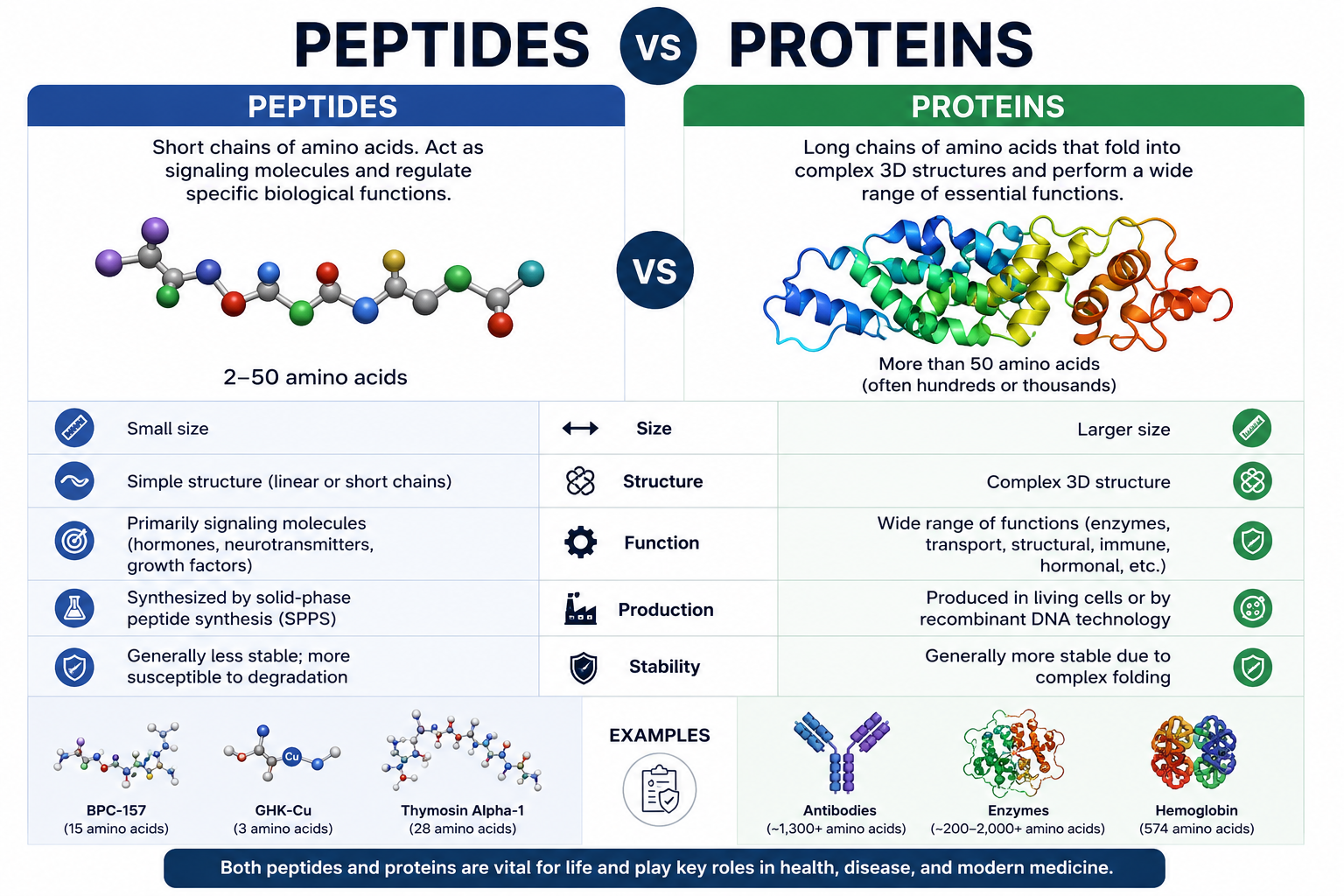
A peptide is a relatively short chain of amino acids, typically containing between 2 and 50 amino acids. These smaller molecules often serve as signaling compounds, hormones, neurotransmitters, or growth factors that regulate various biological processes. Due to their compact size, peptides are easier to synthesize and modify, making them valuable tools in scientific research and therapeutic development.
Proteins, by contrast, are much larger molecules composed of more than 50 amino acids, with many containing hundreds or even thousands of amino acids. Proteins fold into complex three-dimensional structures that allow them to perform a vast array of biological functions. They act as enzymes, antibodies, transport molecules, structural components of cells and tissues, and regulators of countless physiological processes necessary for life.
Although every protein begins as a chain of amino acids similar to a peptide, proteins undergo additional folding and structural organization that give them greater functional diversity. This increased complexity enables proteins to participate in virtually every cellular activity, from catalyzing chemical reactions to supporting immune defense and maintaining the body’s structural integrity.
Learning the differences between peptides and proteins helps researchers, healthcare professionals, and students better understand how these molecules contribute to health, disease, biotechnology, and modern therapeutic innovation.
Part 2: Differences Between Peptides and Proteins
Although peptides and proteins are both chains of amino acids connected by peptide bonds, they differ in several important characteristics. These differences influence how they are produced, how they function in the body, and how they are used in scientific research and medical applications.
1. Molecular Size
The most noticeable difference is their size.
- Peptides generally contain 2 to 50 amino acids.
- Proteins typically contain more than 50 amino acids, with many consisting of several hundred or even thousands.
Their smaller size allows peptides to move more easily through tissues and makes them simpler to manufacture using chemical synthesis.
2. Structural Complexity
Peptides usually have relatively simple structures. Most exist as short linear chains, although some form small loops or contain disulfide bonds that improve stability.
Proteins are considerably more complex. After being synthesized, they fold into precise three-dimensional shapes consisting of primary, secondary, tertiary, and sometimes quaternary structures. This complex folding is essential for proper biological function.
3. Biological Functions
Peptides primarily function as signaling molecules that help cells communicate with one another. They may regulate hormone production, immune responses, metabolism, tissue repair, and cellular growth.
Proteins perform a much wider range of biological activities, including:
- Catalyzing chemical reactions as enzymes
- Transporting oxygen and nutrients
- Building muscles, skin, hair, and connective tissue
- Defending the body through antibodies
- Supporting cell structure and movement
- Regulating gene expression and cellular processes
4. Production Methods
Peptides are commonly produced through solid-phase peptide synthesis (SPPS), a laboratory technique that allows scientists to build specific amino acid sequences with high precision.
Proteins are generally produced inside living cells through ribosomal protein synthesis or manufactured using recombinant DNA technology in bacteria, yeast, or mammalian cells.
5. Stability
Peptides are generally less stable than proteins because their smaller size makes them more susceptible to enzymatic degradation. As a result, some therapeutic peptides require specialized delivery systems or chemical modifications to increase their stability.
Proteins often have greater structural stability due to their complex folding, although they can also become inactive if exposed to heat, extreme pH levels, or other denaturing conditions.
Understanding these differences explains why peptides are widely used in biomedical research, diagnostics, and targeted therapies, while proteins remain the primary structural and functional molecules responsible for carrying out the vast majority of biological processes within living organisms.
Part 3: Similarities Between Peptides and Proteins and Their Importance
Despite their differences, peptides and proteins share many fundamental characteristics because both are built from amino acids connected by peptide bonds. They are essential biological molecules that work together to regulate, maintain, and support virtually every function within living organisms.
Similarities Between Peptides and Proteins
Both peptides and proteins:
- Are composed of amino acids linked by peptide bonds.
- Are produced naturally by living cells through genetic instructions.
- Play important roles in cellular communication and biological regulation.
- Participate in metabolism, growth, repair, and immune function.
- Can serve as therapeutic agents or research tools in biotechnology and medicine.
- May undergo chemical modifications that influence their activity and stability.
Why the Difference Matters
Knowing whether a molecule is classified as a peptide or a protein is important in scientific research, pharmaceutical development, and clinical medicine. Their size and structural complexity affect how they behave in the body, how they are manufactured, and how they interact with cells and biological targets.
Peptides are often favored for applications requiring highly specific biological activity because they can be synthesized with precision and engineered to target particular receptors or signaling pathways. Proteins, due to their larger and more complex structures, perform broader physiological functions and are indispensable for maintaining normal cellular processes.
Applications in Modern Science
Advances in biotechnology have expanded the use of both peptides and proteins across numerous fields, including:
- Drug discovery and pharmaceutical research
- Diagnostic testing and laboratory assays
- Regenerative medicine and tissue engineering
- Cosmetic and skincare product development
- Molecular biology and biochemical research
- Vaccine and therapeutic development
Researchers continue to investigate new peptide-based and protein-based technologies to improve treatments for a wide range of medical conditions and to deepen our understanding of human biology.
Conclusion
Peptides and proteins are closely related molecules that differ primarily in their size, structural complexity, and biological roles. Peptides are shorter amino acid chains that often function as signaling molecules, while proteins are larger, intricately folded molecules responsible for structural support, enzymatic activity, transport, immune defense, and countless other physiological processes. Together, they form the foundation of life and remain central to advances in biomedical research, biotechnology, and modern healthcare.