TB-500 Storage Guidelines
Why Proper TB-500 Storage Matters
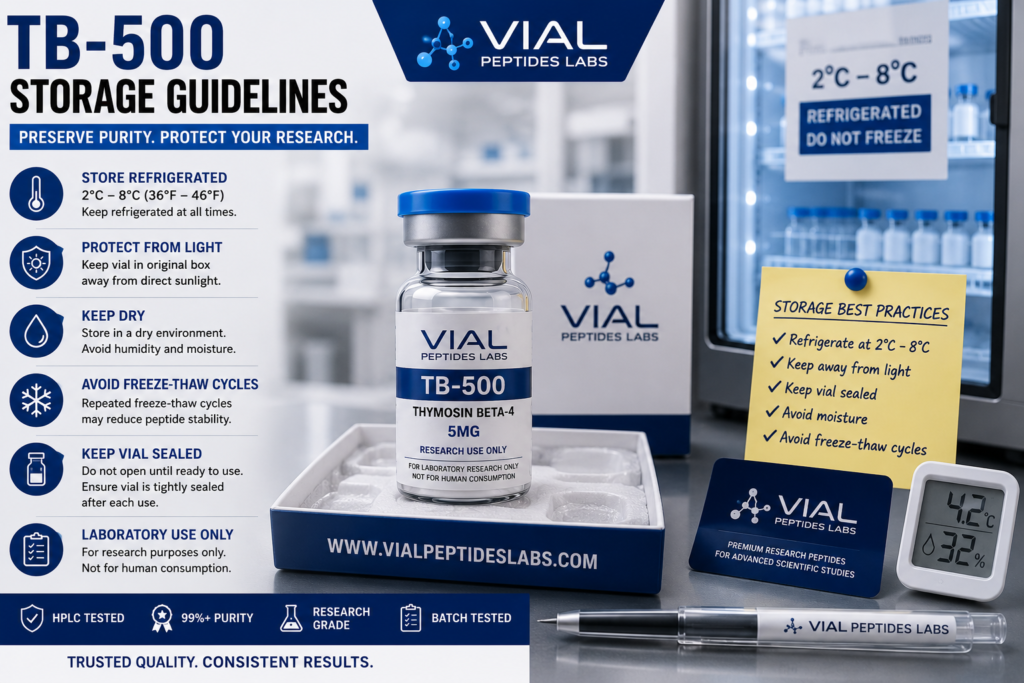
Maintaining the integrity of research peptides requires more than precision manufacturing and analytical verification. Proper storage is equally important for preserving peptide quality, molecular stability, and analytical performance throughout its shelf life. For research laboratories working with synthetic peptides, following established TB-500 storage guidelines helps protect product integrity and supports consistent scientific investigations.
TB-500 is supplied as a high-purity lyophilized (freeze-dried) peptide, allowing it to remain stable under recommended laboratory storage conditions before use. However, environmental factors such as temperature, moisture, light exposure, and repeated handling can influence peptide stability over time. Understanding proper storage practices helps laboratories maintain the quality of research materials while reducing unnecessary degradation.
At Vial Peptides Labs, every TB-500 batch is manufactured using precision solid-phase peptide synthesis, advanced purification methods, and comprehensive analytical testing before being packaged in laboratory-grade containers designed to help preserve peptide quality.
Understanding Lyophilized TB-500
TB-500 is supplied as a lyophilized powder, meaning water has been removed through a controlled freeze-drying process. Lyophilization significantly improves peptide stability during storage and transportation by reducing moisture, which can accelerate degradation.
Advantages of lyophilized TB-500 include:
- Improved long-term stability
- Reduced moisture exposure
- Enhanced storage performance
- Better transportation durability
- Easier laboratory handling
- Reliable preservation of peptide integrity
Researchers should keep the peptide in its original sealed vial until it is ready for laboratory use.
Recommended Storage Temperature
Temperature is one of the most important factors affecting peptide stability.
For unopened vials, TB-500 should be stored refrigerated between 2°C and 8°C in a clean, dry laboratory environment. Refrigeration helps slow natural chemical degradation while preserving analytical quality.
For laboratories requiring extended storage, follow institutional protocols and manufacturer recommendations while avoiding unnecessary temperature fluctuations.
Maintaining a stable storage environment is generally more beneficial than exposing the peptide to repeated warming and cooling cycles.
Protect TB-500 from Moisture
Moisture is one of the primary environmental factors that can affect lyophilized peptides.
To reduce moisture exposure:
- Keep the vial tightly sealed until use.
- Store the peptide in a dry environment.
- Avoid leaving the vial open unnecessarily.
- Handle the vial quickly when accessing laboratory materials.
- Replace the protective cap securely after use when appropriate.
Maintaining a dry storage environment helps preserve the physical integrity of the lyophilized powder.
Avoid Direct Sunlight
Exposure to excessive light and heat may affect the stability of sensitive laboratory materials.
Researchers should store TB-500:
- Away from direct sunlight
- Away from laboratory heat sources
- In temperature-controlled storage
- Inside protective laboratory containers when appropriate
A cool, dark storage environment supports long-term peptide preservation.
Minimize Temperature Fluctuations
Repeated changes in storage temperature may introduce unnecessary stress to laboratory materials.
Researchers are encouraged to:
- Maintain consistent refrigeration
- Avoid repeated warming and cooling
- Return the vial to recommended storage promptly after handling
- Organize laboratory workflows to minimize prolonged exposure outside refrigeration
Stable storage conditions contribute to consistent peptide quality.
Handling Reconstituted TB-500
After reconstitution, researchers should follow their laboratory’s validated procedures and applicable institutional protocols.
General laboratory considerations include:
- Prepare only the quantity required for planned experiments.
- Use clean laboratory techniques during handling.
- Minimize unnecessary handling of prepared solutions.
- Avoid repeated freeze-thaw cycles where possible.
- Clearly label reconstituted samples with preparation dates according to laboratory procedures.
Proper handling supports good laboratory practice and helps preserve sample quality.
Packaging Designed for Laboratory Storage
At Vial Peptides Labs, TB-500 is packaged using laboratory-grade materials selected to protect peptide integrity throughout shipping and storage.
Packaging includes:
- Borosilicate laboratory glass vial
- Sterile research stopper
- Aluminum crimp seal
- Tamper-evident protection
- Batch identification
- Professional Vial Peptides Labs labeling
This packaging system helps reduce environmental exposure before laboratory use.
Quality Assurance Supports Storage Stability
Proper storage begins with proper manufacturing.
Every TB-500 batch undergoes comprehensive analytical verification before release, including:
- High-Performance Liquid Chromatography (HPLC)
- Mass Spectrometry (MS)
- Identity confirmation
- Purity verification
- Batch consistency testing
- Visual inspection
- Manufacturing documentation review
Quality manufacturing and proper storage work together to support dependable research materials.
Product Specifications
| Specification | Details |
|---|---|
| Product Name | TB-500 |
| Classification | Synthetic Research Peptide |
| Grade | Research Grade |
| Purity | ≥99% (HPLC Verified) |
| Physical Form | Lyophilized Powder |
| Recommended Storage | Refrigerated (2°C–8°C) |
| Manufacturer | Vial Peptides Labs |
Common Storage Mistakes to Avoid
Researchers should avoid practices that may reduce peptide stability, including:
- Leaving the vial open for extended periods
- Exposing the peptide to excessive humidity
- Storing near heat sources
- Repeated temperature fluctuations
- Improper labeling after reconstitution
- Failing to follow laboratory storage protocols
Careful handling and storage help preserve analytical quality over time.
Frequently Asked Questions
What is the recommended storage temperature for TB-500?
TB-500 should generally be stored refrigerated between 2°C and 8°C in a clean, dry laboratory environment.
Why is TB-500 supplied as a lyophilized powder?
Lyophilization improves peptide stability by removing moisture, helping preserve the peptide during transportation and storage.
Why should moisture be avoided?
Moisture may affect the stability of lyophilized peptides. Keeping the vial sealed until laboratory use helps maintain product quality.
Why should repeated temperature changes be avoided?
Frequent warming and cooling can introduce unnecessary stress to laboratory materials. Stable storage conditions are generally preferred.
Is TB-500 intended for therapeutic use?
No. TB-500 supplied by Vial Peptides Labs is intended strictly for laboratory research purposes only. It is not intended for human consumption, therapeutic applications, veterinary use, clinical procedures, or diagnostic purposes.
Why Researchers Choose Vial Peptides Labs
Researchers trust Vial Peptides Labs because quality extends beyond manufacturing. Every TB-500 batch is produced using premium raw materials, precision peptide synthesis, advanced chromatographic purification, and rigorous analytical verification. Combined with laboratory-grade packaging and clear storage recommendations, our commitment to quality helps research institutions obtain dependable materials for advanced scientific investigations.
Internal Linking Suggestions
Link this page to:
- TB-500 (Thymosin Beta-4) (5mg / 10mg) (Product Page)
- What Is TB-500 Peptide?
- TB-500 Peptide Structure
- TB-500 Manufacturing Process
- TB-500 Purity Testing
- TB-500 Stability
- TB-500 Quality Control Standards
- TB-500 Certificate of Analysis (COA) Guide
- TB-500 Research Applications
- TB-500 Research References