
Understanding the TB-500 Manufacturing Process
The quality of every research peptide begins long before it reaches a laboratory. Precision manufacturing is one of the most important factors influencing peptide identity, purity, consistency, and analytical reliability. For researchers working with synthetic peptides, understanding the TB-500 manufacturing process provides valuable insight into the rigorous procedures used to produce research-grade materials suitable for scientific investigation.
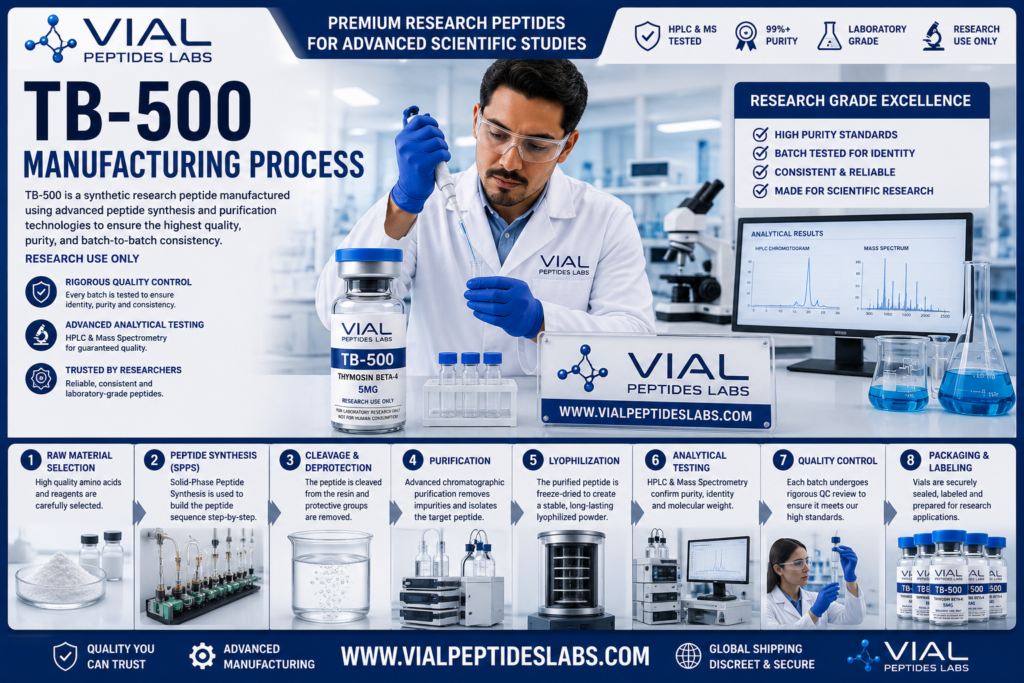
TB-500 is a synthetic peptide manufactured using advanced peptide synthesis technologies and carefully controlled production methods. Every stage of production—from raw material selection to analytical verification—is designed to ensure that the final product meets strict laboratory standards for identity, purity, and batch consistency.
At Vial Peptides Labs, TB-500 is manufactured exclusively for laboratory research. Each production batch follows standardized manufacturing protocols supported by advanced analytical testing, comprehensive quality assurance, and detailed production documentation.
What Is the TB-500 Manufacturing Process?
The TB-500 manufacturing process is a sequence of carefully controlled laboratory procedures used to synthesize, purify, verify, and package research-grade peptide materials.
The primary objective of manufacturing is to produce a peptide that demonstrates:
- High molecular accuracy
- Exceptional purity
- Reliable analytical performance
- Batch-to-batch consistency
- Long-term laboratory stability
Every stage of manufacturing contributes to the overall quality of the finished research peptide.
Step 1: Premium Raw Material Selection
High-quality manufacturing begins with carefully selected laboratory-grade raw materials.
Before peptide synthesis begins, manufacturers evaluate incoming materials for:
- Chemical identity
- Material purity
- Stability
- Manufacturing suitability
- Documentation and traceability
Using high-quality starting materials helps establish a strong foundation for the entire manufacturing process.
Step 2: Solid-Phase Peptide Synthesis (SPPS)
TB-500 is manufactured using Solid-Phase Peptide Synthesis (SPPS), the industry-standard method for producing synthetic peptides.
During this process:
- Amino acids are added sequentially.
- Each addition is carefully controlled.
- Protective groups prevent unwanted reactions.
- Intermediate washing steps remove excess reagents.
- The peptide chain grows one amino acid at a time.
SPPS enables highly accurate peptide production while maintaining exceptional reproducibility between manufacturing batches.
Step 3: Cleavage and Deprotection
Once peptide synthesis is complete, the peptide is separated from the solid support.
This stage includes:
- Cleaving the peptide from the resin
- Removing protective chemical groups
- Recovering the completed peptide
- Preparing the crude peptide for purification
Careful process control helps preserve peptide integrity throughout this transition.
Step 4: Advanced Purification
Following synthesis, the crude peptide contains the desired product along with residual by-products generated during manufacturing.
To achieve research-grade quality, TB-500 undergoes advanced purification using chromatographic techniques designed to isolate the target peptide.
Purification helps remove:
- Truncated peptide sequences
- Residual synthesis reagents
- Side products
- Manufacturing impurities
High-quality purification contributes significantly to the final purity of the peptide.
Step 5: Lyophilization
Following purification, TB-500 is converted into a stable lyophilized powder using freeze-drying technology.
Lyophilization helps:
- Preserve peptide stability
- Reduce moisture content
- Improve storage performance
- Maintain structural integrity
- Simplify laboratory handling
This process allows researchers to store peptides under recommended laboratory conditions while preserving analytical quality.
Step 6: Comprehensive Analytical Testing
Before any batch is approved for laboratory distribution, it undergoes extensive analytical verification.
Testing includes:
High-Performance Liquid Chromatography (HPLC)
HPLC verifies peptide purity and detects remaining impurities following purification.
Mass Spectrometry (MS)
Mass spectrometry confirms molecular weight and verifies that the synthesized peptide matches the intended molecular design.
Identity Verification
Additional analytical procedures confirm peptide identity and manufacturing accuracy.
Batch Consistency Testing
Each production batch is evaluated to ensure consistency between manufacturing runs.
These analytical procedures help verify that researchers receive peptides meeting rigorous quality standards.
Step 7: Quality Control Review
Quality control is integrated throughout the entire manufacturing process rather than being limited to final inspection.
Quality assurance includes:
- Manufacturing record review
- Equipment verification
- Process monitoring
- Analytical result evaluation
- Batch documentation review
- Final product approval
Only batches meeting established research-grade specifications proceed to packaging.
Step 8: Packaging for Laboratory Use
After analytical approval, TB-500 is packaged using laboratory-grade materials designed to preserve product quality.
Each vial includes:
- Borosilicate laboratory glass
- Sterile research stopper
- Aluminum crimp seal
- Tamper-evident protection
- Batch identification
- Professional Vial Peptides Labs labeling
Proper packaging helps maintain peptide integrity throughout transportation and storage.
Why Manufacturing Quality Matters
Researchers depend on manufacturing consistency to generate reproducible scientific data.
A carefully controlled manufacturing process helps provide:
- Reliable experimental materials
- Consistent analytical performance
- Reduced batch variability
- Improved laboratory reproducibility
- Confidence in research outcomes
These qualities are essential for modern peptide research.
Product Specifications
| Specification | Details |
|---|---|
| Product Name | TB-500 |
| Classification | Synthetic Research Peptide |
| Grade | Research Grade |
| Purity | ≥99% (HPLC Verified) |
| Physical Form | Lyophilized Powder |
| Appearance | White to Off-White Powder |
| Manufacturer | Vial Peptides Labs |
Storage Recommendations
Following manufacture, proper storage helps preserve peptide quality.
Recommended storage includes:
- Refrigerate between 2°C and 8°C
- Protect from direct sunlight
- Store in a dry laboratory environment
- Keep the vial sealed until laboratory use
- Avoid repeated freeze-thaw cycles after reconstitution
Following these recommendations supports long-term product stability.
Frequently Asked Questions
What is the TB-500 manufacturing process?
The TB-500 manufacturing process includes raw material selection, solid-phase peptide synthesis, cleavage, purification, lyophilization, analytical verification, quality control, and laboratory packaging.
How is TB-500 synthesized?
TB-500 is produced using Solid-Phase Peptide Synthesis (SPPS), which allows amino acids to be assembled sequentially with a high degree of precision.
Why is purification important?
Purification removes synthesis by-products, incomplete peptide sequences, and residual reagents, helping achieve high research-grade purity.
How is manufacturing quality verified?
Every production batch undergoes HPLC purity analysis, mass spectrometry, identity confirmation, batch consistency testing, and comprehensive quality assurance before release.
Is TB-500 manufactured for therapeutic use?
No. TB-500 supplied by Vial Peptides Labs is manufactured strictly for laboratory research purposes only and is not intended for human consumption, therapeutic applications, veterinary use, clinical procedures, or diagnostic purposes.
Why Choose Vial Peptides Labs?
At Vial Peptides Labs, manufacturing excellence is built into every stage of peptide production. From carefully selected raw materials to precision solid-phase peptide synthesis, advanced chromatographic purification, and comprehensive analytical verification, every batch is produced with consistency and scientific integrity in mind.
Our commitment to standardized manufacturing, rigorous quality control, and complete production documentation allows universities, biotechnology organizations, pharmaceutical research facilities, and independent laboratories to obtain dependable research-grade peptides for advanced scientific investigation.
Internal Linking Suggestions
Link this page to:
- TB-500 (Thymosin Beta-4) (5mg / 10mg) (Product Page)
- What Is TB-500 Peptide?
- TB-500 Peptide Structure
- TB-500 Research Applications
- TB-500 Purity Testing
- TB-500 Quality Control Standards
- TB-500 Certificate of Analysis (COA) Guide
- TB-500 Storage Guidelines
- TB-500 Stability
- TB-500 Research References