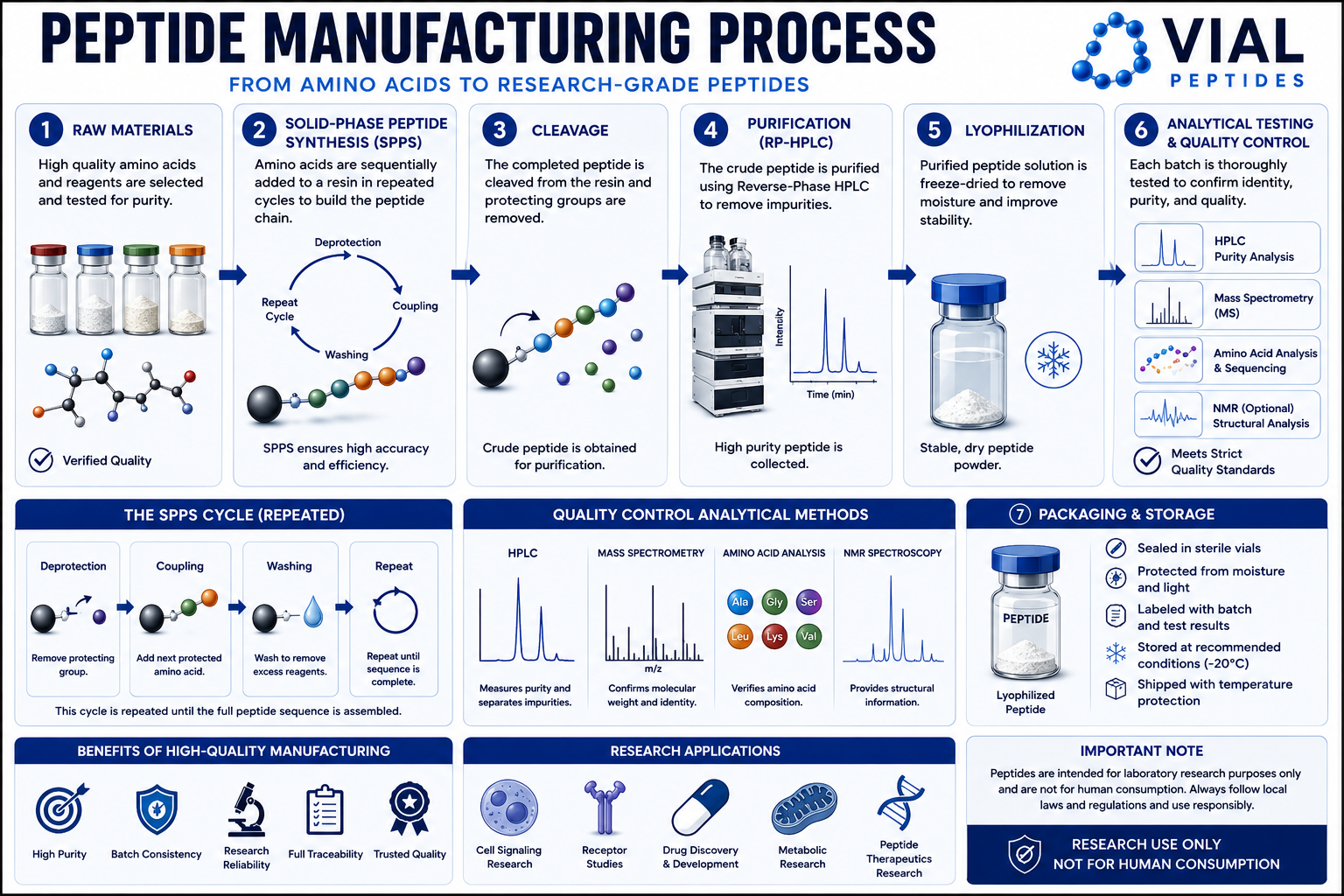
Peptide Manufacturing Process: From Amino Acids to Research-Grade Peptides
Table of Contents
- What Is the Peptide Manufacturing Process?
- Raw Materials and Amino Acids
- Solid-Phase Peptide Synthesis (SPPS)
- Purification and Analytical Testing
- Quality Assurance
- Future Manufacturing Technologies
- Frequently Asked Questions
- Conclusion
PART 1
Peptide Manufacturing Process: From Amino Acids to Research-Grade Peptides
The Peptide Manufacturing Process is a carefully controlled series of laboratory procedures used to produce high-quality synthetic peptides for scientific research. Every stage, from selecting raw materials to analytical verification, is designed to ensure consistency, accuracy, and reproducibility. Modern peptide manufacturing combines advanced chemistry, automated instrumentation, and rigorous quality control to produce well-characterized research materials.
Synthetic peptides have become indispensable tools in molecular biology, biotechnology, analytical chemistry, and structural biology. Researchers rely on precisely manufactured amino acid sequences to investigate protein interactions, receptor biology, molecular signaling, and numerous other scientific questions. Because even minor variations can influence experimental results, manufacturing standards are maintained at every stage of production.
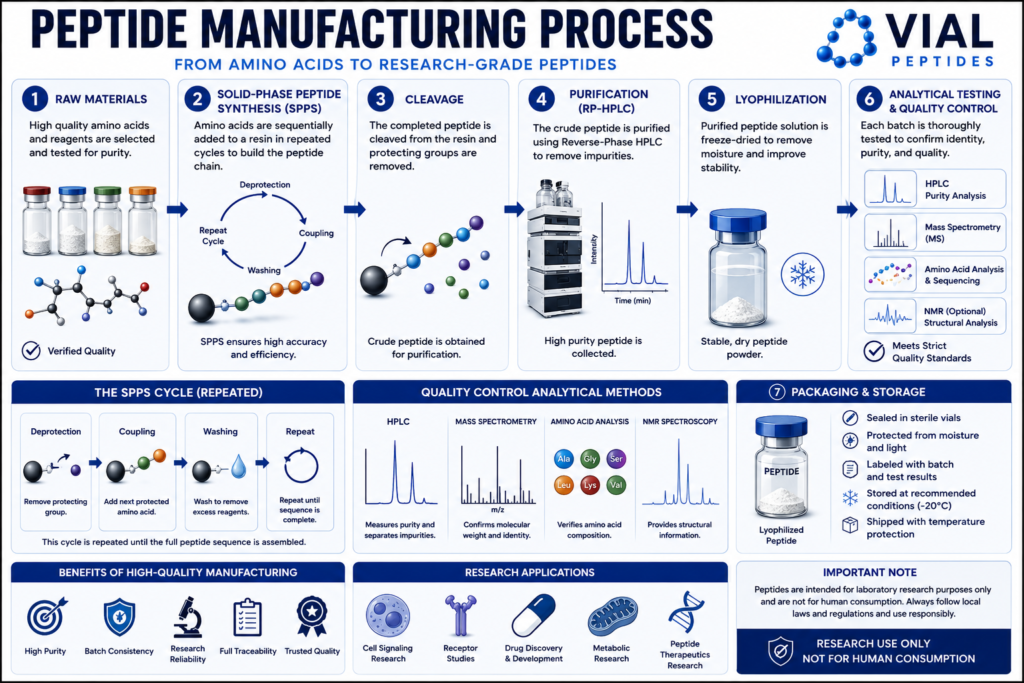
Most research-grade materials are produced using Solid-Phase Peptide Synthesis (SPPS), followed by purification, analytical characterization, and comprehensive quality testing. These procedures allow laboratories to produce consistent batches while verifying molecular identity and purity before distribution for research purposes.
This guide explores the complete Peptide Manufacturing Process, explaining each production stage and highlighting the technologies that support modern peptide science.
Why Manufacturing Quality Matters
Reliable manufacturing forms the foundation of dependable scientific research.
Researchers require consistent materials to ensure that laboratory investigations can be repeated and validated across different institutions.
High manufacturing standards support:
- Experimental reproducibility
- Accurate analytical results
- Reliable molecular characterization
- Consistent batch quality
- Scientific collaboration
- Long-term research confidence
Careful production practices reduce variability and improve the reliability of experimental findings.
Purification, Analytical Testing, Quality Assurance, and Production Standards
Once the amino acid sequence has been assembled, manufacturing enters another critical phase. At this stage, researchers focus on purifying the finished material, verifying its molecular identity, and confirming that it meets established laboratory standards. These procedures help ensure that research materials are consistent, accurately characterized, and suitable for scientific investigation.
Modern laboratories combine advanced analytical instruments with standardized quality systems to evaluate every production batch before release.
Purification After Synthesis
The first product obtained after synthesis is commonly referred to as the crude peptide. Although the desired sequence has been produced, this material may also contain incomplete chains, residual reagents, and other synthesis by-products.
Purification removes these unwanted components and improves the overall quality of the final product.
The objectives of purification include:
- Isolating the target sequence
- Eliminating synthesis impurities
- Improving analytical accuracy
- Supporting reproducible research
- Increasing batch consistency
Careful purification is essential because even small impurities can influence laboratory experiments.
Reverse-Phase High-Performance Liquid Chromatography (RP-HPLC)
Reverse-Phase High-Performance Liquid Chromatography, often abbreviated as RP-HPLC, is one of the most widely used purification and analytical techniques in peptide laboratories.
Researchers use RP-HPLC to:
- Separate molecules according to chemical properties
- Measure product purity
- Detect manufacturing impurities
- Compare production batches
- Verify consistency between lots
Because of its precision, RP-HPLC has become an industry-standard method for quality assessment.
Lyophilization (Freeze-Drying)
After purification, many laboratories convert purified solutions into a stable dry powder through lyophilization, also known as freeze-drying.
During this process:
- The purified solution is frozen.
- Ice is removed under reduced pressure.
- Moisture is eliminated without exposing the material to excessive heat.
Freeze-drying improves long-term stability and simplifies storage, transportation, and laboratory handling.
Identity Confirmation
Purity alone does not guarantee that the correct molecular sequence has been produced.
Scientists perform identity confirmation to verify that the finished material matches the intended design.
Common verification methods include:
- Mass Spectrometry
- Amino acid composition analysis
- Sequence verification
- Molecular weight determination
These procedures provide additional confidence before research materials are approved for laboratory use.
Mass Spectrometry (MS)
Mass Spectrometry is one of the most powerful analytical tools used during manufacturing.
Researchers rely on this technique to:
- Confirm molecular weight
- Detect trace impurities
- Verify molecular composition
- Support analytical documentation
- Evaluate production accuracy
The information obtained from MS complements chromatographic data and strengthens quality assurance.
Nuclear Magnetic Resonance (NMR)
Some laboratories also perform Nuclear Magnetic Resonance (NMR) analysis to study molecular structure.
NMR provides valuable information regarding:
- Three-dimensional conformation
- Atomic environments
- Structural flexibility
- Molecular stability
- Chemical interactions
These structural insights help researchers understand the physical characteristics of the finished material.
Batch-to-Batch Consistency
Consistency between production batches is essential for scientific reproducibility.
Manufacturing facilities monitor every production run to minimize variation and maintain standardized quality.
Key factors include:
- Raw material quality
- Controlled reaction conditions
- Equipment calibration
- Process documentation
- Analytical verification
- Final quality review
Maintaining consistency allows researchers to compare experimental data with greater confidence.
Documentation and Traceability
Every production batch generates extensive documentation.
Laboratories record information such as:
- Batch numbers
- Production dates
- Raw material sources
- Analytical reports
- Instrument calibration records
- Quality review results
Comprehensive documentation improves traceability and supports laboratory quality management systems.
Packaging for Research Materials
Once testing is complete, finished materials are packaged using procedures designed to preserve quality during storage and transport.
Packaging typically protects against:
- Moisture
- Oxygen exposure
- Light
- Physical contamination
- Temperature fluctuations
Proper packaging helps maintain product integrity until the material reaches the research laboratory.
Laboratory Storage Recommendations
Appropriate storage conditions help preserve molecular stability over time.
General laboratory recommendations include:
- Store in a cool, dry environment.
- Minimize exposure to moisture.
- Protect from prolonged light exposure.
- Avoid repeated freeze–thaw cycles after reconstitution.
- Keep containers tightly sealed when not in use.
Following standardized storage practices supports long-term product quality.
Continuous Improvement in Manufacturing
Peptide manufacturing continues to benefit from advances in automation, digital monitoring, and analytical science.
Manufacturers continually refine production methods by:
- Improving synthesis efficiency
- Enhancing purification technologies
- Increasing analytical sensitivity
- Reducing manufacturing variability
- Strengthening quality management systems
These improvements contribute to more consistent research materials and better laboratory outcomes.
Key Takeaways
- Purification removes unwanted impurities and improves product quality.
- RP-HPLC is widely used to evaluate purity and manufacturing consistency.
- Lyophilization enhances storage stability by converting purified solutions into dry powder.
- Mass Spectrometry and NMR provide valuable information about molecular identity and structure.
- Comprehensive documentation, standardized packaging, and controlled storage conditions support reliable scientific research.
- Ongoing technological improvements continue to strengthen manufacturing quality and reproducibility.
Selecting High-Quality Raw Materials
Every manufacturing process begins with carefully selected raw materials.
The quality of amino acids and chemical reagents directly influences the quality of the finished product.
Laboratories evaluate raw materials for:
- Chemical identity
- Purity
- Stability
- Consistency
- Storage conditions
- Supplier documentation
Using well-characterized starting materials helps minimize variability throughout production.
Amino Acids: The Foundation of Peptide Production
Amino acids are the building blocks used to create every peptide sequence.
Each amino acid contributes unique chemical properties that influence the structure and behavior of the finished molecule.
During production, amino acids are assembled in a predetermined order according to the desired sequence.
Careful sequence design allows researchers to manufacture highly specific molecules for laboratory investigations.
Solid-Phase Peptide Synthesis (SPPS)
The most widely used manufacturing method is Solid-Phase Peptide Synthesis (SPPS).
This approach involves attaching the first amino acid to a solid resin, allowing the peptide chain to grow one amino acid at a time.
After each coupling reaction, excess reagents are removed while the developing chain remains attached to the resin.
This simplified workflow offers several important advantages:
- High sequence accuracy
- Excellent reproducibility
- Efficient washing steps
- Easier purification
- Flexible sequence design
- Reliable large-scale production
Because of these benefits, SPPS has become the global standard for manufacturing research-grade peptides.
Coupling and Deprotection Cycles
Production proceeds through a repeating sequence of chemical reactions.
Each cycle includes:
- Removal of a temporary protecting group.
- Addition of the next protected amino acid.
- Formation of a peptide bond.
- Washing away excess reagents.
- Preparation for the next cycle.
These carefully controlled reactions continue until the complete sequence has been assembled.
Protecting Groups
Temporary protecting groups prevent unwanted reactions during manufacturing.
They ensure that only the intended chemical bonds form during each synthesis step.
This strategy helps:
- Improve sequence accuracy
- Reduce side reactions
- Increase manufacturing efficiency
- Support reproducibility
- Simplify purification
Once the sequence is complete, these protecting groups are removed under controlled laboratory conditions.
Cleavage from the Resin
After the final amino acid has been added, the completed molecule is separated from the solid support.
Researchers perform this step using specialized chemical treatments that release the finished sequence while simultaneously removing the remaining protecting groups.
The resulting material is referred to as the crude peptide, which then undergoes purification and analytical testing before use in scientific research.
Key Takeaways
- The Peptide Manufacturing Process begins with high-quality amino acids and carefully selected chemical reagents.
- Solid-Phase Peptide Synthesis (SPPS) remains the standard production method for research-grade peptides.
- Repeating coupling and deprotection cycles build precise amino acid sequences.
- Protecting groups improve manufacturing accuracy by preventing unwanted reactions.
- The crude product proceeds to purification and analytical testing before final quality evaluation.
Future Manufacturing Innovations, FAQs, and Conclusion
The field of peptide manufacturing continues to advance as laboratories adopt new technologies that improve precision, efficiency, and product consistency. Modern production facilities combine automated synthesis platforms, advanced analytical instrumentation, and digital quality management systems to manufacture highly characterized research materials for scientific investigation.
As biotechnology evolves, researchers continue refining production workflows while improving analytical methods and strengthening quality assurance practices. These developments help support reproducible research and expand the capabilities of laboratories around the world.
Emerging Trends in Modern Manufacturing
Manufacturing technologies have improved dramatically over the last two decades.
Researchers continue developing innovative production methods that increase efficiency while maintaining strict laboratory standards.
Several important trends are shaping the future of peptide production.
Artificial Intelligence in Manufacturing
Artificial intelligence is beginning to influence many stages of laboratory production.
Researchers use AI-powered software to:
- Optimize production planning.
- Predict synthesis efficiency.
- Analyze analytical results.
- Identify potential manufacturing issues.
- Improve quality monitoring.
- Support data-driven decision making.
These digital tools help laboratories improve workflow efficiency while reducing unnecessary production delays.
Next-Generation Automation
Automation has become a defining feature of modern manufacturing facilities.
Advanced production systems can:
- Control reaction timing.
- Monitor temperature.
- Deliver reagents accurately.
- Record manufacturing data.
- Reduce operator variability.
- Improve process consistency.
These systems contribute to reliable production while allowing laboratories to manufacture increasingly complex molecular sequences.
Improved Analytical Technologies
Analytical science continues to evolve alongside manufacturing.
Today’s laboratories commonly combine several complementary techniques, including:
- Reverse-Phase High-Performance Liquid Chromatography (RP-HPLC)
- Mass Spectrometry (MS)
- Nuclear Magnetic Resonance (NMR)
- Amino Acid Analysis
- Sequence Verification
- Capillary Electrophoresis
Using multiple analytical methods provides a more complete understanding of molecular identity, purity, and structural characteristics.
Sustainable Manufacturing Practices
Many research facilities are also working to improve environmental sustainability.
Current initiatives include:
- Reducing solvent consumption.
- Recycling laboratory materials where appropriate.
- Improving reaction efficiency.
- Minimizing chemical waste.
- Optimizing energy usage.
These efforts help lower environmental impact while maintaining high manufacturing standards.
Why Standardization Matters
Standardized procedures allow scientists to compare experimental findings across different laboratories with greater confidence.
Manufacturing standards typically include:
- Validated operating procedures
- Equipment maintenance schedules
- Routine calibration
- Comprehensive documentation
- Analytical verification
- Batch review before release
Consistent manufacturing practices support reliable scientific research and long-term data quality.
Frequently Asked Questions
What is the peptide manufacturing process?
The peptide manufacturing process is a series of controlled laboratory procedures used to produce synthetic peptide sequences. It typically includes amino acid assembly, purification, analytical testing, and quality assurance before research materials are released for laboratory use.
Why is SPPS the preferred manufacturing method?
Solid-Phase Peptide Synthesis (SPPS) improves manufacturing efficiency by allowing amino acids to be added one at a time while the growing chain remains attached to a solid support. This approach simplifies production and purification while improving reproducibility.
Why is purification necessary?
Purification removes unwanted substances that may remain after synthesis, including incomplete sequences and reaction by-products. Cleaner materials contribute to more reliable laboratory investigations.
What analytical methods verify manufacturing quality?
Researchers commonly use:
- Reverse-Phase High-Performance Liquid Chromatography (RP-HPLC)
- Mass Spectrometry (MS)
- Nuclear Magnetic Resonance (NMR)
- Sequence Verification
- Amino Acid Analysis
These techniques help confirm purity, identity, molecular weight, and structural integrity.
Why is batch consistency important?
Consistent manufacturing allows researchers to obtain comparable materials over time, supporting reproducibility, scientific collaboration, and reliable interpretation of experimental results.
How are research materials stored?
Many laboratories store finished materials under carefully controlled conditions to reduce exposure to moisture, excessive heat, and other environmental factors that may affect long-term stability.
How is manufacturing expected to evolve?
Future developments are expected to include smarter automation, AI-assisted production planning, enhanced analytical technologies, improved digital quality systems, and more sustainable manufacturing practices.
Conclusion
The Peptide Manufacturing Process is a highly controlled workflow that combines chemistry, biotechnology, analytical science, and quality management to produce reliable research materials. From carefully selecting raw materials to purification, analytical characterization, packaging, and documentation, every stage contributes to product consistency and scientific reproducibility.
Modern production relies on established techniques such as Solid-Phase Peptide Synthesis (SPPS), Reverse-Phase High-Performance Liquid Chromatography (RP-HPLC), Mass Spectrometry, and Nuclear Magnetic Resonance to verify molecular identity and maintain rigorous quality standards. Together, these methods help ensure that research materials are accurately characterized before they are used in laboratory investigations.
As technology continues to advance, manufacturing is becoming more automated, data-driven, and efficient. Continued improvements in analytical science, computational tools, and quality systems will further strengthen peptide research while supporting innovation across biotechnology, molecular biology, analytical chemistry, and related scientific disciplines.
Key Takeaways
- The Peptide Manufacturing Process combines synthesis, purification, analytical testing, and quality assurance into one standardized workflow.
- SPPS remains the primary method for producing research-grade peptide sequences.
- RP-HPLC, Mass Spectrometry, NMR, and sequence verification provide comprehensive quality assessment.
- Standardized manufacturing supports reproducible scientific research and reliable laboratory results.
- Advances in automation, artificial intelligence, and sustainable production continue to improve manufacturing efficiency and product consistency.