How Peptides Are Synthesized: A Step-by-Step Guide to Modern Peptide Production
Table of Contents
- Introduction to Peptide Synthesis
- What Is Peptide Synthesis?
- Amino Acids and Peptide Bonds
- Solid-Phase Peptide Synthesis (SPPS)
- Peptide Purification
- Quality Control and Analysis
- Frequently Asked Questions
- Conclusion
PART 1
How Peptides Are Synthesized: A Step-by-Step Guide to Modern Peptide Production
Understanding How Peptides Are Synthesized is essential for anyone studying peptide chemistry, biotechnology, or molecular biology. Modern peptide synthesis combines precise chemical techniques with advanced analytical technologies, allowing researchers to produce highly defined amino acid sequences for laboratory investigations. Over the past several decades, improvements in synthesis methods have transformed peptide science by making production faster, more accurate, and highly reproducible.How Peptides Are Synthesized
Peptides are short chains of amino acids connected through peptide bonds. While living organisms naturally produce countless peptide molecules, researchers can also manufacture synthetic peptides under carefully controlled laboratory conditions. These laboratory-produced molecules allow scientists to investigate molecular structure, receptor interactions, protein recognition, and many other aspects of biological chemistry.
Today, most research-grade materials are manufactured using Solid-Phase Peptide Synthesis (SPPS), a method that revolutionized peptide production by simplifying the assembly of amino acid chains. Combined with modern purification and analytical testing, SPPS enables laboratories to produce high-quality research materials with exceptional consistency.
This guide explains How Peptides Are Synthesized, from amino acid selection and peptide bond formation to purification, quality control, and modern laboratory analysis.
Why Peptide Synthesis Is Important
Reliable synthesis is the foundation of modern peptide research.How Peptides Are Synthesized
Scientists require precisely manufactured materials to investigate molecular interactions, biological pathways, and structural properties under standardized laboratory conditions.
Accurate production supports research in:
- Molecular biology
- Biotechnology
- Structural biology
- Protein chemistry
- Analytical chemistry
- Synthetic biology
- Biochemistry
- Laboratory assay development
High manufacturing standards improve experimental reproducibility and support meaningful scientific discoveries.
What Is Peptide Synthesis?
Peptide synthesis is the controlled chemical process of joining individual amino acids together to create a specific peptide sequence. How Peptides Are Synthesized
Unlike protein production in living cells, laboratory synthesis allows researchers to control every stage of assembly with exceptional precision.
Scientists can determine:
- Amino acid order
- Chain length
- Chemical modifications
- Terminal groups
- Molecular structure
- Overall composition
This flexibility makes laboratory synthesis an essential tool in modern peptide science.
Amino Acids: The Building Blocks
Every synthetic sequence begins with amino acids.
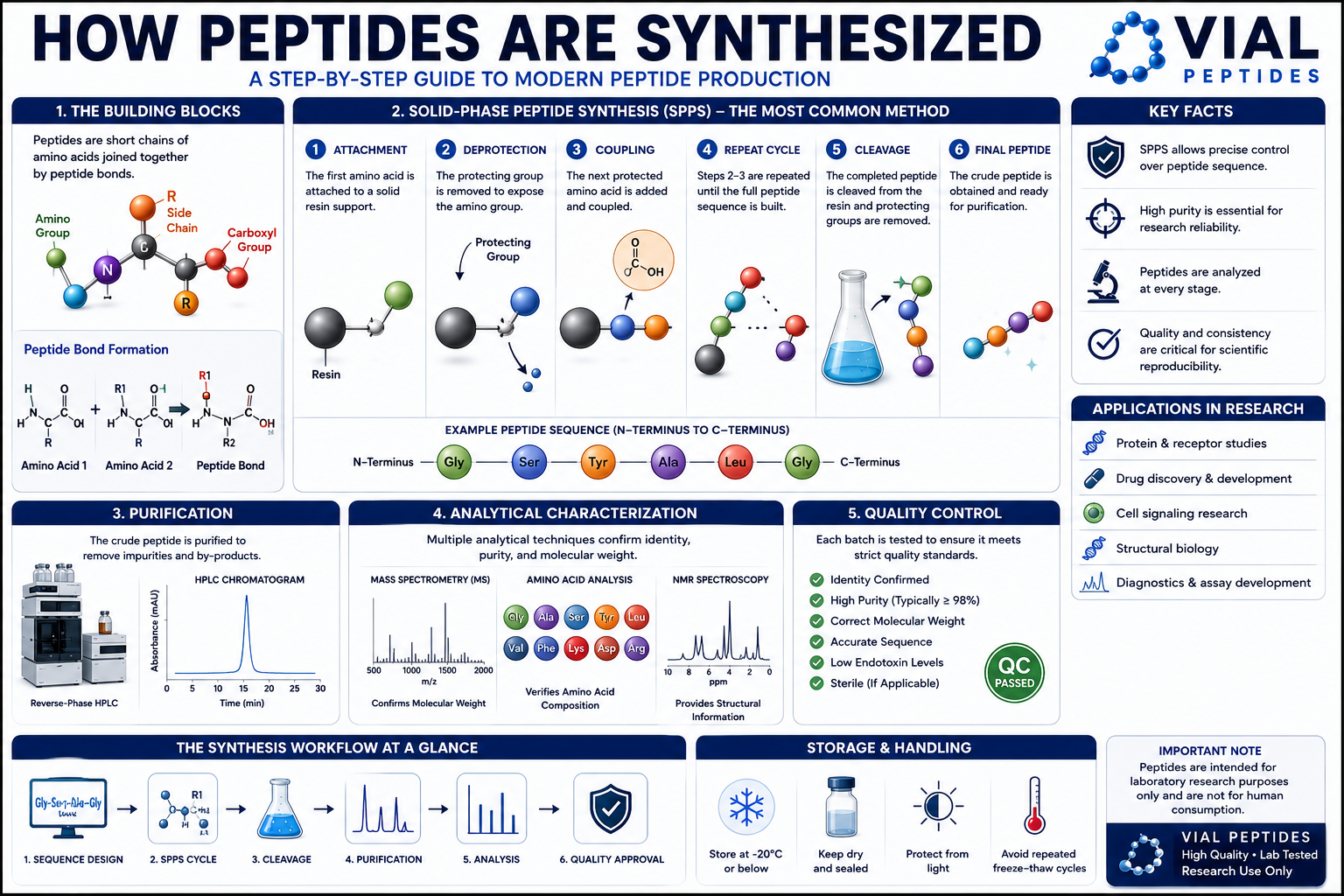
Each amino acid contains an amino group, a carboxyl group, and a unique side chain that determines its chemical properties.
During synthesis, amino acids are linked together through peptide bonds to create a defined molecular sequence.
Because every amino acid contributes unique structural characteristics, careful sequence design is critical for producing consistent research materials.
Peptide Bond Formation
Peptide bonds form when the amino group of one amino acid reacts with the carboxyl group of another.
This reaction releases a water molecule while creating a stable covalent bond.
Repeated bond formation gradually builds the complete peptide chain one amino acid at a time.
Researchers carefully control each reaction step to maintain sequence accuracy and minimize unwanted by-products.
Protecting Groups
One of the greatest challenges in peptide chemistry is preventing unwanted chemical reactions.
To solve this problem, chemists use temporary protecting groups that block reactive portions of amino acids during synthesis.
These protecting groups:
- Prevent side reactions
- Improve sequence accuracy
- Increase production efficiency
- Simplify purification
- Support reproducible manufacturing
After each synthesis cycle, the protecting groups are removed under carefully controlled conditions.
Solid-Phase Peptide Synthesis (SPPS)
The most widely used production method is Solid-Phase Peptide Synthesis (SPPS).
Developed by Robert Bruce Merrifield, SPPS transformed peptide chemistry by attaching the growing peptide chain to a solid resin.
Instead of purifying the product after every reaction, researchers simply wash away excess reagents while the peptide remains attached to the solid support.
This innovation dramatically improved manufacturing efficiency.
Major advantages include:
- Faster synthesis
- Better reproducibility
- High sequence accuracy
- Easier purification
- Improved scalability
- Reliable batch consistency
SPPS remains the global standard for manufacturing research-grade peptides.
The SPPS Cycle
Each synthesis cycle follows a carefully controlled sequence of steps.
The general workflow includes:
- Attachment of the first amino acid to the resin.
- Removal of the temporary protecting group.
- Addition of the next protected amino acid.
- Formation of a new peptide bond.
- Washing to remove excess reagents.
- Repetition until the desired sequence is complete.
Once synthesis has finished, the completed peptide is separated from the resin and prepared for purification.
Why Modern Laboratories Prefer SPPS
Researchers around the world rely on SPPS because it combines speed, accuracy, and flexibility.
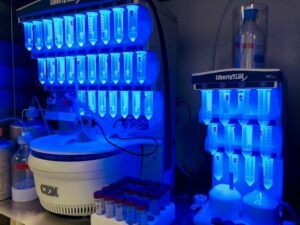
Modern automated synthesizers can produce complex amino acid sequences while maintaining strict quality standards.
These systems reduce manual handling, improve reproducibility, and support efficient production for research laboratories.
As peptide science continues to evolve, SPPS remains the foundation of modern synthetic peptide manufacturing.
Key Takeaways
- How Peptides Are Synthesized begins with carefully selected amino acids joined through peptide bonds.
- Laboratory synthesis allows complete control over amino acid sequence and molecular structure.
- Temporary protecting groups improve accuracy by preventing unwanted chemical reactions.
- Solid-Phase Peptide Synthesis (SPPS) is the most widely used manufacturing method for research peptides.
- Modern synthesis technologies support high-quality, reproducible laboratory research.
Modern Peptide Manufacturing, Purification, and Laboratory Quality Control
Once the amino acid chain has been successfully assembled, the work is far from complete. Researchers must remove protective groups, separate the finished molecule from the solid support, eliminate unwanted impurities, and verify that the final material matches the intended molecular design. These additional stages are essential for producing research-grade materials that meet strict laboratory standards.
Every step following synthesis contributes to product consistency, analytical accuracy, and experimental reproducibility.
Cleavage from the Solid Support
After the complete amino acid sequence has been assembled, the finished molecule remains attached to the solid resin used during the synthesis process.
Researchers use carefully selected chemical reagents to separate the completed chain from the resin while simultaneously removing the remaining temporary protecting groups.
This process produces the crude material that will undergo additional purification and analytical evaluation before laboratory use.
The cleavage stage must be carefully controlled because excessive reaction conditions may damage sensitive amino acid residues or reduce overall product quality.
Removing Impurities
Freshly synthesized material often contains small amounts of unwanted substances, including incomplete sequences, residual reagents, and by-products generated during the manufacturing process.
Removing these impurities is essential because they may interfere with laboratory investigations and reduce experimental reproducibility.
Scientists employ advanced purification techniques to isolate the desired molecular sequence while eliminating unwanted contaminants.
A carefully purified product provides researchers with greater confidence when interpreting analytical results.
High-Performance Liquid Chromatography (HPLC)
One of the most widely used purification methods is High-Performance Liquid Chromatography (HPLC).
HPLC separates molecules according to their chemical properties, allowing scientists to isolate the desired compound from closely related impurities.
Researchers use this technology to:
- Evaluate chemical purity
- Separate incomplete synthesis products
- Remove reaction by-products
- Confirm manufacturing consistency
- Support quality assurance
Because of its accuracy and reliability, HPLC has become a standard technique in peptide laboratories around the world.
Mass Spectrometry (MS)
Following purification, scientists commonly perform Mass Spectrometry (MS) to verify molecular identity.
This highly sensitive analytical technique measures molecular weight with exceptional precision.
Researchers rely on MS to:
- Confirm molecular composition
- Verify amino acid sequence
- Detect trace impurities
- Validate synthesis accuracy
- Support analytical documentation
When used alongside HPLC, Mass Spectrometry provides a comprehensive picture of product quality.
Amino Acid Sequence Verification
Producing a molecule with the correct molecular weight does not automatically confirm that every amino acid occupies the correct position.
For this reason, laboratories perform additional sequence verification using specialized analytical methods.
Sequence verification helps researchers confirm:
- Amino acid order
- Chain length
- Terminal groups
- Structural integrity
- Manufacturing accuracy
These evaluations strengthen confidence in experimental reproducibility.
Nuclear Magnetic Resonance (NMR)
Researchers often use Nuclear Magnetic Resonance (NMR) spectroscopy to investigate molecular structure.
NMR provides valuable information about:
- Three-dimensional conformation
- Atomic interactions
- Molecular flexibility
- Chemical environments
- Structural stability
Understanding molecular structure helps researchers evaluate how different sequences may behave during laboratory investigations.
Quality Assurance Throughout Manufacturing
Quality assurance extends far beyond final testing.
Leading laboratories monitor every stage of production through carefully documented procedures designed to maintain consistency from one batch to another.
Quality assurance programs commonly include:
- Raw material inspection
- Equipment calibration
- Process validation
- Environmental monitoring
- Analytical testing
- Batch documentation
These practices help ensure that every production cycle follows established manufacturing standards.
Automation in Modern Laboratories
Automation has transformed peptide manufacturing by improving precision and reducing manual variability.
Modern synthesis platforms automatically perform repetitive production steps while maintaining carefully controlled reaction conditions.
Automated systems provide several important advantages:
- Improved consistency
- Faster production
- Reduced human error
- Better documentation
- Greater manufacturing efficiency
- Reliable batch reproducibility
Automation also allows researchers to produce increasingly complex molecular sequences with exceptional accuracy.
Computational Design Before Manufacturing
Many laboratories now begin the manufacturing process using advanced computational tools.
Researchers use specialized software to:
- Design amino acid sequences
- Predict molecular properties
- Model three-dimensional structures
- Evaluate chemical stability
- Simulate receptor interactions
Computer-assisted design helps optimize experimental planning before laboratory synthesis even begins.
Storage and Handling
Once analytical testing has been completed, carefully controlled storage conditions help preserve molecular integrity.
Laboratories typically protect research materials from environmental factors that may affect long-term stability, including:
- Excess moisture
- Elevated temperatures
- Repeated freeze–thaw cycles
- Direct light exposure
- Oxidative conditions
Following standardized storage procedures helps maintain consistency throughout the research lifecycle.
Supporting Scientific Reproducibility
One of the primary goals of modern manufacturing is reproducibility.
Reliable production methods allow researchers in different laboratories to obtain comparable materials for independent investigations.
This consistency supports:
- Experimental reliability
- Data comparison
- Scientific collaboration
- Published research
- Method validation
- Long-term quality assurance
Standardized manufacturing has become a cornerstone of peptide science and modern biotechnology.
Key Takeaways
- Manufacturing continues well beyond the initial assembly of amino acids.
- Purification removes unwanted substances and improves research quality.
- HPLC, Mass Spectrometry, sequence verification, and NMR provide detailed analytical characterization.
- Quality assurance procedures monitor every stage of production.
- Automation and computational design have significantly improved manufacturing precision and reproducibility.
- Proper storage and handling help preserve molecular stability for laboratory research.
Future Innovations, Frequently Asked Questions, and Conclusion
The science of peptide manufacturing continues to evolve through advances in automation, computational biology, analytical chemistry, and precision laboratory instrumentation. Modern production methods have significantly improved manufacturing accuracy while allowing researchers to investigate increasingly complex amino acid sequences with exceptional consistency.
As new technologies emerge, laboratories continue refining every stage of production—from sequence design and chemical assembly to purification, analytical verification, and quality assurance. These ongoing improvements strengthen scientific reproducibility while expanding opportunities for peptide research across biotechnology and molecular biology.
Emerging Technologies in Peptide Manufacturing
Scientific innovation continues to improve laboratory workflows and manufacturing efficiency.
Several technologies are driving the future of peptide production.
Artificial Intelligence and Molecular Design
Artificial intelligence is becoming an increasingly valuable research tool.
Scientists use AI to:
- Predict molecular structures.
- Optimize amino acid sequences.
- Simulate molecular interactions.
- Improve synthesis planning.
- Analyze large experimental datasets.
- Support computational peptide design.
These technologies help researchers evaluate complex molecular systems before beginning laboratory work.
Advanced Automated Manufacturing
Automation has transformed modern peptide laboratories.
Today’s automated synthesis platforms provide:
- Greater manufacturing accuracy
- Faster production cycles
- Consistent reaction control
- Improved documentation
- Reduced operator variability
- Higher production efficiency
These improvements support reliable manufacturing while allowing researchers to produce increasingly sophisticated molecular sequences.
Continuous Improvements in Analytical Science
Analytical technologies continue advancing alongside manufacturing methods.
Modern laboratories routinely employ:
- High-Performance Liquid Chromatography (HPLC)
- Mass Spectrometry (MS)
- Nuclear Magnetic Resonance (NMR)
- Amino Acid Analysis
- Sequence Verification
- Capillary Electrophoresis
Together, these techniques provide detailed information about molecular identity, purity, sequence accuracy, and structural integrity.
Sustainable Laboratory Practices
Environmental responsibility has become an important focus within modern laboratory science.
Researchers continue developing methods to:
- Reduce solvent consumption.
- Improve reaction efficiency.
- Minimize chemical waste.
- Increase recycling of laboratory materials.
- Optimize manufacturing workflows.
These efforts support more sustainable scientific research while maintaining high-quality production standards.
The Importance of Standardization
One of the greatest strengths of modern peptide manufacturing is standardization.
Consistent laboratory procedures allow researchers from different institutions to compare experimental results using well-characterized research materials.
Standardization includes:
- Validated synthesis protocols
- Documented manufacturing procedures
- Analytical quality control
- Equipment calibration
- Batch traceability
- Comprehensive laboratory documentation
These practices improve reproducibility while strengthening confidence in published scientific research.
Frequently Asked Questions
What is peptide synthesis?
Peptide synthesis is the laboratory process of joining amino acids together through peptide bonds to create a defined molecular sequence for scientific research.
What is Solid-Phase Peptide Synthesis (SPPS)?
Solid-Phase Peptide Synthesis (SPPS) is the most widely used manufacturing method for producing research-grade peptides. During this process, amino acids are added sequentially while the growing chain remains attached to a solid resin, improving efficiency and simplifying purification.
Why are protecting groups used?
Protecting groups temporarily block reactive portions of amino acids, preventing unwanted chemical reactions and improving sequence accuracy during manufacturing.
Why is purification necessary?
Purification removes incomplete sequences, residual reagents, and synthesis by-products, allowing researchers to obtain well-characterized materials suitable for laboratory investigations.
How do researchers verify product quality?
Scientists commonly use:
- High-Performance Liquid Chromatography (HPLC)
- Mass Spectrometry (MS)
- Nuclear Magnetic Resonance (NMR)
- Amino Acid Analysis
- Sequence Verification
These analytical methods confirm identity, purity, molecular weight, and structural characteristics.
Why is reproducibility important?
Reproducible manufacturing allows researchers in different laboratories to obtain consistent materials, compare results, validate experiments, and improve scientific reliability.
How is artificial intelligence changing peptide manufacturing?
Artificial intelligence supports molecular modeling, sequence optimization, structure prediction, and experimental planning, making research more efficient and data-driven.
What does the future of peptide manufacturing look like?
Future developments are expected to include smarter automation, AI-assisted molecular design, greener manufacturing methods, enhanced analytical technologies, and improved laboratory efficiency.
Conclusion
Understanding How Peptides Are Synthesized provides valuable insight into one of the most important processes in modern peptide science. From selecting amino acids and forming peptide bonds to purification, analytical characterization, and quality assurance, every stage contributes to producing reliable research materials that support scientific investigation.
The introduction of Solid-Phase Peptide Synthesis (SPPS) transformed peptide manufacturing by improving efficiency, accuracy, and reproducibility. Combined with modern analytical technologies such as HPLC, Mass Spectrometry, and Nuclear Magnetic Resonance, laboratories can now characterize molecular structures with remarkable precision.
As biotechnology, computational biology, and laboratory automation continue to evolve, peptide synthesis will become even more efficient and sophisticated. Continued innovation will strengthen scientific collaboration, improve research reproducibility, and expand opportunities for discoveries across molecular biology, analytical chemistry, structural biology, and peptide science.
Key Takeaways
- How Peptides Are Synthesized begins with carefully designed amino acid sequences assembled through peptide bonds.
- Solid-Phase Peptide Synthesis (SPPS) remains the global standard for manufacturing research-grade peptides.
- Purification and analytical testing are essential for verifying molecular identity, purity, and structural integrity.
- Modern manufacturing relies on HPLC, Mass Spectrometry, NMR, sequence verification, and rigorous quality assurance.
- Automation, artificial intelligence, and sustainable laboratory practices continue to shape the future of peptide manufacturing.
Internal Linking Suggestions for Vial Peptides
- What Are Peptides?
- Amino Acids and Peptides
- Peptide Bonds Explained
- Peptide Chemistry Basics
- Peptide Nomenclature
- Natural vs Synthetic Peptides
- Common Types of Peptides
- Understanding Peptide Purity
- HPLC Testing for Research Peptides
- Peptide Manufacturing Process
- Research Peptides Guide
- Bioactive Peptides
- Cell Signaling and Peptides
- Individual research peptide pages such as BPC-157, TB-500, CJC-1295, Ipamorelin, GHRP-2, GHRP-6, Hexarelin, Tesamorelin, Semax, Selank, and related products.