
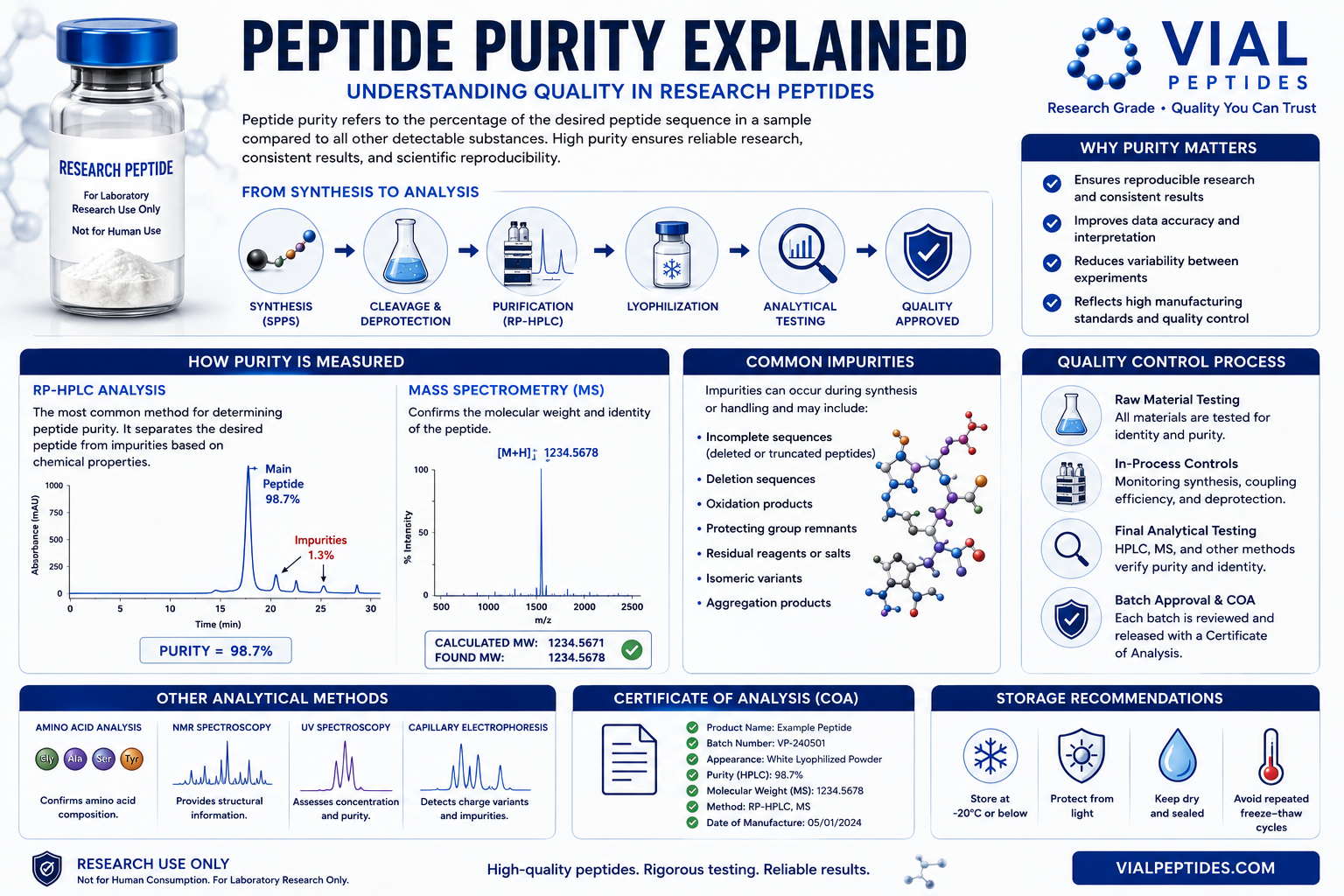
Peptide Purity Explained: Understanding Quality in Research Peptides
Table of Contents
- What Is Peptide Purity?
- Why Purity Matters
- Common Sources of Impurities
- How Purity Is Measured
- Quality Control Standards
- Frequently Asked Questions
- Conclusion
PART 1
Peptide Purity Explained: Understanding Quality in Research Peptides
Understanding Peptide Purity Explained begins with recognizing that peptide quality is about more than simply producing the correct amino acid sequence. Every manufacturing process can generate small amounts of unwanted by-products, incomplete sequences, or residual reagents. Analytical testing helps laboratories identify and measure these components so researchers know exactly what they are working with.
In peptide science, purity refers to the percentage of the desired molecular sequence compared with all other detectable substances in a sample. High purity is important because it improves consistency, supports reproducible laboratory investigations, and allows researchers to better interpret experimental results.
Modern peptide laboratories rely on advanced analytical technologies to evaluate research materials before they are released. These methods help verify molecular identity, assess purity, detect impurities, and confirm that manufacturing procedures have produced the intended sequence.
This guide explains what peptide purity means, how laboratories evaluate it, which analytical methods are commonly used, and why quality control is a critical part of modern peptide manufacturing.
What Is Peptide Purity?
Peptide purity describes the proportion of the intended peptide sequence within a sample after manufacturing and purification have been completed.
No chemical manufacturing process is completely free from by-products. As a result, laboratories use purification techniques and analytical testing to determine how much of the final sample consists of the desired molecular sequence.
Researchers evaluate purity because it helps them:
- Improve experimental consistency
- Compare production batches
- Assess manufacturing quality
- Support analytical accuracy
- Strengthen scientific reproducibility
Accurate purity measurements are a fundamental part of quality assurance.
Why Purity Is Important
High-quality research begins with well-characterized materials.
When researchers know the composition of a sample, they can interpret analytical results with greater confidence.
Reliable quality assessment supports:
- Reproducible experiments
- Consistent laboratory performance
- Better analytical documentation
- Accurate scientific reporting
- Improved collaboration between laboratories
These benefits make purity testing an essential step in peptide research.
What Causes Impurities?
Several factors can introduce unwanted substances during manufacturing.
Common sources include:
- Incomplete synthesis reactions
- Side reactions during production
- Residual protecting groups
- Trace manufacturing reagents
- Incomplete peptide sequences
- Minor degradation products
Understanding these sources helps researchers improve manufacturing efficiency and optimize purification procedures.
Manufacturing and Purification
Purity begins during the manufacturing process.
Carefully controlled synthesis conditions reduce the formation of unwanted by-products, while purification removes many remaining impurities before analytical testing.
Modern laboratories commonly use Reverse-Phase High-Performance Liquid Chromatography (RP-HPLC) to separate the desired molecule from closely related impurities.
This combination of careful manufacturing and effective purification helps produce high-quality research materials.
Identity Versus Purity
Identity and purity are closely related, but they are not the same.
Identity confirms that the intended molecular sequence has been produced.
Purity measures how much of the sample consists of that desired sequence.
For this reason, laboratories often combine multiple analytical methods rather than relying on a single test.
Using complementary techniques provides a more complete evaluation of research materials.
Common Analytical Methods
Researchers use several analytical technologies to evaluate manufactured materials.
The most common include:
- Reverse-Phase High-Performance Liquid Chromatography (RP-HPLC)
- Mass Spectrometry (MS)
- Nuclear Magnetic Resonance (NMR)
- Amino Acid Analysis
- Sequence Verification
Each method contributes unique information about quality, identity, or structural characteristics.
Quality Starts Before Testing
Analytical testing is only one part of quality assurance.
Reliable production also depends on:
- High-quality raw materials
- Standardized manufacturing procedures
- Equipment calibration
- Environmental monitoring
- Process documentation
- Batch traceability
These practices help laboratories maintain consistent production standards over time.
Key Takeaways
- Peptide Purity Explained focuses on measuring the proportion of the intended molecular sequence within a manufactured sample.
- Purity and identity are different but complementary aspects of quality evaluation.
- Manufacturing conditions, purification methods, and analytical testing all influence the final quality of research materials.
- RP-HPLC, Mass Spectrometry, NMR, and sequence verification provide comprehensive quality assessment.
- Standardized manufacturing and quality control support reliable scientific research and reproducible laboratory results.
Analytical Testing, Impurity Profiles, and Quality Assurance
Once purification has been completed, laboratories perform a series of analytical evaluations to determine whether the finished material meets predefined quality standards. Rather than relying on a single measurement, researchers combine several complementary techniques to build a complete understanding of molecular identity, composition, and overall quality.
This multi-layered approach provides greater confidence in research materials and supports reliable scientific investigations.
How Purity Is Measured
Determining purity involves separating the desired molecular sequence from any remaining substances present within the sample.
Scientists evaluate several characteristics during analysis, including:
- Chemical composition
- Molecular identity
- Relative abundance
- Structural consistency
- Manufacturing uniformity
- Batch reproducibility
By combining multiple analytical methods, laboratories obtain a more complete assessment than any individual test could provide.
Reverse-Phase High-Performance Liquid Chromatography (RP-HPLC)
Reverse-Phase High-Performance Liquid Chromatography is the most widely used method for evaluating peptide purity.
During analysis, sample components travel through a chromatographic column at different speeds depending on their chemical properties.
This separation allows scientists to distinguish the desired compound from impurities.
Researchers use RP-HPLC to:
- Measure purity percentages
- Detect manufacturing by-products
- Compare production batches
- Monitor purification efficiency
- Support quality documentation
Because of its reliability, RP-HPLC has become an essential quality control tool throughout the peptide industry.
Understanding Chromatograms
A chromatogram is the graphical output generated during HPLC analysis.
Each peak represents a different component detected within the sample.
Scientists evaluate chromatograms by examining:
- Peak position
- Peak size
- Peak shape
- Peak symmetry
- Peak separation
- Relative peak area
A well-resolved chromatogram provides valuable insight into overall sample composition.
Mass Spectrometry (MS)
Mass Spectrometry complements chromatographic testing by confirming molecular weight and identity.
Researchers use MS to:
- Verify molecular composition
- Confirm expected molecular mass
- Detect trace contaminants
- Support sequence confirmation
- Strengthen analytical confidence
When chromatographic and mass spectrometric data agree, laboratories gain stronger evidence supporting product identity.
Amino Acid Analysis
Amino acid analysis provides another layer of analytical information.
Scientists use this technique to evaluate:
- Amino acid composition
- Relative amino acid content
- Manufacturing consistency
- Sequence verification support
Although not always required for every production batch, amino acid analysis remains an important quality assessment tool in many research laboratories.
Nuclear Magnetic Resonance (NMR)
Nuclear Magnetic Resonance spectroscopy helps researchers investigate structural characteristics.
NMR provides valuable information regarding:
- Three-dimensional conformation
- Molecular flexibility
- Chemical environments
- Structural stability
- Atomic interactions
This information complements chromatographic and mass spectrometric analyses.
Understanding Impurity Profiles
No manufacturing process produces absolutely perfect results.
Instead, laboratories evaluate impurity profiles to understand what additional substances may be present after synthesis.
Common impurity categories include:
- Incomplete synthesis products
- Deleted amino acid sequences
- Oxidation products
- Residual protecting groups
- Manufacturing reagents
- Minor degradation products
Characterizing these materials helps scientists refine manufacturing procedures and improve purification efficiency.
Batch-to-Batch Consistency
Reliable scientific research depends on consistency between production batches.
Quality control programs evaluate whether successive manufacturing runs produce comparable analytical results.
Researchers examine:
- Purity measurements
- Molecular identity
- Chromatographic profiles
- Production documentation
- Stability observations
- Manufacturing records
Maintaining consistent quality improves confidence in experimental reproducibility.
Certificates of Analysis (COAs)
Many research laboratories prepare a Certificate of Analysis (COA) for each production batch.
A COA commonly includes:
- Batch identification
- Manufacturing date
- Purity results
- Molecular weight
- Analytical methods used
- Quality review information
These documents provide researchers with important technical information regarding the materials they receive.
Stability Monitoring
Quality assessment does not necessarily end after manufacturing.
Researchers may continue evaluating materials over time to understand how storage conditions influence stability.
Factors commonly monitored include:
- Temperature exposure
- Moisture
- Light
- Oxidation
- Container integrity
- Storage duration
Long-term monitoring helps laboratories establish appropriate storage recommendations.
Why Multiple Tests Are Necessary
No single analytical method can answer every quality question.
Instead, laboratories combine several complementary techniques because each provides different information.
Together these methods allow researchers to:
- Verify identity
- Measure purity
- Detect impurities
- Examine structure
- Confirm consistency
- Support scientific reproducibility
Using multiple analytical approaches creates a more reliable overall quality assessment.
Key Takeaways
- Purity evaluation relies on several complementary analytical techniques rather than a single test.
- RP-HPLC remains the primary method for measuring purity and identifying impurity profiles.
- Mass Spectrometry confirms molecular identity and expected molecular weight.
- NMR and amino acid analysis provide additional structural and compositional information.
- Certificates of Analysis and batch documentation strengthen transparency and quality assurance.
- Comprehensive analytical testing supports reliable laboratory research and reproducible scientific results.
Future Advances, Frequently Asked Questions, and Conclusion
The science of analytical testing continues to evolve as laboratories adopt more advanced technologies, automated workflows, and digital quality management systems. These innovations allow researchers to evaluate molecular composition with greater precision while improving manufacturing consistency and scientific reproducibility.
Modern quality assessment no longer depends on a single analytical instrument. Instead, laboratories combine chromatography, mass spectrometry, structural analysis, computational modeling, and standardized documentation to build a complete understanding of every production batch.
As biotechnology continues to advance, quality evaluation will become even more accurate, efficient, and standardized across the global scientific community.
Emerging Technologies in Analytical Science
Continuous innovation is improving every stage of laboratory quality assessment.
Researchers are developing technologies that provide faster analyses, greater sensitivity, and more detailed molecular information.
Several important trends are shaping the future of analytical testing.
Artificial Intelligence and Data Analysis
Artificial intelligence is increasingly being incorporated into laboratory workflows.
Scientists use AI-assisted software to:
- Interpret chromatographic data.
- Identify unusual analytical patterns.
- Compare manufacturing batches.
- Detect subtle variations.
- Improve quality monitoring.
- Support automated reporting.
These technologies reduce manual analysis while improving consistency and efficiency.
Next-Generation Chromatography
Chromatographic instruments continue to become more sensitive and efficient.
Modern systems provide:
- Higher analytical resolution
- Faster run times
- Improved peak separation
- Enhanced reproducibility
- Better detection of trace impurities
These improvements allow researchers to characterize samples with greater confidence.
Enhanced Mass Spectrometry
Mass spectrometry technology also continues to evolve.
New instruments provide:
- Greater mass accuracy
- Improved sensitivity
- Faster acquisition speeds
- Better impurity detection
- Expanded analytical capabilities
These advances strengthen identity confirmation and molecular characterization.
Digital Laboratory Management
Many research facilities now use digital laboratory management systems to organize manufacturing and analytical information.
These systems improve:
- Batch traceability
- Document control
- Instrument records
- Quality review workflows
- Regulatory documentation
- Long-term data storage
Digital records support transparency while simplifying quality management.
Building a Culture of Quality
Reliable manufacturing depends not only on advanced equipment but also on standardized laboratory practices.
Successful quality programs emphasize:
- Staff training
- Standard operating procedures
- Equipment maintenance
- Routine calibration
- Internal quality reviews
- Continuous improvement
Together, these practices help laboratories maintain consistent production standards while supporting scientific integrity.
Frequently Asked Questions
What does peptide purity mean?
Purity refers to the proportion of the desired molecular sequence within a sample compared with all other detectable substances present after manufacturing and purification.
Why is high purity important?
Well-characterized materials help researchers generate more consistent experimental results and improve confidence when interpreting laboratory data.
Which analytical technique measures purity most often?
Reverse-Phase High-Performance Liquid Chromatography (RP-HPLC) is widely used because it effectively separates the desired molecule from related impurities and provides detailed chromatographic data.
Does purity confirm identity?
No. Purity indicates how much of the desired sequence is present, while identity confirms that the sequence itself matches the intended molecular design. Laboratories commonly use multiple analytical methods to evaluate both characteristics.
What information does Mass Spectrometry provide?
Mass Spectrometry confirms molecular weight, supports identity verification, detects trace impurities, and strengthens analytical documentation.
Why are Certificates of Analysis important?
Certificates of Analysis summarize key analytical information for each production batch, including purity, molecular weight, testing methods, and batch identification.
Can different production batches vary?
Minor variation may occur during any manufacturing process. Standardized production procedures and comprehensive quality control programs help minimize variability and maintain consistent quality.
How is analytical testing expected to evolve?
Future developments include artificial intelligence, improved chromatography, enhanced mass spectrometry, greater automation, and expanded digital quality management systems.