Peptide Structure Explained: Understanding the Building Blocks of Modern Peptide Science
Every peptide begins with a carefully arranged sequence of amino acids, but its true identity is defined by much more than the order of those building blocks. The way a peptide folds, interacts with surrounding molecules, and maintains its three-dimensional shape determines many of its molecular characteristics. Understanding peptide structure is therefore one of the most important areas of peptide science.
Researchers spend years studying peptide structures because even the smallest change in molecular architecture can alter how a peptide behaves during laboratory investigations. A single amino acid substitution, a slight change in folding, or a minor structural modification may influence molecular recognition, chemical stability, and interactions with other biological molecules.
As peptide science continues to advance, improved manufacturing methods and analytical technologies allow scientists to examine peptide structures with remarkable precision. These discoveries continue to expand our understanding of molecular biology, structural chemistry, biotechnology, and pharmaceutical research.
In this comprehensive guide, you’ll learn how peptide structures are formed, why amino acid sequences matter, how peptides fold into stable molecular shapes, and how modern laboratories analyze peptide architecture using advanced scientific techniques.
What Is Peptide Structure?
Peptide structure refers to the complete molecular organization of a peptide, from its amino acid sequence to its final three-dimensional shape.
Although peptides may appear to be simple chains of amino acids, they are highly organized molecules. Every amino acid occupies a specific position within the chain, and each contributes to the peptide’s overall chemical properties.
Scientists describe peptide structure as the arrangement of atoms, chemical bonds, and molecular interactions that together create a stable biological molecule.
Understanding peptide structure helps researchers investigate:
- Molecular stability
- Chemical behavior
- Amino acid interactions
- Folding patterns
- Receptor recognition
- Laboratory analysis
- Peptide manufacturing
- Quality control
Without understanding peptide structure, scientists cannot accurately evaluate peptide purity, synthesis quality, or molecular identity.
Amino Acids: The Foundation of Every Peptide
Every peptide is built from amino acids.
Twenty naturally occurring amino acids serve as the fundamental building blocks used to construct peptides and proteins. Although they share a common molecular framework, each amino acid possesses a unique side chain known as an R-group.
These side chains determine how amino acids behave during peptide formation.
Some amino acids are attracted to water.
Others repel water.
Some carry positive electrical charges, while others carry negative charges or remain electrically neutral.
These differences influence how peptide chains fold into stable molecular structures.
Researchers carefully select amino acid sequences during peptide synthesis because every amino acid contributes to the final structure of the peptide.
Understanding Amino Acid Side Chains
The R-group attached to each amino acid is one of the most important factors influencing peptide structure.
Scientists generally classify amino acid side chains into several groups.
Nonpolar Amino Acids
Nonpolar amino acids tend to avoid water and often become buried within folded molecular structures.
Examples include:
- Alanine
- Valine
- Leucine
- Isoleucine
Polar Amino Acids
Polar amino acids readily interact with water and often remain exposed on the outer surface of peptides.
Examples include:
- Serine
- Threonine
- Asparagine
- Glutamine
Positively Charged Amino Acids
These amino acids carry positive electrical charges under many biological conditions.
Examples include:
- Lysine
- Arginine
- Histidine
Negatively Charged Amino Acids
These amino acids contribute negative electrical charges that influence molecular interactions.
Examples include:
- Aspartic acid
- Glutamic acid
Understanding these chemical properties helps explain why peptides adopt particular structural arrangements.
Peptide Bonds: Connecting Amino Acids
Amino acids become peptides through the formation of peptide bonds.
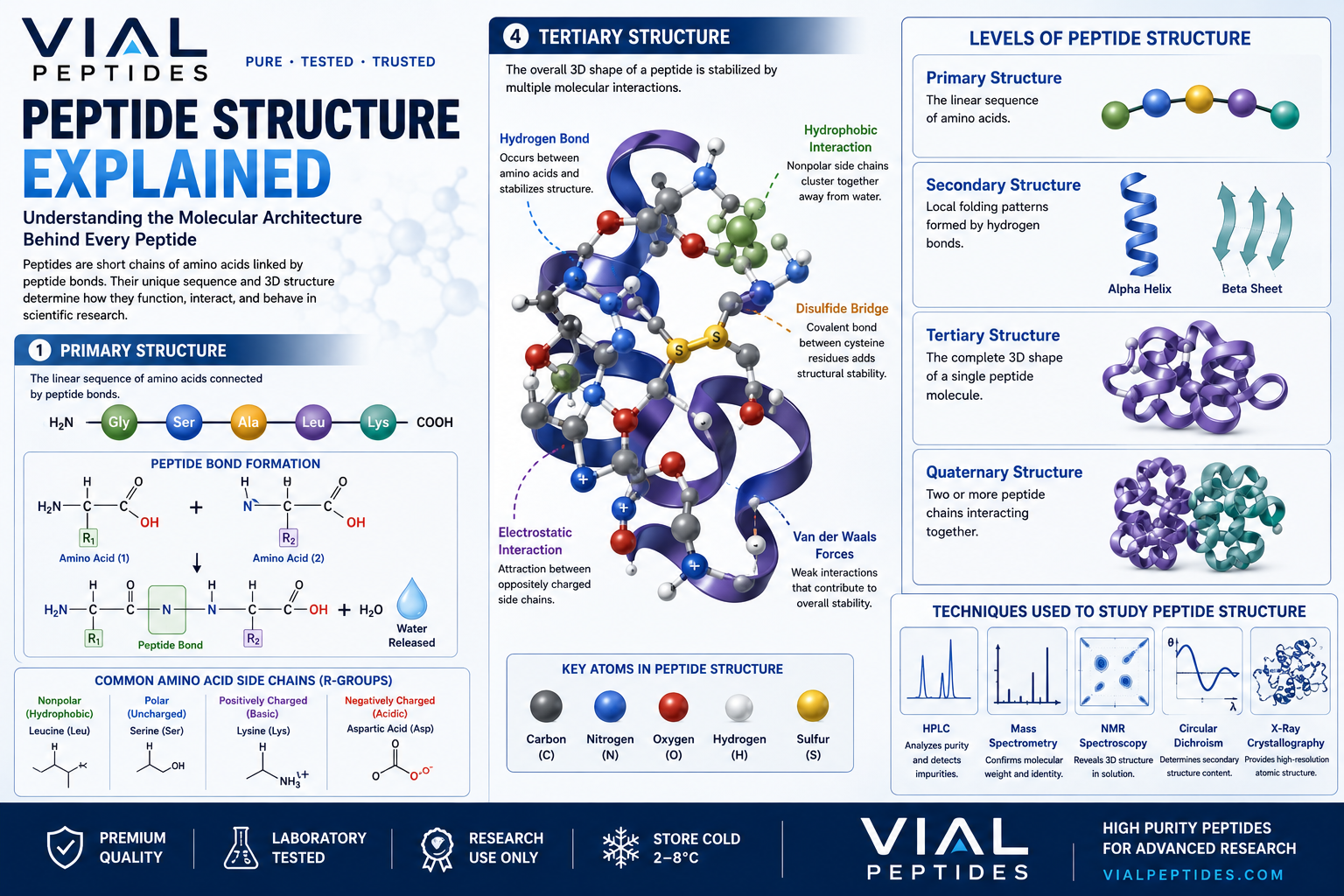
A peptide bond is a strong covalent bond created when the amino group of one amino acid reacts with the carboxyl group of another amino acid.
During this chemical reaction:
- Water is released.
- A new peptide bond forms.
- The amino acid chain grows longer.
Scientists refer to this reaction as a condensation reaction because water is removed as the bond forms.
Peptide bonds provide remarkable stability while allowing peptide chains to remain flexible enough to fold into complex molecular shapes.
Without peptide bonds, peptides could not exist.
The Importance of Amino Acid Sequence
One of the defining characteristics of peptide structure is the precise order of amino acids.
This sequence is known as the primary structure.
Even though peptides may contain relatively few amino acids compared with proteins, their exact sequence determines nearly every aspect of their molecular behavior.
Researchers evaluate amino acid sequences because they influence:
- Molecular weight
- Electrical charge
- Solubility
- Folding patterns
- Stability
- Receptor recognition
- Chemical interactions
Changing a single amino acid may alter the structure of the entire peptide.
This remarkable sensitivity explains why peptide synthesis demands exceptional precision throughout manufacturing.
Primary Structure: The Blueprint of Every Peptide
The primary structure represents the linear sequence of amino acids connected by peptide bonds.
Scientists often describe it as the molecular blueprint because every higher level of peptide structure depends upon this sequence.
For example, two peptides containing identical amino acids but arranged in different orders may possess completely different molecular characteristics.
This sequence controls:
- Folding behavior
- Chemical interactions
- Structural stability
- Biological recognition
Modern peptide manufacturers carefully verify amino acid sequences using advanced analytical techniques before products are released for laboratory research.
Secondary Structure: Local Folding Patterns
As peptide chains become longer, portions of the chain may begin forming organized structural arrangements.
These localized folding patterns are known as secondary structures.
The most common include:
Alpha Helices
Alpha helices resemble tightly wound springs.
Hydrogen bonds stabilize these structures while allowing flexibility within the peptide chain.
Beta Sheets
Beta sheets consist of neighboring peptide strands connected through hydrogen bonding.
These arrangements provide additional structural stability.
Random Coils
Not every region adopts highly organized structures.
Some portions remain flexible and irregular, allowing peptides to interact with surrounding molecules more easily.
Researchers study secondary structures because they influence molecular recognition, stability, and analytical behavior.
Hydrogen Bonds: Invisible Forces That Shape Peptides
Hydrogen bonds play a crucial role in peptide architecture.
Although much weaker than peptide bonds, hydrogen bonds help stabilize folded molecular structures.
These interactions occur between oxygen, nitrogen, and hydrogen atoms located throughout the peptide chain.
Individually, hydrogen bonds contribute only modest stability.
Collectively, however, thousands of hydrogen bonds can determine the overall organization of complex peptide structures.
Scientists devote significant attention to hydrogen bonding because it influences folding, stability, and molecular recognition.
Why Peptide Structure Matters in Scientific Research
Understanding peptide structure allows researchers to predict how peptides may behave under laboratory conditions.
Structural analysis helps scientists:
- Confirm molecular identity.
- Evaluate manufacturing quality.
- Improve peptide synthesis.
- Study molecular interactions.
- Investigate receptor recognition.
- Examine folding behavior.
- Analyze stability.
- Support quality control procedures.
Every stage of peptide research begins with understanding structure.
From manufacturing to purification and analytical testing, molecular architecture remains one of the defining characteristics of every research peptide.
Tertiary Structure: The Three-Dimensional Shape of Peptides
While the primary structure describes the amino acid sequence and the secondary structure explains local folding patterns, the tertiary structure represents the complete three-dimensional shape of the peptide.
This final arrangement is created by numerous molecular forces acting together throughout the peptide chain.
Scientists often describe tertiary structure as the molecule’s “final architecture.” It determines how the peptide occupies physical space and how it interacts with surrounding molecules during laboratory investigations.
Even small structural changes may influence receptor recognition, stability, solubility, and analytical behavior.
Understanding tertiary structure is therefore essential in peptide chemistry, molecular biology, and biotechnology.
The Forces That Shape Peptides
Peptides do not randomly fold into stable structures.
Several molecular interactions work together to determine the final three-dimensional arrangement.
Researchers study these forces because they influence peptide stability and molecular recognition.
Hydrogen Bonding
Hydrogen bonds are among the most important stabilizing forces within peptide molecules.
Although each hydrogen bond is relatively weak, thousands of them working together help maintain organized molecular structures.
Hydrogen bonds contribute significantly to:
- Alpha-helices
- Beta-sheets
- Overall structural stability
- Folding accuracy
Scientists carefully evaluate hydrogen bonding during structural analysis because even subtle changes may influence peptide behavior.
Hydrophobic Interactions
Certain amino acids avoid contact with water.
These hydrophobic amino acids naturally move toward the interior of the peptide while hydrophilic amino acids remain closer to surrounding water molecules.
This process helps peptides achieve energetically stable three-dimensional structures.
Hydrophobic interactions are among the strongest driving forces behind peptide folding.
Electrostatic Interactions
Some amino acids carry positive electrical charges while others carry negative charges.
Opposite charges attract one another.
Like charges repel.
These electrostatic interactions help stabilize peptide structures while influencing molecular recognition and receptor binding.
Changes in environmental pH may alter electrical charges and influence peptide structure.
Van der Waals Forces
Although individually weak, Van der Waals forces contribute to the overall stability of folded peptides.
These subtle attractions occur whenever atoms are positioned very close together.
Thousands of Van der Waals interactions collectively help maintain structural integrity.
Disulfide Bridges
Certain peptides contain cysteine amino acids capable of forming strong covalent bonds known as disulfide bridges.
Unlike hydrogen bonds, disulfide bridges are extremely strong.
These bonds help lock portions of peptide chains into stable configurations.
Many naturally occurring peptides depend on disulfide bridges for structural stability.
Peptide Folding
One of the most fascinating aspects of peptide science is folding.
After synthesis, peptide chains begin organizing themselves into energetically favorable structures.
Researchers often describe folding as the process through which a peptide discovers its most stable molecular arrangement.
Folding is influenced by:
- Amino acid sequence
- Temperature
- pH
- Solvent conditions
- Ionic strength
- Hydrogen bonding
- Hydrophobic interactions
Improper folding may alter molecular characteristics, which is why structural analysis remains such an important part of peptide research.
Why Folding Matters
Correct folding influences nearly every property researchers evaluate.
Properly folded peptides generally demonstrate improved:
- Structural stability
- Molecular recognition
- Receptor compatibility
- Chemical consistency
- Analytical reproducibility
Incorrect folding may influence laboratory observations and reduce confidence in analytical results.
Scientists therefore devote significant attention to folding behavior during peptide development.
Structural Flexibility
Unlike rigid crystals, peptides are dynamic molecules.
Many peptides continuously change shape while maintaining their overall structural organization.
Researchers refer to this behavior as structural flexibility.
This flexibility allows peptides to adapt during molecular interactions while still preserving essential structural features.
Understanding structural flexibility helps researchers investigate receptor binding, molecular recognition, and peptide dynamics.
Peptide Conformation
The term conformation describes the specific spatial arrangement of atoms within a peptide at a given moment.
A single peptide may adopt multiple conformations depending on environmental conditions.
Scientists investigate peptide conformations because they help explain:
- Molecular stability
- Folding pathways
- Structural transitions
- Receptor interactions
- Chemical behavior
Modern analytical technologies allow researchers to observe conformational changes with increasing precision.
Structural Stability
Stable peptide structures are essential for reliable laboratory investigations.
Several factors influence stability, including:
- Amino acid composition
- Hydrogen bonding
- Hydrophobic interactions
- Electrostatic attractions
- Disulfide bridges
- Temperature
- Moisture
- Oxidation
Researchers evaluate structural stability throughout manufacturing and analytical testing to ensure dependable research materials.
Structural Analysis During Manufacturing
Manufacturing does not end once peptide synthesis has been completed.
Scientists carefully examine peptide structure throughout production to verify that the intended molecule has been successfully created.
Structural evaluation occurs during:
- Synthesis
- Purification
- Analytical testing
- Stability studies
- Final quality release
This systematic approach helps ensure manufacturing consistency and product quality.
High-Performance Liquid Chromatography (HPLC)
Although HPLC is primarily known for purity analysis, it also provides valuable structural information.
Differences in molecular structure often influence how peptides move through chromatography columns.
Researchers compare chromatographic behavior between production batches to help evaluate manufacturing consistency.
HPLC has therefore become one of the most important analytical tools used throughout peptide manufacturing.
Mass Spectrometry
Mass Spectrometry complements HPLC by confirming molecular identity.
Scientists determine whether the measured molecular weight matches the theoretical molecular weight calculated from the amino acid sequence.
Agreement between these values provides additional confidence that the peptide possesses the intended structure.
Mass Spectrometry has become an indispensable tool in modern peptide quality assurance.
Liquid Chromatography-Mass Spectrometry (LC-MS)
Many laboratories combine chromatography with Mass Spectrometry.
This integrated analytical approach provides information about:
- Purity
- Molecular identity
- Structural consistency
- Manufacturing quality
LC-MS represents one of the most comprehensive analytical methods available for peptide evaluation.
Advanced Techniques Used to Study Peptide Structure
Understanding peptide structure requires sophisticated laboratory technology. Modern researchers use multiple analytical methods to examine peptide composition, molecular architecture, and structural integrity.
Rather than relying on a single technique, scientists combine several complementary analytical tools to verify peptide identity and evaluate manufacturing quality.
Nuclear Magnetic Resonance (NMR) Spectroscopy
Nuclear Magnetic Resonance (NMR) spectroscopy allows researchers to examine peptide structures at the atomic level.
This powerful analytical technique provides information about:
- Molecular conformation
- Atomic interactions
- Three-dimensional arrangement
- Bond connectivity
- Structural flexibility
NMR is especially valuable when researchers need to understand how peptides behave in solution, where many biological interactions naturally occur.
Circular Dichroism (CD) Spectroscopy
Circular Dichroism is widely used to study peptide folding and secondary structure.
By measuring how peptides interact with polarized light, researchers can estimate whether a peptide contains:
- Alpha-helices
- Beta-sheets
- Random coils
- Mixed structural arrangements
This information helps scientists evaluate whether a synthesized peptide has folded as expected.
X-Ray Crystallography
When peptides can be crystallized successfully, X-ray crystallography provides extraordinarily detailed structural information.
Researchers use this technique to determine:
- Atomic positions
- Bond angles
- Molecular geometry
- Three-dimensional architecture
Although not every peptide is suitable for crystallography, it remains one of the most accurate methods for structural determination.
Cryo-Electron Microscopy
Cryo-electron microscopy (Cryo-EM) has transformed structural biology.
Instead of requiring crystals, Cryo-EM rapidly freezes molecules and captures thousands of microscopic images.
Computer software reconstructs these images into detailed three-dimensional models.
This technique has significantly expanded scientists’ ability to investigate complex biological molecules.
Molecular Modeling
Advances in computer science have introduced powerful molecular modeling software capable of predicting peptide structures before laboratory synthesis.
Researchers use computational tools to:
- Predict folding
- Estimate stability
- Analyze molecular interactions
- Compare peptide variants
- Design improved peptide sequences
Artificial intelligence is increasingly becoming part of peptide design and structural prediction.
Factors That Influence Peptide Structure
Although amino acid sequence provides the blueprint, several additional factors influence the final molecular structure.
Temperature
Changes in temperature may alter peptide stability and folding.
Researchers carefully control laboratory temperatures during manufacturing, purification, and storage.
pH
Acidic or alkaline environments may influence electrical charges carried by amino acids.
Changes in charge distribution may affect folding and molecular interactions.
Solvent Conditions
Different solvents influence peptide solubility and structural stability.
Scientists select solvents carefully depending on the objectives of each laboratory investigation.
Oxidation
Exposure to oxygen may gradually modify certain amino acids.
Manufacturers therefore package peptides using procedures designed to minimize unnecessary oxidation.
Moisture
Moisture may reduce stability in certain peptide formulations.
For this reason, many research peptides are supplied as lyophilized (freeze-dried) powders.
Peptide Degradation
Even well-manufactured peptides gradually degrade if stored improperly.
Several factors contribute to degradation:
- Heat
- Moisture
- Light
- Oxidation
- Enzymatic activity
- Repeated freeze-thaw cycles
Researchers follow recommended storage procedures to help preserve molecular integrity throughout laboratory use.
Understanding degradation helps improve manufacturing practices and product stability.
The Role of Structural Analysis in Manufacturing
Every stage of peptide manufacturing depends upon structural verification.
Scientists monitor peptide structure during:
- Raw material inspection
- Amino acid verification
- Peptide synthesis
- Purification
- Analytical testing
- Packaging
- Stability studies
- Final quality release
Without structural analysis, manufacturers cannot confidently verify product identity.
Quality Assurance and Structural Consistency
Quality assurance extends beyond purity testing.
Manufacturers also evaluate:
- Amino acid sequence accuracy
- Molecular identity
- Structural consistency
- Batch reproducibility
- Stability
- Documentation
- Analytical verification
These procedures help ensure researchers receive dependable materials suitable for laboratory investigations.
Why Structural Accuracy Matters
A peptide containing an incorrect amino acid sequence may appear nearly identical to the intended molecule.
However, even a single amino acid substitution may alter:
- Folding behavior
- Receptor recognition
- Stability
- Solubility
- Molecular interactions
Because of this sensitivity, peptide manufacturers devote considerable attention to structural accuracy throughout production.
Future Advances in Peptide Structural Biology
Peptide science continues to evolve rapidly.
Researchers are developing new analytical instruments capable of examining peptide structures with greater speed and precision than ever before.
Emerging technologies include:
- Artificial intelligence-assisted structure prediction
- Machine learning models
- High-resolution Cryo-EM
- Improved NMR instrumentation
- Automated peptide synthesis
- Advanced computational chemistry
These innovations are helping scientists better understand peptide behavior while improving manufacturing efficiency and analytical reliability.
Frequently Asked Questions
What is peptide structure?
Peptide structure refers to the complete molecular organization of a peptide, including its amino acid sequence, chemical bonds, folding patterns, and three-dimensional shape.
Why is peptide structure important?
Peptide structure influences molecular stability, receptor recognition, chemical behavior, and analytical properties.
What is the primary structure of a peptide?
Primary structure is the exact sequence of amino acids connected by peptide bonds.
What creates secondary structure?
Hydrogen bonding between atoms within the peptide chain helps create alpha-helices, beta-sheets, and other local folding patterns.
What determines a peptide’s three-dimensional shape?
Three-dimensional structure results from multiple molecular interactions including hydrogen bonding, hydrophobic interactions, electrostatic forces, and disulfide bridges.
How do scientists study peptide structure?
Researchers use analytical techniques such as HPLC, Mass Spectrometry, Nuclear Magnetic Resonance (NMR), Circular Dichroism, X-ray Crystallography, and Cryo-Electron Microscopy.
Why do amino acid sequences matter?
Every amino acid contributes unique chemical properties that influence peptide folding, stability, and molecular recognition.
What is peptide folding?
Peptide folding is the process by which an amino acid chain adopts its final three-dimensional structure.
Can peptide structure change?
Yes. Temperature, pH, oxidation, moisture, and storage conditions may influence peptide stability and structure.
What is structural stability?
Structural stability refers to a peptide’s ability to maintain its molecular organization under defined conditions.
Why is structural consistency important?
Consistent peptide structure helps improve manufacturing reliability and supports reproducible laboratory investigations.
Are all peptides structurally similar?
No. Every peptide possesses a unique amino acid sequence and molecular architecture.
Conclusion
Peptide structure is the foundation of peptide science. Every peptide begins with a precisely arranged sequence of amino acids that ultimately determines its folding, stability, molecular recognition, and chemical behavior. From the formation of peptide bonds to the development of complex three-dimensional structures, each stage contributes to the characteristics researchers investigate in modern laboratories.
Advances in analytical technologies—including HPLC, Mass Spectrometry, Nuclear Magnetic Resonance, Circular Dichroism, X-ray Crystallography, and Cryo-Electron Microscopy—have transformed scientists’ ability to examine peptide structures with remarkable precision. These tools not only verify molecular identity but also support manufacturing quality, structural consistency, and ongoing peptide research.
At VIAL PEPTIDES, we recognize that structural accuracy is fundamental to producing high-quality research peptides. Through rigorous manufacturing standards, comprehensive analytical testing, and transparent quality assurance, we are committed to supplying research materials that meet the demands of modern scientific investigation.
As peptide science continues to evolve, a thorough understanding of peptide structure will remain essential for researchers working in molecular biology, biotechnology, analytical chemistry, and pharmaceutical research.
Suggested Internal Links
Link this article naturally to:
- What Are Peptides?
- How Peptides Work
- Amino Acids and Peptides
- Peptide Bonds Explained
- Peptides vs Proteins
- Peptide Folding Explained
- Understanding Peptide Purity and Testing
- HPLC Testing Explained
- Mass Spectrometry Explained
- Certificate of Analysis Guide
- Laboratory Tested Peptides
- High Purity Peptide Products
- Choosing a Reliable Peptide Supplier
- BPC-157 Peptide
- TB-500 Peptide
- GHK-Cu Peptide
- CJC-1295 Peptide