
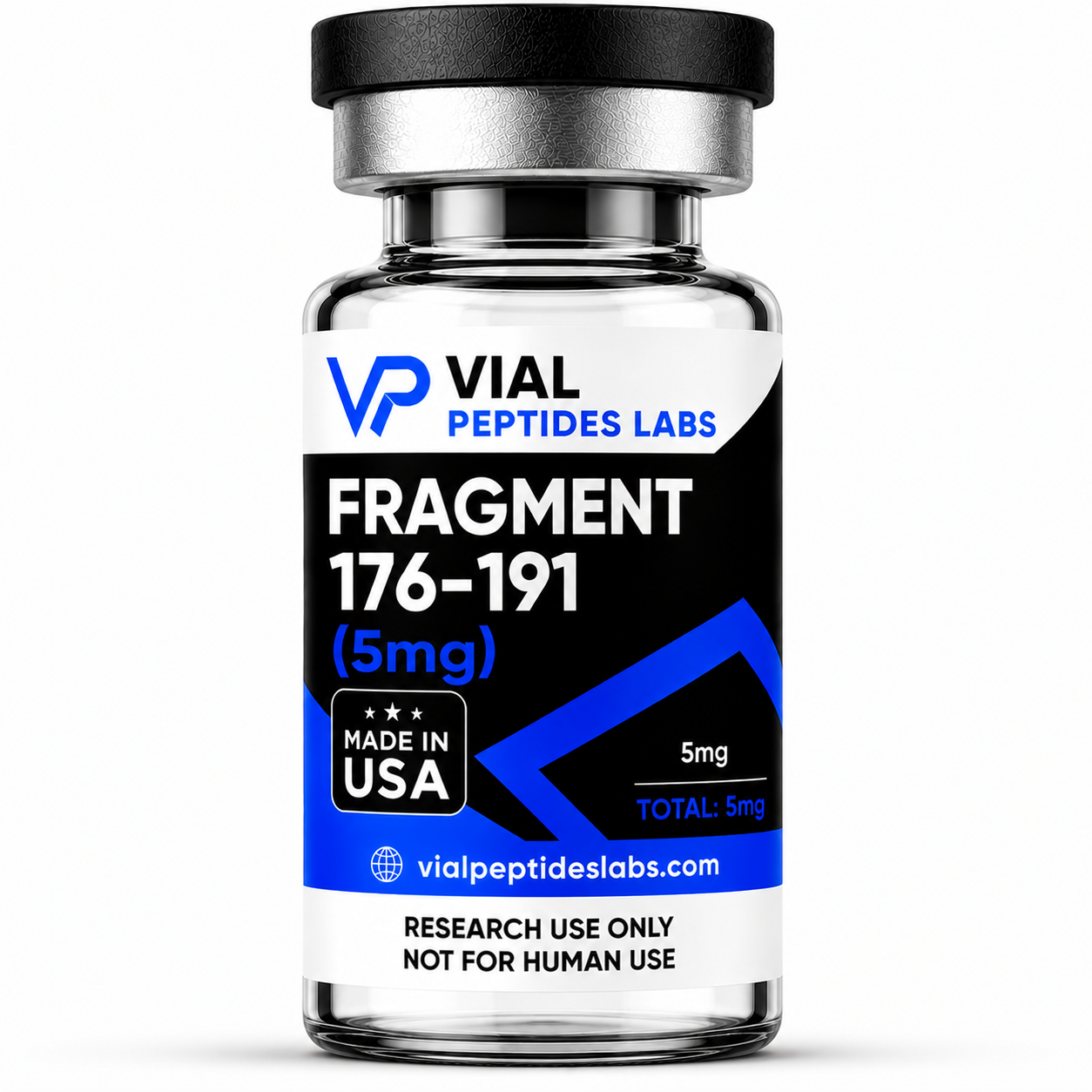
Fragment 176-191 (5mg)
$44.00
Size: 5mg
Contents: Fragment 176-191
Form: Lyophilized powder
Purity: >99%
SKU: P-FRAG176-191
FREE Shipping on $200+ orders
| Quantity | 5 – 8 | 9 + |
|---|---|---|
| Discount | 5% | 10% |
| Price | $41.80 | $39.60 |
Description
Fragment 176-191 (5mg)
Fragment 176-191 (5mg) is a research-grade synthetic peptide manufactured exclusively for laboratory and scientific research applications. Also known as HGH Fragment 176-191, this peptide is supplied as a 5mg lyophilized powder and is intended for use in peptide chemistry, molecular biology, biotechnology, and biochemical research performed by qualified professionals in controlled laboratory environments.
At Vial Peptides Labs, every research peptide is manufactured using standardized laboratory procedures and undergoes comprehensive analytical testing to help verify product identity, purity, and batch consistency. Every vial is clearly labeled For Research Use Only – Not for Human Use and is intended solely for scientific research.
Product Specifications
- Product Name: Fragment 176-191
- Also Known As: HGH Fragment 176-191
- Strength: 5mg
- Grade: Research Grade
- Appearance: White to off-white lyophilized powder
- Purity: High Purity
- Manufacturer: Vial Peptides Labs
- Website: https://vialpeptideslabs.com/
Peptide Structure
- Peptide Type: Synthetic Peptide
- Sequence Length: 16 Amino Acids
- Amino Acid Sequence: Tyr-Leu-Arg-Ile-Val-Gln-Cys-Arg-Ser-Val-Glu-Gly-Ser-Cys-Gly-Phe
- Molecular Formula: Sequence-dependent peptide compound
- Molecular Weight: Approximately 1.8 kDa (1,817 Da)
Analytical Testing
Each production batch undergoes comprehensive laboratory evaluation, which may include:
- Reverse-Phase High-Performance Liquid Chromatography (RP-HPLC)
- Mass Spectrometry (MS)
- Molecular Identity Verification
- Purity Assessment
- Batch Documentation
- Quality Control Review
These analytical procedures help support product characterization and manufacturing consistency.
Manufacturing Standards
Vial Peptides Labs follows standardized manufacturing procedures designed to produce premium research-grade peptides.
Our manufacturing process emphasizes:
- Verified raw materials
- Standardized peptide synthesis
- Advanced purification techniques
- Batch traceability
- Comprehensive quality control
- Transparent technical documentation
Storage Recommendations
To maintain product stability:
- Store refrigerated between 2°C and 8°C.
- Protect from heat, moisture, and direct sunlight.
- Keep the vial tightly sealed until laboratory use.
- Follow proper laboratory handling procedures.
Packaging
Each Fragment 176-191 vial is professionally packaged to help preserve product quality during storage and transportation.
Packaging includes:
- Secure laboratory vial
- Premium product label
- Batch identification
- Protective shipping materials
Research Use Only
Fragment 176-191 (5mg) is supplied strictly for laboratory research purposes only.
Not for human consumption, therapeutic use, clinical application, diagnostic use, or veterinary use.
Why Choose Vial Peptides Labs?
Researchers choose Vial Peptides Labs because of our commitment to scientific quality, transparency, and manufacturing consistency.
We provide:
- Premium research-grade peptides
- High-purity peptide products
- Standardized manufacturing procedures
- Comprehensive analytical testing
- Batch–specific quality control
- Secure packaging and shipping
- Professional customer support
- Continuously expanding research peptide catalog
Related Products
- CJC-1295 DAC (5mg)
- CJC-1295 NO DAC (Mod GRF 1-29) (5mg)
- Ipamorelin (5mg)
- GHRP-2 (5mg)
- GHRP-6 (5mg)
- Tesamorelin (10mg)
- AOD-9604 (5mg)
- PEG-MGF
Fragment 176-191 and Hyperglycemia
In one study,(8) several synthetic hGH peptides, including Fragment 176-191, were presented in normal functioning murine models to determine its potential on glycogen metabolism. Upon delivery, it was reported that the peptide appeared to induce a slight increment in levels of blood glucose and lactate, with a slight reduction in the ratio of glycogen synthase in muscle, adipose tissues, and the liver. It was suggested that this outcome was due to the peptide’s apparent action of converting the enzymes from their active state to inactive state, as the total synthase levels appeared to remain at constant concentrations.
Fragment 176-191 peptide is available for research and laboratory purposes only. Please review and adhere to our Terms and Conditions before ordering.
References:
- Cox HD, Smeal SJ, Hughes CM, Cox JE, Eichner D. Detection and in vitro metabolism of AOD9604. Drug Test Anal. 2015 Jan;7(1):31-8. doi: 10.1002/dta.1715. Epub 2014 Sep 10. PMID: 25208511.
- Heffernan, Mark, et al. “The Effects of Human GH and Its Lipolytic Fragment (AOD9604) on Lipid Metabolism Following Chronic Treatment in Obese Mice andβ 3-AR Knock-Out Mice.” Endocrinology 142.12 (2001): 5182-5189.
- Heffernan M, Summers RJ, Thorburn A, Ogru E, Gianello R, Jiang WJ, Ng FM. The effects of human GH and its lipolytic fragment (AOD9604) on lipid metabolism following chronic treatment in obese mice and beta(3)-AR knock-out mice. Endocrinology. 2001 Dec;142(12):5182-9. doi: 10.1210/endo.142.12.8522. PMID: 11713213.
- Stier, Heike, Evert Vos, and David Kenley. “Safety and Tolerability of the Hexadecapeptide AOD9604 in Humans.” Journal of Endocrinology and Metabolism 3.1-2 (2013): 7-15.
- Moré, Margret I., and David Kenley. “Safety and metabolism of AOD9604, a novel nutraceutical ingredient for improved metabolic health.” Journal of Endocrinology and Metabolism 4.3 (2014): 64-77.
- Valentino, M A et al. “Central and peripheral molecular targets for antiobesity pharmacotherapy.” Clinical pharmacology and therapeutics vol. 87,6 (2010): 652-62. doi: 10.1038/clpt.2010.57
- Kwon, Dong Rak, and Gi Young Park. “Effect of Intra-articular Injection of AOD9604 with or without Hyaluronic Acid in Rabbit Osteoarthritis Model.” Annals of clinical and laboratory science vol. 45,4 (2015): 426-32.
- Ma GY, Macaulay SL, Maggs JA, Armstrong JM, Bornstein J. The mechanism of the hyperglycaemic action of synthetic peptides related to the C-terminal sequence of human growth hormone. Biochim Biophys Acta. 1982 Jun 16;716(3):400-9. doi: 10.1016/0304-4165(82)90033-2. PMID: 6810951.
Reviews
There are no reviews yet.