Research Peptides Guide: Everything You Need to Know About Research-Grade Peptides
Table of Contents
- What Are Research Peptides?
- How Research Peptides Are Produced
- Types of Research Peptides
- Laboratory Quality Standards
- Storage and Handling
- Frequently Asked Questions
- Conclusion
PART 1
Research Peptides Guide: Everything You Need to Know About Research-Grade Peptides
A comprehensive Research Peptides Guide is an essential resource for understanding the science behind research-grade peptides, their production, analytical evaluation, laboratory handling, and role in modern scientific investigation. These carefully manufactured amino acid sequences are widely used in biotechnology, molecular biology, analytical chemistry, and related research disciplines where precise molecular characterization is essential.
Peptides are short chains of amino acids connected by peptide bonds. Their relatively small size, combined with highly defined molecular structures, makes them valuable tools for studying molecular interactions, receptor biology, protein chemistry, and cellular communication. Advances in synthesis technology have enabled laboratories to produce highly characterized materials with excellent consistency and reproducibility.
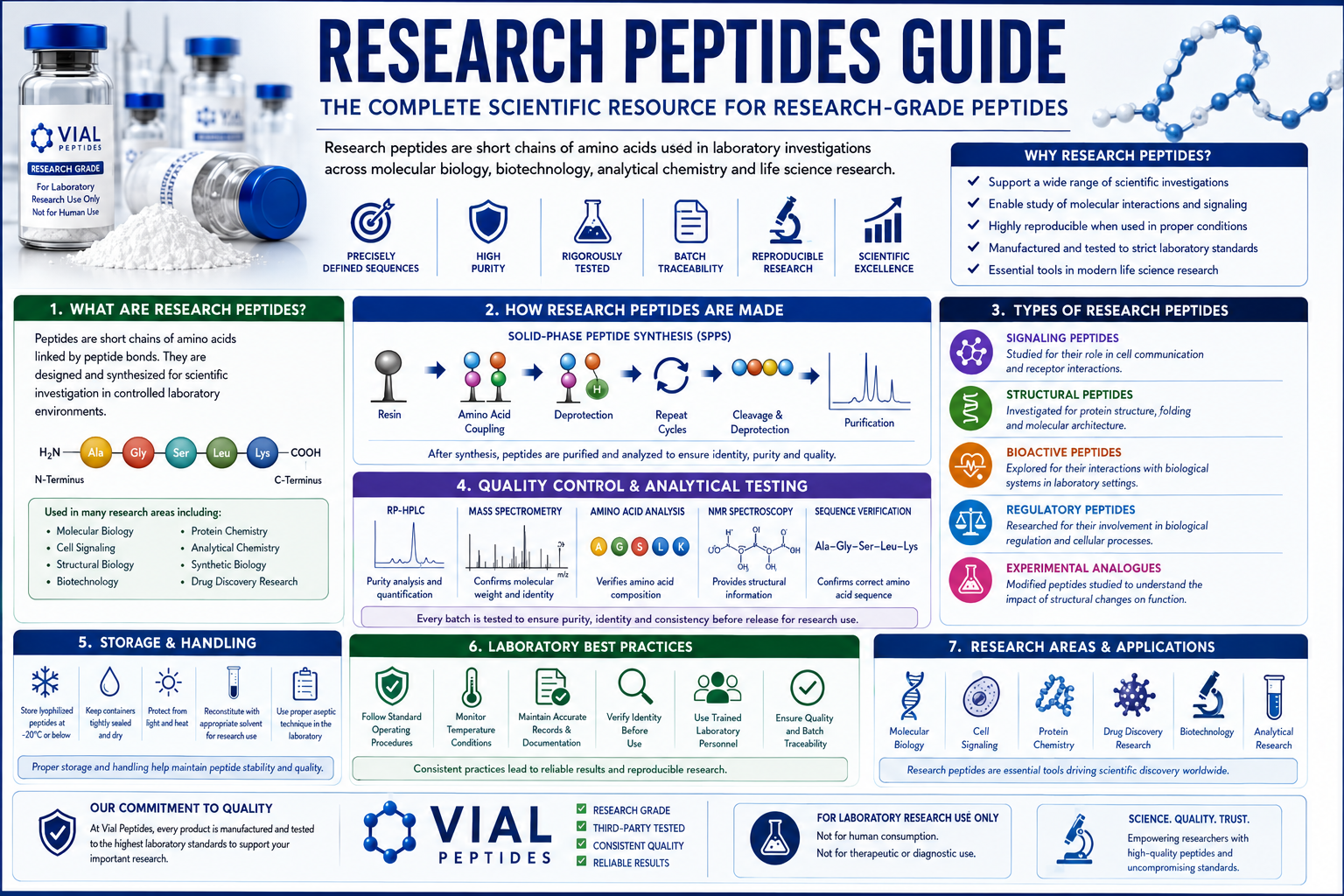
Modern peptide research relies on standardized manufacturing procedures, comprehensive analytical testing, and strict quality management systems. These practices help ensure that research materials are accurately characterized before they are used in laboratory investigations. Technologies such as Solid-Phase Peptide Synthesis (SPPS), High-Performance Liquid Chromatography (HPLC), Mass Spectrometry (MS), and Nuclear Magnetic Resonance (NMR) have become fundamental components of this scientific process.
This Research Peptides Guide provides a detailed overview of peptide science, explaining how research materials are produced, analyzed, stored, and used in laboratory environments while highlighting the technologies that support reliable scientific research.
What Are Research Peptides?
Research peptides are laboratory-produced amino acid sequences designed for scientific investigation. Their defined molecular composition allows researchers to study biological processes, molecular recognition, receptor interactions, and structural properties under carefully controlled experimental conditions.
Scientists investigate these materials because they offer:
- Precisely defined amino acid sequences
- Consistent molecular composition
- High analytical quality
- Reliable batch reproducibility
- Compatibility with modern laboratory techniques
- Broad applications across multiple scientific disciplines
These characteristics make them valuable tools for experimental research and analytical investigations.
Why Peptide Research Is Important
Peptide science continues to expand because these molecules help researchers investigate complex biological systems with exceptional precision.
Current areas of scientific investigation include:
- Molecular biology
- Cell biology
- Structural biology
- Biotechnology
- Protein chemistry
- Analytical chemistry
- Synthetic biology
- Biochemistry
Knowledge gained from these fields contributes to a broader understanding of molecular function and biological organization.
Basic Structure of Peptides
Every peptide begins with amino acids linked together through peptide bonds.
The order of amino acids determines the sequence, while the chemical properties of individual amino acids influence the molecule’s overall characteristics.
Researchers commonly evaluate:
- Sequence length
- Molecular weight
- Three-dimensional structure
- Chemical stability
- Charge distribution
- Hydrophobic and hydrophilic regions
Understanding these structural features helps scientists investigate molecular interactions and biological mechanisms.
How Research Materials Are Manufactured
Most research-grade materials are produced using Solid-Phase Peptide Synthesis (SPPS).
This manufacturing approach allows amino acids to be added sequentially while the growing chain remains attached to a solid resin.
Major advantages include:
- Excellent sequence accuracy
- High reproducibility
- Efficient production
- Flexible molecular design
- Simplified purification
- Reliable batch consistency
SPPS remains the most widely used manufacturing method in peptide laboratories worldwide.
From Manufacturing to Quality Assessment
Producing a peptide sequence is only the beginning.
Every production batch undergoes additional procedures designed to verify molecular quality before laboratory use.
These stages commonly include:
- Purification
- Identity confirmation
- Purity evaluation
- Sequence verification
- Stability assessment
- Documentation review
Each stage contributes to the reliability of scientific investigations.
The Importance of Analytical Testing
Researchers depend on analytical testing to evaluate the characteristics of every production batch.
Widely used analytical methods include:
- Reverse-Phase High-Performance Liquid Chromatography (RP-HPLC)
- Mass Spectrometry (MS)
- Nuclear Magnetic Resonance (NMR)
- Amino Acid Analysis
- Sequence Verification
Together, these complementary techniques provide detailed information about molecular identity, purity, and structural characteristics.
Research Laboratory Standards
Reliable scientific investigations require standardized laboratory practices.
Quality-focused laboratories emphasize:
- Standard operating procedures
- Equipment calibration
- Batch traceability
- Environmental monitoring
- Comprehensive documentation
- Continuous quality improvement
These systems help maintain consistency throughout manufacturing and analytical evaluation.
Key Takeaways
- A Research Peptides Guide provides a comprehensive understanding of peptide science, manufacturing, analytical testing, and laboratory quality.
- Research-grade peptides are carefully synthesized amino acid sequences designed for scientific investigation.
- SPPS remains the global standard for peptide manufacturing.
- RP-HPLC, Mass Spectrometry, NMR, and sequence verification are fundamental analytical techniques used to characterize research materials.
- Standardized laboratory procedures support reproducible scientific research and reliable experimental outcomes.
Types of Research Peptides, Laboratory Applications, and Quality Standards
Research peptides represent a diverse group of scientifically developed molecules that allow investigators to explore biochemical pathways, molecular recognition, structural biology, and cellular communication. Although each peptide possesses unique structural characteristics, they all share one important feature: they are produced and evaluated using standardized laboratory methods that support reproducible scientific research.
Understanding the different categories of research peptides helps scientists select appropriate materials for specific laboratory investigations while improving knowledge of peptide chemistry and molecular biology.
Classification of Research Peptides
Researchers classify peptide molecules using several different criteria.
Common classification methods include:
- Amino acid sequence
- Molecular size
- Chemical structure
- Biological origin
- Laboratory synthesis method
- Primary area of scientific investigation
These classifications help organize research while simplifying scientific communication.
Naturally Occurring Peptides
Many peptide molecules are naturally produced within living organisms.
Scientists investigate naturally occurring sequences to better understand biological regulation, molecular signaling, and protein interactions.
Research involving naturally occurring molecules contributes to multiple scientific disciplines, including:
- Cell biology
- Molecular biology
- Biochemistry
- Structural biology
- Biotechnology
Understanding natural peptide systems often provides valuable insight for future laboratory investigations.
Synthetic Research Peptides
Synthetic peptides are produced under carefully controlled laboratory conditions.
Modern manufacturing techniques allow researchers to create highly defined amino acid sequences with exceptional precision.
Advantages of laboratory synthesis include:
- Precise sequence control
- Consistent molecular composition
- High analytical quality
- Reliable batch reproducibility
- Flexible molecular design
These characteristics make synthetic materials especially valuable for scientific research.
Common Categories of Research Peptides
Research laboratories investigate many different peptide families.
Examples include:
Signaling Peptides
Widely studied because of their roles in molecular communication and receptor interactions.
Structural Peptides
Investigated to understand molecular architecture, protein folding, and structural biology.
Bioactive Peptides
Studied to explore interactions between peptide molecules and biological systems under controlled laboratory conditions.
Regulatory Peptides
Researchers examine these molecules to better understand biological regulation and cellular communication.
Experimental Analogues
Scientists sometimes develop modified peptide sequences to investigate how structural changes influence molecular behavior.
Each category contributes unique information to peptide science while expanding scientific understanding.
Laboratory Research Applications
Research peptides support investigations across numerous scientific fields.
Current areas of study include:
- Molecular biology
- Biotechnology
- Cell biology
- Structural biology
- Protein chemistry
- Analytical chemistry
- Synthetic biology
- Biomolecular engineering
Their versatility makes them valuable tools in modern laboratory research.
Manufacturing Standards
High-quality research materials begin with standardized manufacturing procedures.
Leading laboratories emphasize:
- Verified raw materials
- Controlled synthesis
- Purification procedures
- Analytical testing
- Quality documentation
- Batch consistency
These manufacturing standards support reproducibility and reliable scientific outcomes.
Analytical Characterization
Every production batch undergoes detailed analytical evaluation before laboratory use.
Researchers commonly perform:
- Reverse-Phase High-Performance Liquid Chromatography (RP-HPLC)
- Mass Spectrometry (MS)
- Nuclear Magnetic Resonance (NMR)
- Amino Acid Analysis
- Sequence Verification
Each analytical technique contributes valuable information about molecular identity, purity, and structural integrity.
Certificates of Analysis
Many laboratories provide a Certificate of Analysis (COA) with each production batch.
A COA commonly includes:
- Batch number
- Product identification
- Purity results
- Molecular weight
- Analytical methods
- Quality review information
These documents help researchers understand the analytical characteristics of the materials they receive.
Storage and Handling
Proper storage helps preserve molecular quality throughout the research process.
Laboratories typically focus on:
- Controlled temperatures
- Protection from moisture
- Limited light exposure
- Proper labeling
- Accurate inventory management
- Comprehensive documentation
Standardized handling procedures reduce unnecessary variability and support long-term stability.
Documentation and Traceability
Every stage of production and laboratory handling should be carefully documented.
Typical records include:
- Manufacturing information
- Analytical reports
- Storage conditions
- Batch identification
- Laboratory observations
- Quality reviews
Comprehensive documentation strengthens traceability while supporting laboratory quality management systems.
The Importance of Reproducibility
One of the primary goals of laboratory science is reproducibility.
Researchers rely on standardized manufacturing, analytical testing, and quality systems so that independent laboratories can obtain comparable results.
Reproducibility supports:
- Scientific collaboration
- Experimental validation
- Reliable publications
- Long-term research progress
- Quality assurance
Consistent research materials form the foundation of dependable scientific investigations.
Key Takeaways
- Research peptides include several categories based on structure, origin, and scientific application.
- Synthetic manufacturing provides highly defined amino acid sequences with excellent reproducibility.
- Standardized production and analytical testing improve quality and consistency.
- Certificates of Analysis provide important batch-specific analytical information.
- Proper storage, documentation, and traceability support reliable laboratory research.
Future of Research Peptides, Frequently Asked Questions, and Conclusion
Research involving peptides continues to expand as scientists develop new analytical methods, improve manufacturing technologies, and deepen their understanding of molecular biology. Advances in computational modeling, automation, structural analysis, and laboratory instrumentation are providing researchers with increasingly detailed information about peptide structure, molecular interactions, and experimental reproducibility.
As scientific knowledge grows, standardized manufacturing and analytical quality systems will continue supporting reliable laboratory investigations across biotechnology, analytical chemistry, structural biology, and related research disciplines.
Emerging Trends in Peptide Research
The future of peptide science is being shaped by technological innovation and interdisciplinary collaboration.
Researchers are combining chemistry, biology, engineering, and computational science to improve laboratory investigations while expanding scientific knowledge.
Several important trends continue driving progress.
Artificial Intelligence and Computational Biology
Artificial intelligence is becoming an increasingly valuable tool for scientific research.
Researchers use advanced computational platforms to:
- Predict molecular structures.
- Compare amino acid sequences.
- Simulate molecular interactions.
- Analyze experimental datasets.
- Improve sequence design.
- Support laboratory planning.
These technologies complement traditional laboratory experiments and improve research efficiency.
Automation in Modern Laboratories
Automation has transformed many areas of peptide research.
Modern laboratory systems help researchers:
- Improve manufacturing consistency.
- Reduce manual variability.
- Increase analytical precision.
- Streamline laboratory workflows.
- Enhance quality documentation.
Automated technologies support reproducibility while allowing scientists to investigate increasingly complex molecular systems.
Advanced Analytical Technologies
Analytical science continues advancing rapidly.
Modern laboratories combine multiple complementary techniques to characterize research materials, including:
- Reverse-Phase High-Performance Liquid Chromatography (RP-HPLC)
- Mass Spectrometry (MS)
- Nuclear Magnetic Resonance (NMR)
- Amino Acid Analysis
- Sequence Verification
- Capillary Electrophoresis
Together, these technologies provide detailed information about molecular identity, purity, composition, and structural characteristics.
Global Scientific Collaboration
Researchers around the world increasingly collaborate through shared publications, standardized analytical methods, and international scientific partnerships.
These collaborations help:
- Improve reproducibility.
- Validate experimental findings.
- Share analytical knowledge.
- Develop standardized laboratory procedures.
- Accelerate scientific discovery.
Collaboration remains one of the strongest drivers of progress in peptide science.
Building Strong Laboratory Quality Systems
Reliable research depends on more than advanced technology.
Successful laboratories emphasize:
- Standard operating procedures
- Equipment calibration
- Staff training
- Quality documentation
- Batch traceability
- Continuous improvement
These quality systems support consistent scientific investigations and long-term research reliability.
Frequently Asked Questions
What are research peptides?
Research peptides are laboratory-produced amino acid sequences used for scientific investigation. They are manufactured and characterized using standardized laboratory procedures to support experimental research.
How are research peptides produced?
Most research materials are manufactured using Solid-Phase Peptide Synthesis (SPPS), followed by purification, analytical testing, and quality assurance before release for laboratory use.
Why are analytical tests important?
Analytical methods such as RP-HPLC, Mass Spectrometry, and NMR help verify molecular identity, evaluate purity, and characterize the structural properties of research materials.
What information is included in a Certificate of Analysis?
A Certificate of Analysis generally includes product identification, batch number, analytical results, purity measurements, molecular weight, testing methods, and quality review information.
Why are standardized laboratory procedures important?
Standardized procedures improve consistency, reduce variability, and help researchers reproduce experimental findings across different laboratories.
How should research materials be stored?
Laboratories typically protect research materials from unnecessary exposure to moisture, heat, light, and repeated handling while following documented storage procedures appropriate for the material.
How is peptide research expected to evolve?
Future developments are expected to include smarter automation, artificial intelligence, enhanced analytical instrumentation, improved computational modeling, and more efficient laboratory quality systems.
Conclusion
A comprehensive Research Peptides Guide provides researchers with the scientific foundation needed to understand peptide manufacturing, analytical testing, quality assurance, storage practices, and laboratory standards. By combining carefully controlled synthesis with advanced analytical technologies and standardized quality systems, modern laboratories produce highly characterized research materials that support reliable scientific investigations.
Throughout this guide, we have explored the principles that define research-grade peptides, including manufacturing through Solid-Phase Peptide Synthesis (SPPS), purification, analytical characterization using RP-HPLC, Mass Spectrometry, and Nuclear Magnetic Resonance, as well as best practices for storage, documentation, and quality management. Together, these processes contribute to consistent experimental outcomes and stronger scientific reproducibility.
As peptide science continues to advance, innovations in automation, computational biology, analytical chemistry, and digital laboratory management will further improve manufacturing precision and research efficiency. These ongoing developments will continue expanding scientific understanding while supporting high-quality research across universities, biotechnology organizations, and laboratories worldwide.
Key Takeaways
- A Research Peptides Guide brings together the essential principles of peptide science, manufacturing, analytical testing, storage, and laboratory quality.
- Standardized production methods and analytical characterization support reliable scientific research.
- RP-HPLC, Mass Spectrometry, NMR, and sequence verification remain core technologies for evaluating research materials.
- Quality management systems, documentation, and traceability strengthen reproducibility across laboratories.
- Future innovations in automation, artificial intelligence, and analytical science will continue advancing peptide research.