Peptide Quality Control: Ensuring Consistent Research-Grade Standards
Table of Contents
- What Is Peptide Quality Control?
- Why Quality Control Matters
- Quality Control Throughout Manufacturing
- Analytical Testing Methods
- Documentation and Batch Traceability
- Frequently Asked Questions
- Conclusion
PART 1
Peptide Quality Control: Ensuring Consistent Research-Grade Standards
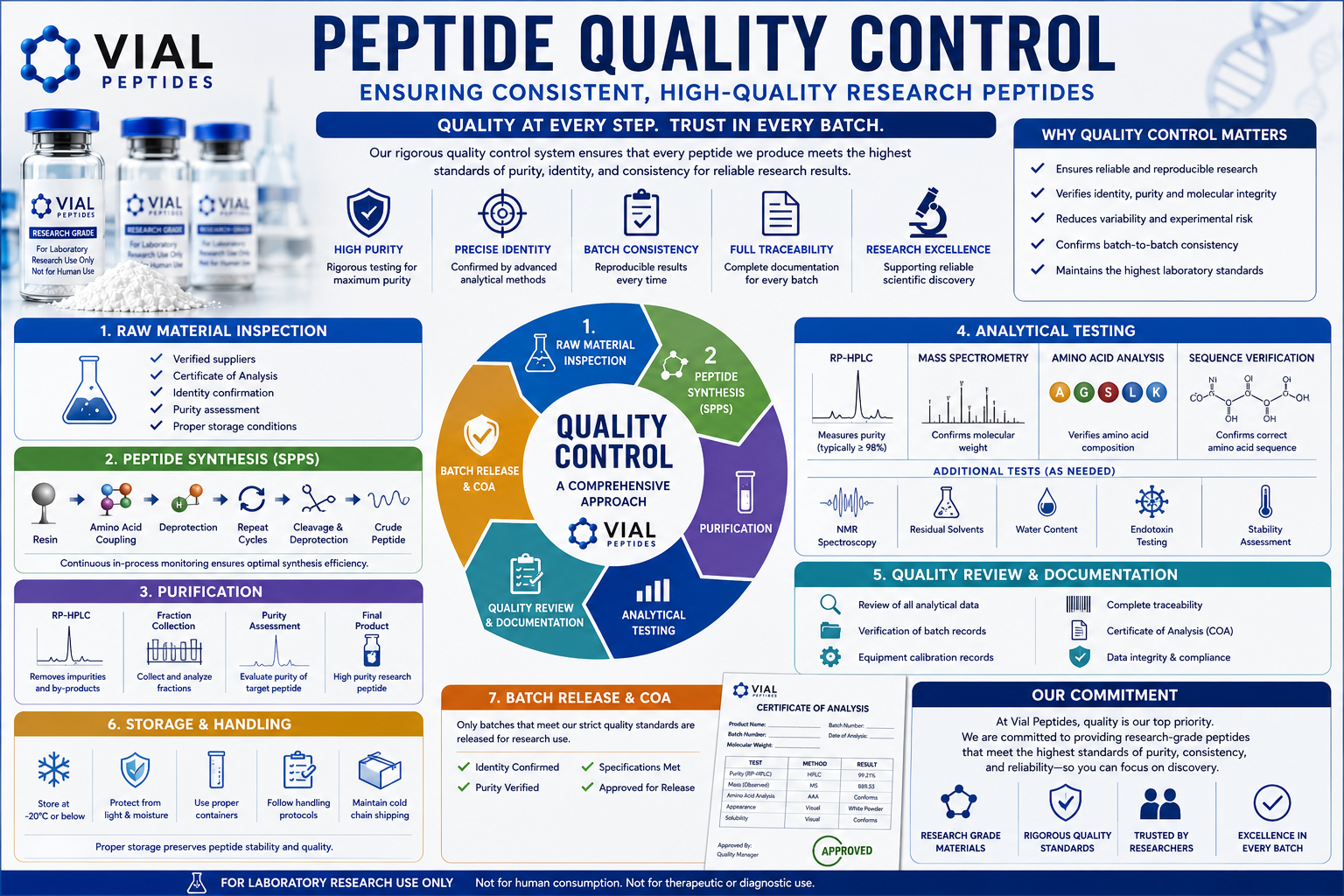
Understanding Peptide Quality Control is essential for anyone involved in peptide research or laboratory operations. Quality control is a structured system of procedures, inspections, analytical testing, and documentation designed to verify that research materials consistently meet established manufacturing and analytical standards. From raw material selection to final batch release, every stage contributes to the production of reliable research-grade peptides.
Modern peptide manufacturing depends on much more than successful synthesis. Laboratories also evaluate purity, molecular identity, sequence accuracy, stability, and batch consistency before materials are approved for scientific investigation. These quality-focused practices help reduce variability while supporting reproducible laboratory results across different research environments.
Advanced analytical technologies such as Reverse-Phase High-Performance Liquid Chromatography (RP-HPLC), Mass Spectrometry (MS), and Nuclear Magnetic Resonance (NMR) provide detailed information about molecular characteristics. Combined with standardized manufacturing procedures and comprehensive documentation, these techniques form the foundation of modern laboratory quality systems.
This guide explains Peptide Quality Control, the procedures used to evaluate research-grade peptides, the analytical methods that support quality assurance, and why standardized laboratory practices are essential for dependable scientific research.
What Is Quality Control?
Quality control is the systematic process of verifying that manufactured research materials meet predefined specifications before they are released for laboratory use.
Rather than relying on a single inspection, laboratories perform multiple evaluations throughout production.
Quality control helps researchers verify:
- Product identity
- Molecular purity
- Sequence accuracy
- Manufacturing consistency
- Batch reproducibility
- Documentation accuracy
These evaluations help ensure that research materials remain consistent from one production batch to the next.
Why Quality Control Is Important
Reliable laboratory investigations depend on well-characterized materials.
Consistent quality helps researchers:
- Improve experimental reproducibility
- Compare analytical results
- Reduce unnecessary variability
- Strengthen scientific confidence
- Support collaboration between laboratories
- Maintain accurate research documentation
Without standardized quality procedures, interpreting experimental findings becomes significantly more difficult.
Quality Begins Before Manufacturing
Effective quality control starts before synthesis begins.
Laboratories carefully evaluate incoming raw materials and production equipment to establish a reliable manufacturing foundation.
Early quality measures commonly include:
- Raw material verification
- Supplier documentation review
- Equipment calibration
- Environmental monitoring
- Process planning
- Standard operating procedures
These preliminary steps reduce variability throughout the manufacturing process.
Monitoring During Manufacturing
Quality is monitored continuously during peptide production rather than only after manufacturing is complete.
Researchers routinely observe:
- Reaction progress
- Coupling efficiency
- Deprotection cycles
- Process consistency
- Equipment performance
- Production documentation
Continuous monitoring allows laboratories to identify potential issues early while maintaining consistent production standards.
The Role of Analytical Testing
Analytical testing confirms that the finished material matches the intended molecular design.
Common analytical techniques include:
- Reverse-Phase High-Performance Liquid Chromatography (RP-HPLC)
- Mass Spectrometry (MS)
- Nuclear Magnetic Resonance (NMR)
- Amino Acid Analysis
- Sequence Verification
Each technique contributes unique information about molecular identity, purity, composition, and structural integrity.
Batch-to-Batch Consistency
One of the primary goals of laboratory quality systems is maintaining consistency between production batches.
Researchers compare:
- Purity measurements
- Molecular weight
- Chromatographic profiles
- Manufacturing records
- Stability observations
- Analytical documentation
Batch consistency improves confidence in scientific reproducibility while supporting long-term research programs.
Documentation and Traceability
Every production batch generates detailed laboratory records.
Typical documentation includes:
- Batch identification
- Manufacturing dates
- Analytical results
- Instrument records
- Quality reviews
- Storage information
Comprehensive documentation strengthens traceability while supporting laboratory quality management systems.
Key Takeaways
- Peptide Quality Control is a structured process that combines manufacturing oversight, analytical testing, and documentation.
- Quality begins before synthesis through raw material verification, equipment calibration, and standardized procedures.
- RP-HPLC, Mass Spectrometry, NMR, and sequence verification are key analytical techniques used to evaluate research materials.
- Continuous monitoring throughout manufacturing improves consistency and reduces variability.
- Detailed documentation and batch traceability support reliable laboratory research and scientific reproducibility.
Laboratory Testing, Process Validation, and Quality Management
Maintaining consistent research materials requires a comprehensive quality management system that extends throughout the entire manufacturing process. Laboratories do not depend on a single inspection or analytical result. Instead, they combine process monitoring, validated analytical methods, standardized documentation, and continuous quality reviews to ensure every production batch meets established specifications.
This systematic approach helps researchers obtain reliable materials that support reproducible laboratory investigations and long-term scientific studies.
Raw Material Inspection
Every production cycle begins with careful inspection of incoming raw materials.
Before manufacturing starts, laboratories verify that each material meets predefined quality specifications.
Typical evaluations include:
- Identity confirmation
- Supplier documentation review
- Purity assessment
- Storage condition verification
- Packaging inspection
- Batch identification
Starting with verified raw materials helps reduce variability throughout the manufacturing process.
Process Validation
Process validation demonstrates that manufacturing procedures consistently produce reliable results.
Rather than evaluating only the finished product, laboratories assess the performance of the entire production workflow.
Validation commonly includes:
- Equipment qualification
- Manufacturing consistency
- Reaction reproducibility
- Process documentation
- Performance verification
- Continuous monitoring
Validated processes provide greater confidence in long-term manufacturing reliability.
In-Process Quality Monitoring
Quality evaluation continues while manufacturing is underway.
Researchers routinely monitor:
- Coupling efficiency
- Reaction completion
- Process timing
- Environmental conditions
- Equipment performance
- Manufacturing records
Monitoring production in real time allows laboratories to identify potential issues before they influence the finished material.
Analytical Quality Assessment
Once manufacturing has been completed, researchers perform a series of analytical evaluations.
These procedures verify that the finished material matches predefined laboratory specifications.
Common analytical methods include:
- Reverse-Phase High-Performance Liquid Chromatography (RP-HPLC)
- Mass Spectrometry (MS)
- Nuclear Magnetic Resonance (NMR)
- Amino Acid Analysis
- Sequence Verification
Each method contributes unique information regarding molecular identity, purity, composition, and structural characteristics.
Instrument Calibration
Reliable analytical data depends on properly maintained laboratory equipment.
Calibration programs help ensure that analytical instruments continue operating within established performance limits.
Laboratories routinely calibrate:
- Chromatography systems
- Mass spectrometers
- Analytical balances
- Temperature monitoring equipment
- Pipettes
- Laboratory sensors
Routine calibration supports accurate measurements and consistent analytical performance.
System Suitability Testing
Before routine analysis begins, laboratories often perform system suitability testing.
These evaluations verify that analytical instruments are functioning correctly.
Researchers commonly assess:
- Detector performance
- Peak resolution
- Baseline stability
- Retention consistency
- Instrument precision
- Overall system performance
Successful system suitability testing provides confidence before production samples are analyzed.
Batch Release Procedures
Finished materials are not released immediately after manufacturing.
Instead, laboratories complete a structured review process before approving each batch.
Batch release typically includes:
- Analytical result review
- Documentation verification
- Quality approval
- Identity confirmation
- Purity assessment
- Batch record evaluation
Only after these procedures are completed is a production batch considered ready for laboratory distribution.
Certificates of Analysis (COAs)
A Certificate of Analysis (COA) provides a summary of important analytical information for each production batch.
A COA may include:
- Product identification
- Batch number
- Purity results
- Molecular weight
- Analytical methods used
- Quality review information
These documents improve transparency while providing researchers with valuable technical information.
Corrective and Preventive Actions
Quality management systems encourage continuous improvement.
When unexpected observations occur, laboratories investigate potential causes and implement appropriate corrective or preventive actions to strengthen future manufacturing processes.
Examples include:
- Procedure updates
- Equipment maintenance
- Additional staff training
- Documentation improvements
- Process optimization
Continuous improvement helps maintain consistently high laboratory standards.
Documentation and Data Integrity
Every quality-related activity is carefully documented.
Laboratories maintain records covering:
- Manufacturing procedures
- Analytical testing
- Calibration schedules
- Storage conditions
- Quality reviews
- Batch approvals
Complete documentation improves traceability while supporting reliable laboratory quality systems.
Why Comprehensive Quality Systems Matter
Quality control is most effective when every stage of production works together as part of one integrated system.
A comprehensive quality program helps:
- Improve consistency
- Strengthen reproducibility
- Reduce manufacturing variability
- Support reliable analytical results
- Increase confidence in research materials
- Maintain long-term laboratory standards
Integrated quality systems remain one of the defining characteristics of modern peptide manufacturing.
Key Takeaways
- Quality management begins with raw material verification and continues through manufacturing, testing, and final batch review.
- Process validation and in-process monitoring improve manufacturing consistency.
- RP-HPLC, Mass Spectrometry, NMR, and sequence verification remain core analytical methods.
- Instrument calibration and system suitability testing help maintain reliable analytical performance.
- Certificates of Analysis and comprehensive documentation strengthen transparency, traceability, and scientific reproducibility.
Future of Quality Control, Frequently Asked Questions, and Conclusion
Quality management continues to evolve as laboratories adopt more advanced analytical technologies, digital monitoring systems, and automated manufacturing processes. These innovations improve manufacturing consistency while helping researchers generate highly reliable analytical data.
Modern quality systems combine chemistry, biotechnology, analytical science, and digital documentation into one integrated framework that supports reproducible laboratory investigations and continuous process improvement.
As peptide science continues to advance, quality assurance will remain one of the most important foundations of dependable research.
Emerging Technologies in Laboratory Quality Management
Advances in laboratory technology continue to improve quality control procedures.
Researchers are developing more efficient systems that strengthen analytical accuracy while simplifying laboratory workflows.
Several innovations are shaping the future of quality management.
Artificial Intelligence for Quality Analysis
Artificial intelligence is increasingly supporting laboratory quality programs.
Scientists use AI-assisted software to:
- Analyze chromatographic data.
- Detect unusual analytical patterns.
- Compare production batches.
- Improve trend analysis.
- Support quality monitoring.
- Reduce manual data review.
These systems help laboratories process large volumes of analytical information more efficiently.
Digital Laboratory Management Systems
Many laboratories now manage manufacturing and analytical information electronically.
Digital quality systems improve:
- Batch traceability
- Documentation control
- Instrument records
- Quality review workflows
- Sample tracking
- Long-term data storage
Electronic records strengthen data integrity while improving operational efficiency.
Smarter Analytical Instrumentation
Modern analytical instruments continue to provide higher sensitivity and greater precision.
Laboratories benefit from:
- Improved chromatographic resolution
- Faster analytical testing
- Enhanced impurity detection
- Greater measurement accuracy
- Better instrument reliability
These advances allow researchers to characterize production batches with increasing confidence.
Continuous Improvement Programs
Quality systems are designed to improve over time.
Laboratories routinely review manufacturing data to identify opportunities for:
- Process optimization
- Equipment upgrades
- Staff development
- Documentation improvements
- Workflow efficiency
Continuous improvement strengthens manufacturing consistency while supporting scientific excellence.
Frequently Asked Questions
What is peptide quality control?
Peptide quality control is the systematic evaluation of research materials throughout manufacturing, purification, analytical testing, and final batch review to verify that established laboratory standards have been met.
Why is quality control important?
Quality control improves manufacturing consistency, supports reproducible research, reduces variability, and increases confidence in analytical results.
Which analytical methods are commonly used?
Laboratories frequently use:
- Reverse-Phase High-Performance Liquid Chromatography (RP–HPLC)
- Mass Spectrometry (MS)
- Nuclear Magnetic Resonance (NMR)
- Amino Acid Analysis
- Sequence Verification
Each method contributes different information about molecular quality and composition.
What is a Certificate of Analysis?
A Certificate of Analysis (COA) is a laboratory document that summarizes important batch-specific analytical information such as product identification, purity, molecular weight, analytical methods, and quality review data.
Why is batch consistency important?
Consistent manufacturing allows researchers to compare experimental results across multiple production batches while improving scientific reproducibility.
How do laboratories maintain reliable analytical results?
Laboratories maintain quality through equipment calibration, validated analytical methods, standardized procedures, documentation, system suitability testing, and continuous quality monitoring.
How is quality control expected to evolve?
Future developments are expected to include greater automation, artificial intelligence, improved analytical technologies, enhanced digital documentation, and more sophisticated quality management systems.
Conclusion
Peptide Quality Control is a fundamental part of modern peptide manufacturing and laboratory research. From raw material verification and process validation to purification, analytical characterization, and batch release, every stage contributes to producing research materials that meet rigorous laboratory standards.
Today’s laboratories combine established manufacturing practices with advanced analytical technologies such as Reverse-Phase High-Performance Liquid Chromatography (RP-HPLC), Mass Spectrometry (MS), and Nuclear Magnetic Resonance (NMR) to evaluate molecular identity, purity, and structural integrity. Together with comprehensive documentation, traceability, and continuous monitoring, these systems help ensure consistency across production batches.
As laboratory science advances, improvements in automation, artificial intelligence, digital quality management, and analytical instrumentation will continue strengthening quality systems. These innovations will support more efficient manufacturing, greater reproducibility, and higher confidence in scientific research across biotechnology, molecular biology, analytical chemistry, and peptide science.
Key Takeaways
- Peptide Quality Control combines manufacturing oversight, analytical testing, documentation, and quality management into one integrated system.
- Quality begins before production and continues through final batch approval.
- RP-HPLC, Mass Spectrometry, NMR, and sequence verification remain core analytical techniques.
- Certificates of Analysis, traceability, and documentation strengthen laboratory transparency and reproducibility.
- Future advances in automation, artificial intelligence, and digital quality systems will continue improving peptide manufacturing and laboratory quality assurance.
Internal Linking Suggestions for Vial Peptides
Use this page to link naturally to:
Cornerstone educational articles
- What Are Peptides
- Amino Acids and Peptides
- Peptide Bonds Explained
- Peptide Chemistry Basics
- How Peptides Are Synthesized
- Peptide Manufacturing Process
- Peptide Purity Explained
- HPLC Testing for Research Peptides
- Peptide Stability and Storage
- Research Peptides Guide
- Bioactive Peptides
- Cell Signaling and Peptides
Commercial product pages
Include contextual links to products such as:
- BPC-157
- TB-500
- CJC-1295
- Ipamorelin
- GHK-Cu
- Tesamorelin
- GHRP-2
- GHRP-6
- Hexarelin
- Semax
- Selank
- MOTS-c
- Epitalon
- AOD-9604
- IGF-1 LR3
- LL-37
- KPV
- Melanotan II
- AICAR
- DSIP
Future of Quality Control, Frequently Asked Questions, and Conclusion
Quality management continues to evolve as laboratories adopt more advanced analytical technologies, automated manufacturing systems, and digital quality management platforms. These innovations improve manufacturing consistency while helping researchers generate highly reliable analytical data that supports reproducible scientific investigations.
Modern quality systems combine chemistry, biotechnology, analytical science, and standardized documentation into a unified framework. As peptide science continues to advance, quality assurance will remain one of the foundations of dependable laboratory research.
Future Trends in Peptide Quality Management
Laboratories continue investing in new technologies that improve analytical precision and manufacturing efficiency.
Several innovations are shaping the future of quality assurance.
Artificial Intelligence in Quality Review
Artificial intelligence is increasingly assisting scientists with quality analysis and data interpretation.
Researchers use AI-supported software to:
- Analyze chromatographic results
- Detect unusual analytical patterns
- Compare historical production batches
- Improve trend analysis
- Support quality monitoring
- Reduce manual review time
These tools help laboratories process complex analytical information more efficiently while supporting informed decision-making.
Advanced Digital Quality Systems
Electronic laboratory management systems are replacing many paper-based workflows.
Digital platforms improve:
- Batch traceability
- Document management
- Sample tracking
- Instrument maintenance records
- Audit readiness
- Long-term data storage
Improved digital organization strengthens transparency and laboratory efficiency.
Next-Generation Analytical Instruments
Modern analytical instruments continue to deliver greater sensitivity and accuracy.
Researchers benefit from:
- Higher chromatographic resolution
- Improved impurity detection
- Faster analytical workflows
- Greater measurement precision
- Enhanced reproducibility
These improvements allow laboratories to characterize research materials with increasing confidence.
Continuous Process Improvement
Strong quality programs are never static.
Laboratories regularly review manufacturing and analytical data to identify opportunities for:
- Process optimization
- Equipment upgrades
- Staff training
- Workflow improvements
- Documentation refinement
- Enhanced operational efficiency
Continuous improvement helps maintain consistently high laboratory standards.
Frequently Asked Questions
What is peptide quality control?
Peptide quality control is the structured process of evaluating research materials during manufacturing, purification, analytical testing, and final review to ensure they meet established laboratory specifications.
Why is quality control essential?
Quality control helps improve manufacturing consistency, supports reproducible scientific research, reduces unnecessary variability, and strengthens confidence in laboratory findings.
Which analytical methods are commonly used?
Researchers frequently use:
- Reverse-Phase High-Performance Liquid Chromatography (RP-HPLC)
- Mass Spectrometry (MS)
- Nuclear Magnetic Resonance (NMR)
- Amino Acid Analysis
- Sequence Verification
Each method provides valuable information about molecular identity, purity, composition, or structural characteristics.
What is a Certificate of Analysis?
A Certificate of Analysis (COA) summarizes important batch-specific information such as product identity, purity results, molecular weight, analytical methods, and quality review details.
Why is batch consistency important?
Consistent production allows researchers to compare results across different manufacturing batches, improving reproducibility and supporting long-term scientific investigations.
How do laboratories maintain reliable quality?
Laboratories combine validated manufacturing procedures, calibrated equipment, analytical testing, standardized documentation, and continuous quality monitoring to maintain dependable quality systems.
How will quality control evolve in the future?
Future developments are expected to include expanded automation, artificial intelligence, more advanced analytical technologies, enhanced digital quality management, and increasingly efficient manufacturing systems.
Conclusion
Peptide Quality Control is a critical component of modern peptide manufacturing and scientific research. From verifying raw materials and monitoring synthesis to purification, analytical characterization, and final batch approval, every stage contributes to producing well-characterized research materials.
Modern laboratories rely on complementary analytical technologies such as Reverse-Phase High-Performance Liquid Chromatography (RP-HPLC), Mass Spectrometry (MS), and Nuclear Magnetic Resonance (NMR) to evaluate molecular identity, purity, and structural integrity. Together with comprehensive documentation, traceability, and standardized laboratory procedures, these systems help support consistent research outcomes.
As peptide science advances, innovations in automation, digital quality management, computational analysis, and analytical instrumentation will continue improving laboratory efficiency and manufacturing precision. These developments will strengthen scientific reproducibility while supporting ongoing progress across biotechnology, molecular biology, analytical chemistry, and peptide research.
Key Takeaways
- Quality management covers every stage from raw material verification to final batch release.
- Standardized manufacturing and analytical testing improve consistency and reproducibility.
- RP-HPLC, Mass Spectrometry, NMR, and sequence verification remain core laboratory quality tools.
- Documentation, traceability, and Certificates of Analysis strengthen transparency and confidence.
- Future advances in automation, artificial intelligence, and digital laboratory systems will continue improving research peptide quality management.