Cell Signaling and Peptides: Understanding Molecular Communication
Cell Signaling and Peptides are closely connected because many peptide molecules function as highly specific messengers that allow cells to exchange information. Every second, billions of cells communicate with one another to coordinate growth, development, metabolism, immune activity, and numerous other biological processes. Without this constant exchange of molecular information, complex living organisms could not maintain normal biological organization.
Researchers study Cell Signaling and Peptides to better understand how cells recognize external signals, respond to changing environments, and coordinate intracellular activities. These investigations have become an essential part of molecular biology, biotechnology, peptide chemistry, and life science research.
Modern laboratories use advanced analytical technologies to investigate signaling pathways, receptor interactions, amino acid sequences, and molecular recognition. These studies continue to improve scientific understanding of cellular communication while expanding knowledge of peptide biology.
In this comprehensive guide, we explore how peptide molecules participate in cellular signaling, the different types of signaling pathways, and why this field remains one of the most important areas of peptide research.
Why Cell Signaling Is Important
Every living cell must constantly receive, interpret, and respond to information from its surroundings.
Communication between cells helps regulate numerous biological activities, including:
- Cellular growth
- Cell differentiation
- Gene expression
- Molecular transport
- Protein synthesis
- Immune system coordination
- Tissue organization
- Cellular adaptation
Accurate signaling ensures that cells function together as organized biological systems rather than as isolated units.
What Is Cell Signaling?
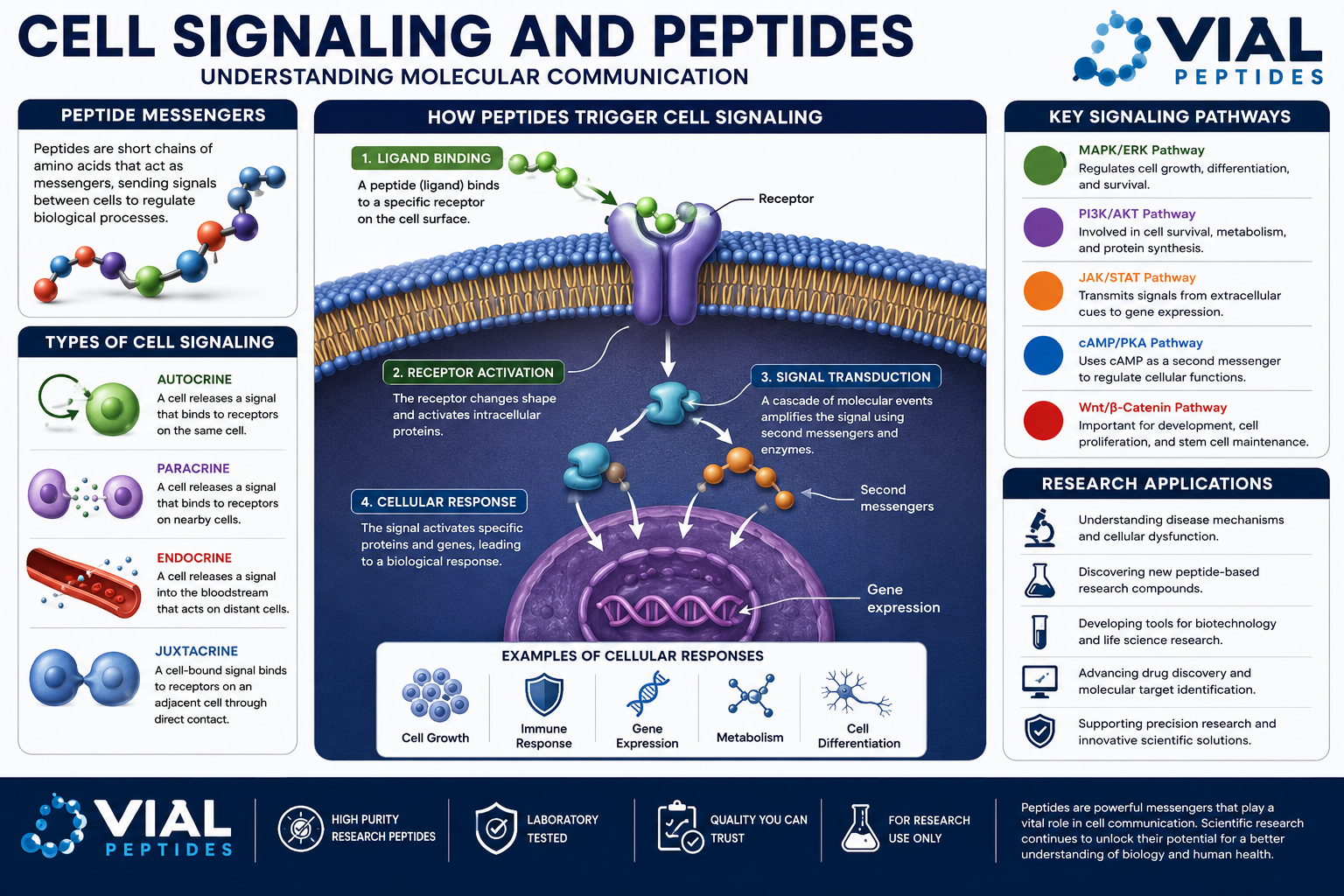
Cell signaling is the process by which one cell communicates with another using specialized signaling molecules.
These signaling molecules bind to specific receptors located on the surface of a target cell or, in some cases, within the cell itself.
Once binding occurs, a series of molecular events known as a signaling pathway begins.
This pathway ultimately produces a specific cellular response.
Although many different molecules participate in signaling, peptide messengers are among the most extensively studied because of their specificity and efficiency.
Components of a Cell Signaling Pathway
Most signaling pathways contain several common components.
These include:
- A signaling molecule
- A receptor
- Signal recognition
- Intracellular messenger molecules
- Protein activation
- Cellular response
Each component contributes to accurate communication between cells.
Even small changes in one part of the pathway may influence how a signal is transmitted throughout the cell.
How Peptides Participate in Cellular Communication
Many peptide molecules function as signaling messengers.
Researchers investigate how these molecules:
- Bind to receptors
- Activate signaling pathways
- Trigger molecular responses
- Coordinate communication between tissues
- Regulate biological processes
- Influence protein interactions
Because peptide molecules are highly specific, they often interact with only particular receptors, allowing scientists to investigate precise molecular mechanisms.
Cell Surface Receptors
For signaling to occur, a signaling molecule must first recognize its target receptor.
Most peptide messengers bind to receptors located on the outer surface of cells.
These receptors act as molecular sensors.
After recognizing the appropriate signaling molecule, the receptor changes shape and initiates intracellular communication.
This process converts an external molecular signal into an internal biological response.
Signal Transduction
Signal transduction describes the series of molecular events that occurs after receptor activation.
Rather than producing an immediate response, receptor activation usually initiates a cascade of intracellular reactions.
These reactions may involve:
- Protein phosphorylation
- Enzyme activation
- Second messenger molecules
- Gene regulation
- Protein interactions
Researchers continue to investigate these pathways to better understand cellular communication and molecular regulation.
Types of Cell Signaling
Scientists classify cellular communication into several major categories.
The most common include:
Autocrine Signaling
Cells communicate with themselves by releasing signaling molecules that bind to receptors on the same cell.
Paracrine Signaling
Signals act over short distances between neighboring cells.
Endocrine Signaling
Signaling molecules travel through the circulatory system before reaching distant target cells.
Juxtacrine Signaling
Communication occurs through direct physical contact between adjacent cells.
Each signaling mechanism contributes to the remarkable coordination observed in complex biological systems.
Why Researchers Study Cellular Communication
Understanding molecular communication provides valuable insight into biological organization.
Researchers investigate signaling pathways to better understand:
- Molecular recognition
- Receptor specificity
- Protein interactions
- Cellular adaptation
- Biological regulation
- Biochemical pathways
Advances in peptide chemistry, analytical biology, and computational modeling continue to improve the study of these complex systems.
Key Takeaways
- Cell Signaling and Peptides are closely linked because peptide molecules often serve as highly specific signaling messengers.
- Cell signaling allows cells to exchange information and coordinate biological activities.
- Signaling pathways involve receptors, intracellular messengers, enzymes, and regulated cellular responses.
- Autocrine, paracrine, endocrine, and juxtacrine signaling represent the major forms of cellular communication.
- Modern research combines peptide chemistry, molecular biology, and biotechnology to investigate signaling mechanisms.
Receptors, Signal Transduction, Laboratory Research, and Scientific Applications
Understanding cellular communication requires more than identifying signaling molecules. Researchers also investigate how receptors recognize these molecules, how information is transmitted inside cells, and how different signaling pathways coordinate biological responses. These molecular events form the foundation of many areas of modern biotechnology and life science research.
By combining peptide chemistry, molecular biology, structural biology, and advanced analytical technologies, scientists continue to uncover new details about communication networks that regulate cellular activity.
Peptide Receptors
Every signaling event begins when a messenger molecule encounters the correct receptor.
A receptor is a specialized protein capable of recognizing a particular molecular structure. Because receptors are highly selective, they usually interact with only a limited number of signaling molecules.
Researchers study receptor biology to better understand:
- Molecular recognition
- Binding specificity
- Structural compatibility
- Signal activation
- Protein interactions
- Cellular communication
The relationship between a signaling molecule and its receptor resembles a highly selective recognition system, where structural compatibility determines whether communication occurs successfully.
Types of Cellular Receptors
Scientists classify receptors according to their location and mechanism of action.
The major receptor categories include:
Cell Surface Receptors
These receptors are located within the plasma membrane and detect signaling molecules outside the cell.
After binding occurs, intracellular communication begins through a series of molecular events.
Intracellular Receptors
Some signaling molecules enter the cell and interact with receptors found within the cytoplasm or nucleus.
These receptors often influence gene expression and other intracellular regulatory processes.
Enzyme-Linked Receptors
Certain receptors possess enzymatic activity or become associated with enzymes after activation.
These receptors participate in complex signaling networks that regulate many cellular functions.
G Protein-Coupled Receptors (GPCRs)
GPCRs represent one of the largest receptor families in biology.
Researchers continue studying these receptors because they participate in numerous signaling pathways and demonstrate remarkable structural diversity.
Signal Transduction Pathways
Once receptor binding occurs, the original signal must be transmitted throughout the cell.
This process is known as signal transduction.
Rather than relying on a single reaction, cells often use a sequence of molecular events that amplify and regulate the incoming signal.
Common components include:
- Protein kinases
- Phosphatases
- Adapter proteins
- Second messenger molecules
- Regulatory enzymes
- Transcription factors
These signaling networks allow cells to generate highly coordinated responses while maintaining precise control over biological activity.
Signal Amplification
One remarkable feature of cellular communication is signal amplification.
A single receptor activation event can initiate a cascade that influences many downstream molecules.
Researchers investigate amplification because it allows relatively small molecular signals to produce measurable biological responses.
Amplification also improves communication efficiency within complex biological systems.
Signal Termination
Communication must eventually stop.
Without proper regulation, signaling pathways could remain active longer than intended.
Cells use several mechanisms to terminate signaling, including:
- Receptor internalization
- Enzyme-mediated deactivation
- Messenger degradation
- Protein dephosphorylation
- Molecular recycling
These regulatory processes help maintain balanced cellular function.
Laboratory Investigation of Cellular Communication
Modern laboratories use numerous experimental techniques to investigate molecular communication.
Researchers commonly examine:
- Receptor binding
- Protein interactions
- Molecular structure
- Amino acid sequences
- Intracellular signaling pathways
- Gene regulation
Each experimental approach provides valuable information about biological organization and molecular function.
Analytical Technologies
Several analytical techniques support modern laboratory investigations.
Common methods include:
- High-Performance Liquid Chromatography (HPLC)
- Mass Spectrometry (MS)
- Nuclear Magnetic Resonance (NMR)
- Fluorescence microscopy
- Flow cytometry
- Confocal microscopy
- Protein crystallography
These technologies allow scientists to observe molecular interactions with increasing precision.
Computational Biology
Computational biology has become an important part of modern peptide research.
Scientists use computer models to:
- Predict molecular structures
- Analyze receptor interactions
- Simulate signaling pathways
- Compare amino acid sequences
- Visualize molecular dynamics
These computational tools complement laboratory experiments while improving research efficiency.
Biotechnology Applications
Knowledge gained from cellular communication research contributes to many scientific disciplines.
Current research areas include:
- Molecular biology
- Structural biology
- Biochemistry
- Biotechnology
- Cell biology
- Protein chemistry
- Synthetic biology
- Biomolecular engineering
Continued advances in these fields improve scientific understanding while expanding research capabilities.
Importance of Experimental Reproducibility
Reliable scientific research depends on reproducibility.
Laboratories improve consistency through:
- Standardized experimental protocols
- Verified analytical methods
- Careful documentation
- Instrument calibration
- Quality control procedures
- Independent validation
These practices help ensure that experimental observations remain accurate and repeatable.
Key Takeaways
- Cellular receptors recognize specific signaling molecules through highly selective molecular interactions.
- Signal transduction converts receptor activation into coordinated intracellular responses.
- Signal amplification allows a single molecular event to influence multiple downstream processes.
- Regulatory mechanisms terminate signaling and maintain cellular balance.
- Modern laboratories combine analytical chemistry, molecular biology, microscopy, and computational modeling to investigate communication pathways.
- Standardized laboratory methods support reliable and reproducible scientific research.
Future Research, Frequently Asked Questions, and Conclusion
Scientific understanding of cellular communication continues to grow as researchers develop more sophisticated analytical tools, computational models, and laboratory techniques. Modern investigations now examine communication networks at extraordinary levels of detail, allowing scientists to observe how individual molecules interact, how biological information is transmitted, and how complex regulatory systems maintain cellular organization.
Continued innovation in biotechnology, structural biology, and analytical chemistry is expanding knowledge while Cell Signaling and Peptides