
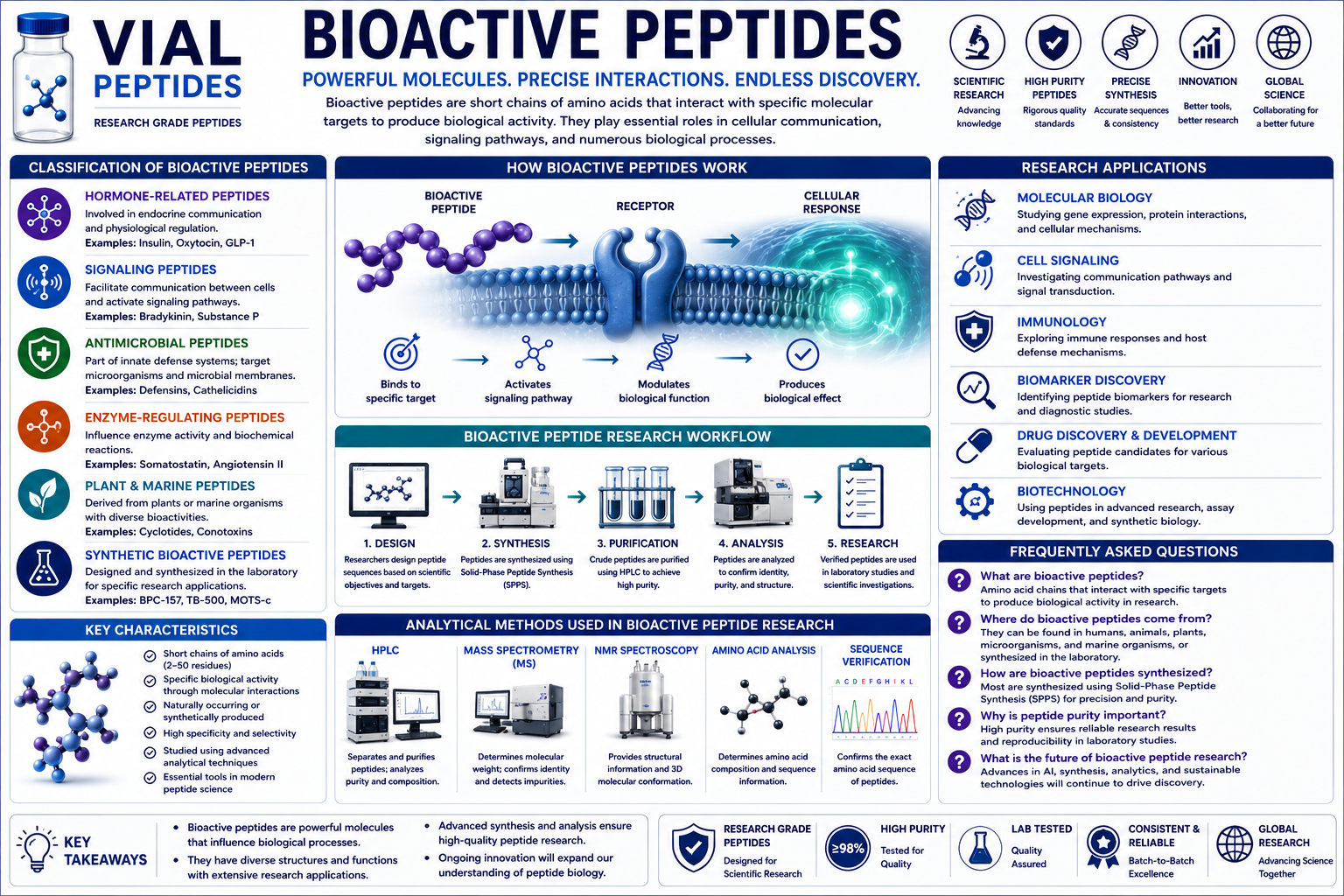
Bioactive Peptides – Understanding Their Structure, Function, and Scientific Importance
Bioactive Peptides: Understanding Their Role in Modern Peptide Research
Bioactive Peptides are among the most extensively studied molecules in modern peptide science. These short chains of amino acids influence a wide range of biological processes by interacting with receptors, enzymes, ion channels, and other molecular targets. Because of their highly specific biological activities, Bioactive have become an important focus of research in molecular biology, biotechnology, analytical chemistry, and life science.
Unlike larger proteins, Bioactive Pept are relatively small molecules that often contain between two and fifty amino acids. Their compact size allows researchers to investigate their structures, molecular interactions, and biological properties with exceptional precision. Scientists continue to study naturally occurring and synthetic Bioactive Peps to better understand how these molecules participate in cellular communication and biological regulation.
As advances in peptide chemistry continue, Bioactive Peptides remain at the center of scientific innovation. Improved synthesis methods, analytical technologies, and computational tools allow researchers to investigate peptide behavior in greater detail than ever before.
This comprehensive guide explains what Bioactive Peptides are, how they function, how researchers study them, and why they continue to play a significant role in peptide science.
What Are Bioactive Peptides?
Bioactive Peptides are amino acid chains that produce measurable biological activity through specific interactions with molecular targets.
These peptides may occur naturally within living organisms or be synthesized in laboratories for scientific investigation.
Researchers study Bioactive Peptides because they can interact with:
- Cell surface receptors
- Enzymes
- Transport proteins
- Ion channels
- Cellular signaling pathways
- Protein complexes
These interactions help scientists better understand fundamental biological processes.
Unlike structural proteins, Bioactive Peptides often function as molecular messengers, allowing cells and tissues to communicate efficiently.
Why Bioactive Peptides Are Important
Understanding Bioactive Peptides helps researchers investigate complex biological systems.
Their importance extends across numerous scientific disciplines.
Researchers use Bioactive Peptides to study:
- Cell signaling
- Molecular recognition
- Protein interactions
- Enzyme regulation
- Immune system biology
- Hormonal communication
- Biochemical pathways
Because these peptides participate in many biological processes, they remain valuable tools for laboratory research.
Natural Sources of Bioactive Peptides
Many Bioactive Peptides occur naturally in living organisms.
Scientists have identified naturally occurring peptides in:
- Humans
- Mammals
- Fish
- Plants
- Microorganisms
- Marine organisms
- Insects
Natural Bioactive Peptides are often produced through normal cellular processes or generated when larger proteins are broken down by enzymes.
Researchers continue to discover new peptide sequences in diverse biological sources.
Synthetic Bioactive Peptides
Not all Bioactive Peptides occur naturally.
Scientists can manufacture synthetic peptides using Solid-Phase Peptide Synthesis (SPPS).
Synthetic production offers several important advantages:
- Precise amino acid sequences
- Excellent reproducibility
- High purity
- Controlled chemical modifications
- Reliable laboratory quality
Because synthetic peptides can closely replicate naturally occurring sequences or be specifically designed for research, they have become essential tools in modern peptide science.
Structure of Bioactive Peptides
Understanding molecular structure is a key component of studying Bioactive Peptides.
Every peptide consists of amino acids connected by peptide bonds.
Several structural characteristics influence biological activity, including:
- Amino acid sequence
- Chain length
- Molecular charge
- Hydrophobicity
- Three-dimensional conformation
- Chemical modifications
Even a single amino acid substitution may alter how a peptide interacts with biological targets.
This is why sequence accuracy is critical in peptide research.
How Bioactive Peptides Work
The biological activity of Bioactive Peptides depends on their ability to recognize and interact with specific molecular targets.
Researchers investigate how peptides:
- Bind to receptors.
- Influence enzyme activity.
- Participate in signaling pathways.
- Regulate molecular interactions.
- Communicate between cells.
- Affect protein behavior.
These molecular interactions help scientists understand complex biological systems without necessarily implying clinical effects.
Laboratory Investigation of Bioactive Peptides
Modern laboratories use advanced technologies to study Bioactive Peptides.
Researchers commonly investigate:
- Amino acid sequences
- Molecular stability
- Structural conformation
- Peptide purity
- Biological interactions
- Chemical properties
These investigations provide valuable information for peptide chemistry and biotechnology research.
Analytical Methods Used to Study Bioactive Peptides
Several analytical techniques are commonly used in Bioactive Peptides research.
These include:
- High-Performance Liquid Chromatography (HPLC)
- Mass Spectrometry (MS)
- Nuclear Magnetic Resonance (NMR)
- Amino Acid Analysis
- Sequence Verification
- Capillary Electrophoresis
Each method provides unique information about peptide identity, purity, molecular weight, or structural characteristics.
Why Bioactive Peptides Continue to Interest Researchers
Interest in Bioactive Peptides continues to grow because these molecules offer exceptional opportunities for scientific investigation.
Researchers value them because they are:
- Structurally diverse
- Highly specific
- Relatively easy to synthesize
- Compatible with advanced analytical methods
- Useful in many research disciplines
- Adaptable to numerous laboratory applications
As new peptide sequences continue to be discovered, the scientific understanding of Bioactive Peptides continues to expand.
Key Characteristics of Bioactive Peptides
Researchers often describe Bioactive Peptides using several defining characteristics.
These peptides are generally:
- Composed of short amino acid chains
- Formed through peptide bonds
- Naturally occurring or synthetically produced
- Biologically active at the molecular level
- Studied using advanced laboratory techniques
- Important tools in peptide science and biotechnology
These characteristics distinguish Bioactive Peptides from many larger proteins while highlighting their significance in research.
Key Takeaways
- Bioactive Peptides are short amino acid chains that interact with specific molecular targets.
- They may occur naturally or be synthesized using laboratory techniques such as Solid-Phase Peptide Synthesis (SPPS).
- Researchers investigate Bioactive Peptides to understand cell signaling, protein interactions, enzyme regulation, and molecular biology.
- Modern analytical methods such as HPLC, Mass Spectrometry, and NMR help characterize peptide identity, purity, and structure.
- Continued advances in peptide chemistry and biotechnology are expanding scientific knowledge of Bioactive Peptides.
Bioactive Peptides – Classification, Mechanisms, Research Applications, and Laboratory Analysis
Understanding Bioactive Peptides requires more than knowing their basic structure. Researchers also classify these peptides according to their biological activities, investigate how they interact with molecular targets, and use advanced laboratory techniques to analyze their properties. As a result, Bioactive Peptides have become one of the most important subjects in peptide chemistry and biotechnology.
This section explores the major classes of Bioactive Peptides, their mechanisms of action in biological systems, and the analytical methods used to study them.
Classification of Bioactive Peptides
Scientists classify Bioactive Peptides using several different criteria. Although every peptide consists of amino acids joined by peptide bonds, their biological activities vary significantly.
Researchers commonly classify Bioactive Peptides according to:
- Biological function
- Molecular structure
- Amino acid sequence
- Natural or synthetic origin
- Cellular target
- Research application
Because of their diversity, one peptide may belong to more than one category.
Hormone-Related Bioactive Peptides
Hormone-related Bioactive Peptides are naturally produced by living organisms and participate in cellular communication.
Researchers study these peptides to understand:
- Molecular signaling
- Receptor interactions
- Endocrine communication
- Cellular regulation
- Biological feedback systems
These investigations improve our understanding of how biological systems coordinate complex processes.
Signaling Bioactive Peptides
Signaling Bioactive Peptides allow cells to exchange information.
Scientists investigate how these peptides:
- Bind to cell receptors
- Activate intracellular signaling pathways
- Regulate communication between tissues
- Coordinate biological responses
- Influence molecular interactions
Understanding these mechanisms contributes to advances in molecular biology and biochemistry.
Antimicrobial Bioactive Peptides
Antimicrobial Bioactive Peptides are produced naturally by many organisms as part of their innate biological defense systems.
Researchers investigate these peptides to study:
- Membrane interactions
- Molecular recognition
- Peptide evolution
- Host defense mechanisms
- Structural diversity
These studies help scientists understand the remarkable diversity of naturally occurring peptides.
Enzyme-Regulating Bioactive Peptides
Certain Bioactive Peptides interact with enzymes and influence biochemical reactions.
Researchers investigate enzyme-regulating peptides to better understand:
- Enzyme recognition
- Catalytic mechanisms
- Molecular specificity
- Protein interactions
- Biochemical regulation
Studying these interactions expands knowledge of molecular biology and peptide chemistry.
How Bioactive Peptides Interact with Cells
One reason Bioactive Peptides attract significant scientific interest is their ability to interact with highly specific molecular targets.
Researchers study how peptides:
- Recognize receptors
- Bind to proteins
- Influence enzymes
- Participate in signaling pathways
- Interact with cell membranes
These molecular interactions are highly selective, allowing scientists to investigate biological systems with exceptional precision.
Peptide Synthesis for Bioactive Peptide Research
Many Bioactive Peptides used in research are manufactured synthetically.
The most common production method is Solid-Phase Peptide Synthesis (SPPS).
SPPS provides several important advantages:
- Accurate amino acid sequences
- High reproducibility
- Excellent purity
- Flexible peptide design
- Efficient production
These benefits make SPPS the preferred technique for producing research-grade peptides.
Laboratory Analysis of Bioactive Peptides
Following synthesis, researchers carefully analyze Bioactive Peptides before they are used in laboratory studies.
Analytical testing helps confirm:
- Sequence accuracy
- Molecular identity
- Chemical purity
- Structural integrity
- Amino acid composition
Reliable analysis improves research quality and reproducibility.
High-Performance Liquid Chromatography (HPLC)
High-Performance Liquid Chromatography (HPLC) is one of the most important analytical methods used in Bioactive Peptides research.
Scientists use HPLC to:
- Separate peptide molecules
- Measure purity
- Remove impurities
- Evaluate synthesis quality
- Support quality assurance
High-purity peptides help produce more reliable laboratory results.
Mass Spectrometry (MS)
Mass Spectrometry allows researchers to determine the molecular weight and identity of Bioactive Peptides.
Scientists use MS to:
- Confirm molecular identity
- Detect impurities
- Verify peptide mass
- Support sequence confirmation
- Characterize synthesized peptides
When combined with HPLC, Mass Spectrometry provides comprehensive analytical information.
Nuclear Magnetic Resonance (NMR)
Researchers use Nuclear Magnetic Resonance (NMR) spectroscopy to investigate peptide structure.
NMR provides information about:
- Three-dimensional conformation
- Atomic interactions
- Molecular flexibility
- Structural stability
- Chemical environments
These data help researchers understand how peptide structure influences molecular interactions.
Quality Control in Bioactive Peptide Research
Quality control is a critical part of studying Bioactive Peptides.
Modern laboratories perform rigorous testing before peptides are used in research.
Common quality control procedures include:
- Sequence verification
- Purity assessment
- Identity confirmation
- Molecular weight analysis
- Stability evaluation
- Amino acid composition analysis
These procedures help ensure reproducible and reliable scientific results.
Research Applications of Bioactive Peptides
Researchers use Bioactive Peptides across many scientific disciplines.
Common areas of investigation include:
- Molecular biology
- Biotechnology
- Structural biology
- Cell signaling
- Protein chemistry
- Immunology
- Biomarker discovery
- Analytical chemistry
- Synthetic biology
These applications demonstrate the broad scientific value of Bioactive Peptides.
Key Takeaways
- Bioactive Peptides are classified according to biological function, structure, origin, molecular targets, and research applications.
- Researchers investigate hormone-related, signaling, antimicrobial, and enzyme-regulating peptides to better understand biological systems.
- Synthetic Bioactive Peptides are commonly produced using Solid-Phase Peptide Synthesis (SPPS).
- HPLC, Mass Spectrometry, and NMR are essential analytical techniques for peptide characterization.
- Quality control procedures help ensure reliable, reproducible, and high-quality peptide research.
Bioactive Peptides – Future Research, Frequently Asked Questions, and Conclusion
The study of Bioactive Peptides continues to expand as scientists develop improved synthesis methods, advanced analytical technologies, and computational tools for peptide discovery. Researchers investigate these molecules to better understand their structures, molecular interactions, and roles in biological systems. As peptide science advances, Bioactive Peptides remain a major focus of biotechnology, molecular biology, and analytical chemistry.
This final section explores future directions in Bioactive Peptides research, answers common questions, and summarizes why these molecules are so important in modern scientific investigation.
Emerging Trends in Bioactive Peptides Research
The future of Bioactive Peptides research is driven by innovation. Scientists continue to improve laboratory techniques, expand peptide libraries, and develop new technologies that increase the speed and accuracy of peptide analysis.
Several important trends are shaping the next generation of peptide science.
Artificial Intelligence and Bioactive Peptides
Artificial intelligence (AI) is transforming how researchers investigate Bioactive Peptides.
Scientists use AI to:
- Predict peptide structures.
- Analyze amino acid sequences.
- Model peptide–protein interactions.
- Identify promising peptide candidates.
- Process complex biological datasets.
- Improve computational peptide design.
These tools help researchers analyze large amounts of information more efficiently while supporting new scientific discoveries.
Advanced Peptide Synthesis
Peptide synthesis technologies continue to evolve.
Modern automated synthesis platforms allow researchers to produce Bioactive Peptides with exceptional precision.
Benefits include:
- Greater sequence accuracy
- Improved reproducibility
- Faster synthesis
- Reduced production errors
- Better scalability
- More consistent research materials
These advances continue to improve laboratory efficiency.
Improved Analytical Technologies
Modern analytical instruments provide researchers with increasingly detailed information about Bioactive Peptides.
Common analytical techniques include:
- High-Performance Liquid Chromatography (HPLC)
- Mass Spectrometry (MS)
- Nuclear Magnetic Resonance (NMR)
- Amino Acid Analysis
- Sequence Verification
- Capillary Electrophoresis
These technologies help scientists verify peptide identity, purity, molecular weight, and structural characteristics before laboratory use.
Sustainable Peptide Manufacturing
Environmental sustainability is becoming increasingly important in peptide science.
Researchers are developing methods to:
- Reduce solvent consumption.
- Improve reaction efficiency.
- Minimize laboratory waste.
- Optimize manufacturing processes.
- Develop greener peptide synthesis technologies.
These efforts support responsible scientific research while maintaining high manufacturing standards.
Expanding Research Applications
As knowledge of Bioactive Peptides grows, researchers continue exploring new areas of scientific investigation.
Current research applications include:
- Molecular biology
- Structural biology
- Cell signaling
- Protein interaction studies
- Immunology
- Biomarker discovery
- Biotechnology
- Analytical chemistry
- Synthetic biology
- Laboratory assay development
These expanding research areas demonstrate the versatility of Bioactive Peptides.
Frequently Asked Questions About Bioactive Peptides
What are Bioactive Peptides?
Bioactive Peptides are short chains of amino acids that interact with specific molecular targets and exhibit measurable biological activity in research settings. Scientists study these peptides to better understand molecular biology and peptide chemistry.
Where do Bioactive Peptides come from?
Bioactive Peptides may occur naturally in humans, animals, plants, microorganisms, and marine organisms. They can also be produced synthetically using laboratory techniques such as Solid-Phase Peptide Synthesis (SPPS).
Why are Bioactive Peptides important?
Researchers investigate Bioactive Peptides because they contribute to understanding cell signaling, molecular recognition, protein interactions, enzyme regulation, and many other biological processes.
How are Bioactive Peptides produced?
Most synthetic Bioactive Peptides are manufactured using Solid-Phase Peptide Synthesis (SPPS), which allows scientists to assemble amino acids into precise sequences under controlled laboratory conditions.
How do researchers verify peptide quality?
Scientists commonly use:
- High-Performance Liquid Chromatography (HPLC)
- Mass Spectrometry (MS)
- Nuclear Magnetic Resonance (NMR)
- Amino Acid Analysis
- Sequence Verification
These techniques help confirm peptide identity, purity, molecular weight, and structural integrity.
Why is peptide purity important?
High peptide purity helps ensure that laboratory investigations are based on well-characterized materials, improving reproducibility and analytical reliability.
How is artificial intelligence used in Bioactive Peptides research?
Artificial intelligence assists researchers by predicting peptide structures, modeling molecular interactions, analyzing amino acid sequences, and processing complex biological data.
What is the future of Bioactive Peptides research?
The future of Bioactive Peptides research includes improved automation, AI-assisted molecular design, greener synthesis technologies, enhanced analytical methods, and expanded scientific collaboration.
The Importance of High-Quality Peptide Characterization in Scientific Research
Accurate peptide characterization is one of the most important steps in laboratory research. Before any experimental work begins, researchers verify that the material being studied matches the expected amino acid sequence, molecular weight, and purity specifications. Thorough characterization helps improve reproducibility, supports reliable data collection, and reduces the risk of unexpected experimental variation.
Modern laboratories use several complementary analytical techniques to evaluate peptide quality. High-Performance Liquid Chromatography (HPLC) is commonly used to assess purity by separating the target molecule from synthesis by-products and other impurities. Mass Spectrometry (MS) confirms molecular weight and helps verify molecular identity, while Nuclear Magnetic Resonance (NMR) spectroscopy provides valuable information about three-dimensional structure and molecular conformation. Together, these techniques allow scientists to build a detailed profile of each research material before it is introduced into laboratory studies.
Proper handling and storage are equally important for maintaining molecular integrity. Research materials are generally stored under carefully controlled conditions to minimize degradation caused by temperature fluctuations, moisture, oxygen exposure, or repeated freeze–thaw cycles. Laboratories also follow standardized procedures for transportation, documentation, and inventory management to preserve consistency throughout the research process.
Another critical aspect of peptide science is reproducibility. Scientific discoveries depend on experiments that can be repeated under the same conditions with comparable outcomes. Standardized manufacturing procedures, validated analytical methods, and comprehensive quality control protocols help ensure that research materials remain consistent from one production batch to another. This consistency allows scientists in different laboratories to compare findings with greater confidence and supports collaboration across institutions.
Advances in computational biology are also transforming laboratory workflows. Researchers increasingly use computer modeling to predict molecular structures, analyze amino acid sequences, and simulate interactions between molecules before conducting experimental work. These computational tools reduce development time, improve experimental planning, and generate valuable insights that complement laboratory investigations.
As biotechnology continues to evolve, improvements in automation, analytical instrumentation, and data analysis are making research more efficient and precise. Automated synthesis platforms, digital laboratory management systems, and advanced software for sequence analysis have significantly improved workflow efficiency while reducing the possibility of human error. These innovations allow researchers to investigate increasingly complex molecular questions with greater accuracy.
Looking ahead, continued investment in analytical science, computational modeling, and laboratory automation is expected to strengthen scientific research even further. By combining rigorous quality standards with modern technologies, researchers can generate reliable data, improve collaboration, and expand our understanding of molecular biology, biochemistry, and peptide chemistry. These ongoing developments continue to support innovation across universities, biotechnology companies, and research institutions worldwide.
Advances in Laboratory Technologies Supporting Modern Peptide Science
Scientific progress depends on reliable laboratory technologies that allow researchers to investigate molecular structures with precision and consistency. Over the past several decades, improvements in instrumentation and laboratory workflows have significantly expanded the ability to study amino acid sequences, molecular interactions, and structural properties under carefully controlled conditions. These technological advances have improved the quality of experimental data while supporting greater reproducibility across research laboratories worldwide.
Automation has become one of the most significant developments in modern laboratory science. Automated peptide synthesizers, liquid handling systems, and digital monitoring platforms help researchers perform complex procedures with a high degree of accuracy. By reducing manual intervention, automation minimizes variability between experiments and improves consistency across production batches. These systems also enable laboratories to manage larger research projects while maintaining strict quality standards.
Analytical instrumentation has experienced equally remarkable progress. Modern chromatographic systems offer higher sensitivity and resolution, allowing scientists to separate complex molecular mixtures with exceptional precision. Likewise, advances in mass spectrometry have improved the ability to identify molecular weights, detect trace impurities, and confirm sequence accuracy. These technologies provide researchers with detailed analytical data that support confident interpretation of experimental findings.
Digital technologies have also transformed scientific research. Laboratory Information Management Systems (LIMS) allow researchers to organize experimental records, analytical reports, inventory data, and quality control documentation within secure digital platforms. These systems improve traceability, simplify collaboration between research teams, and ensure that valuable scientific data remain organized throughout every stage of a project.
Another rapidly growing area is molecular modeling and computational simulation. Researchers use sophisticated software to visualize three-dimensional molecular structures, evaluate chemical stability, and predict how different amino acid sequences may influence structural behavior. These computational methods help scientists refine research strategies before conducting laboratory experiments, saving both time and valuable resources.
Collaboration between laboratories has also become easier because of standardized scientific protocols and digital communication tools. Research teams from different countries can compare analytical data, exchange experimental methods, and validate findings using internationally recognized quality standards. This global cooperation continues to accelerate discoveries across biotechnology, molecular biology, analytical chemistry, and structural biology.
Education remains another essential driver of scientific advancement. Universities, research institutions, and biotechnology organizations continually develop training programs that introduce students and professionals to modern laboratory techniques, analytical instrumentation, and quality assurance practices. As more researchers gain access to advanced technologies and standardized methodologies, the overall quality of scientific investigation continues to improve.
The future of peptide science will likely be shaped by even more sophisticated automation, enhanced computational tools, faster analytical instruments, and improved laboratory workflows. These ongoing innovations will provide researchers with increasingly powerful capabilities for exploring molecular structure, understanding biological mechanisms, and generating high-quality scientific data that supports continued progress across the life sciences.