Peptide Nomenclature: Understanding How Peptides Are Named
Peptide Nomenclature is the standardized system used to name, identify, and describe peptides according to their amino acid composition and sequence. Scientists around the world rely on peptide nomenclature to communicate accurately, avoid confusion, and ensure that peptide sequences are interpreted consistently across research laboratories.
Whether a peptide contains two amino acids or several dozen, a standardized naming system allows researchers to identify its structure quickly. Peptide Nomenclature is therefore one of the fundamental topics in peptide chemistry, molecular biology, and biotechnology.
If peptide names were not standardized, scientific communication would become difficult, research findings could be misinterpreted, and laboratory records would lack consistency. For these reasons, peptide nomenclature has become an essential component of modern peptide science.
What Is Peptide Nomenclature?
Peptide Nomenclature refers to the internationally recognized rules used to write peptide sequences, identify amino acids, and describe peptide structures.
These rules are based largely on recommendations developed by the International Union of Pure and Applied Chemistry, ensuring that scientists worldwide use consistent terminology.
A peptide name generally communicates important information, including:
- The amino acids present in the peptide
- Their order within the sequence
- The peptide’s length
- Chemical modifications
- Terminal groups
- Structural characteristics
Using consistent Peptide Nomenclature helps researchers reproduce experiments, compare published studies, and exchange scientific information with confidence.
Why Peptide Nomenclature Matters
Understanding Peptide Nomenclature offers several practical benefits.
It allows researchers to:
- Read scientific literature more efficiently.
- Interpret peptide sequences correctly.
- Communicate findings clearly.
- Reduce errors in laboratory documentation.
- Design synthetic peptides accurately.
- Understand peptide databases and catalogs.
Whether working in peptide synthesis, analytical chemistry, biotechnology, or molecular biology, standardized peptide naming supports reliable scientific communication.
Amino Acids: The Foundation of Peptide Nomenclature
Every peptide begins with amino acids. Therefore, learning amino acid names and abbreviations is the first step in mastering Peptide Nomenclature.
Scientists commonly represent amino acids using:
- Full chemical names
- Three-letter abbreviations
- One-letter abbreviations
These systems simplify peptide writing while maintaining consistency.
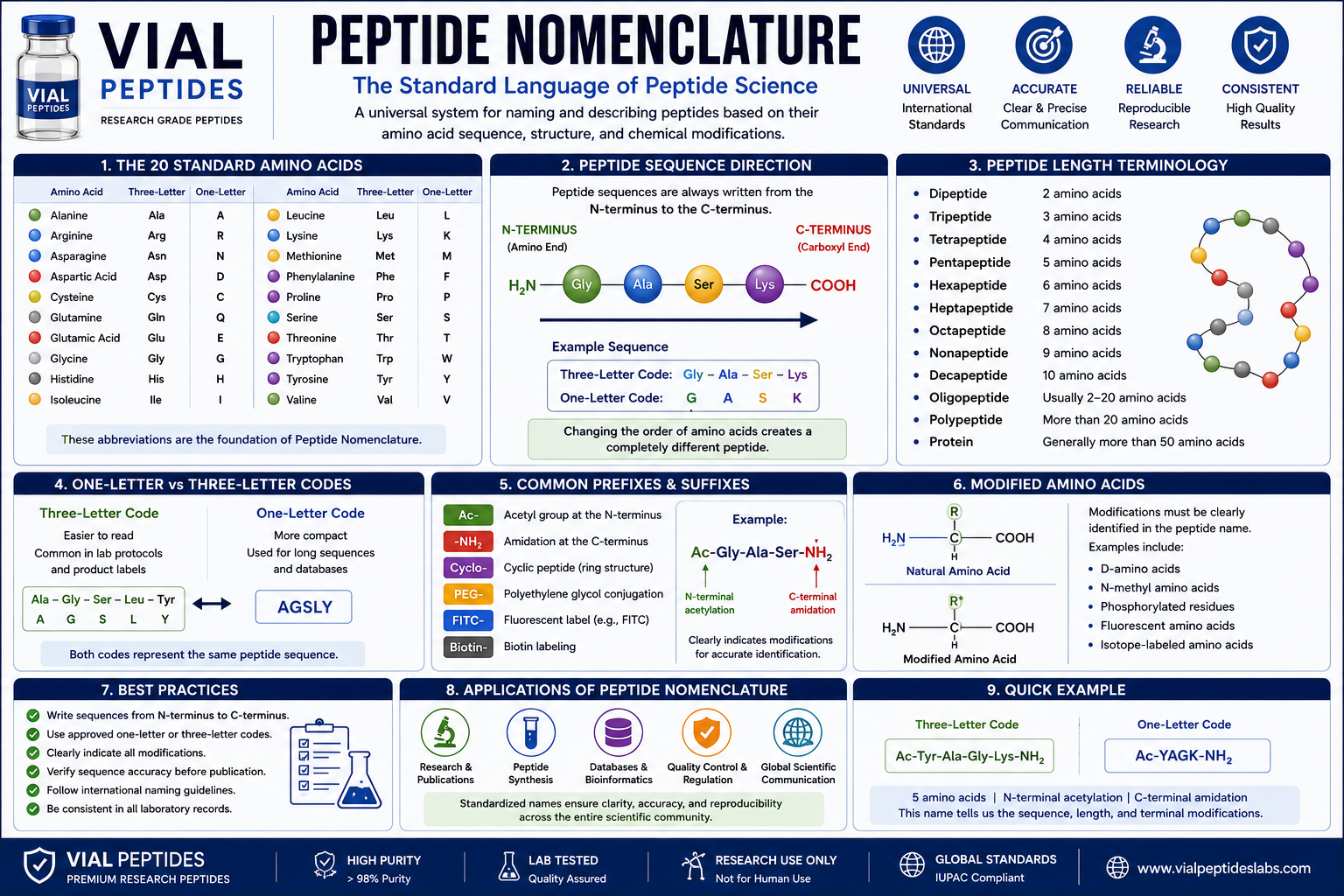
The Twenty Standard Amino Acids
Most naturally occurring peptides are composed of twenty standard amino acids.
Each amino acid has a unique name and internationally accepted abbreviation.
| Amino Acid | Three-Letter Code | One-Letter Code |
|---|---|---|
| Alanine | Ala | A |
| Arginine | Arg | R |
| Asparagine | Asn | N |
| Aspartic Acid | Asp | D |
| Cysteine | Cys | C |
| Glutamine | Gln | Q |
| Glutamic Acid | Glu | E |
| Glycine | Gly | G |
| Histidine | His | H |
| Isoleucine | Ile | I |
| Leucine | Leu | L |
| Lysine | Lys | K |
| Methionine | Met | M |
| Phenylalanine | Phe | F |
| Proline | Pro | P |
| Serine | Ser | S |
| Threonine | Thr | T |
| Tryptophan | Trp | W |
| Tyrosine | Tyr | Y |
| Valine | Val | V |
Learning these abbreviations is one of the most important aspects of Peptide Nomenclature, as they are used extensively in scientific publications, peptide databases, laboratory notebooks, and product documentation.
Three-Letter Amino Acid Codes
The three-letter system is widely used because it is easy to read and minimizes confusion.
Examples include:
- Gly
- Ala
- Lys
- Tyr
- Pro
- Cys
- Trp
Researchers often write peptide sequences by separating each abbreviation with a hyphen.
For example:
Gly-Ala-Ser-Lys
This notation immediately communicates both the amino acid composition and the order of the sequence.
One-Letter Amino Acid Codes
For longer peptide sequences, scientists frequently use the one-letter code.
The same sequence shown above becomes:
GASK
This shorthand makes it easier to represent long peptide chains in research articles, sequence databases, bioinformatics software, and laboratory records.
Although shorter, the one-letter system follows the same principles of Peptide Nomenclature and remains universally recognized within peptide research.
N-Terminus and C-Terminus
An essential rule in Peptide Nomenclature is the direction in which peptide sequences are written.
Scientists always write peptide sequences from the:
- N-terminus (amino end) → C-terminus (carboxyl end)
This convention ensures that peptide sequences are interpreted consistently around the world.
Changing the order of amino acids changes the identity of the peptide. Consequently, sequence direction is just as important as the amino acids themselves.
Why Standardized Peptide Nomenclature Supports Research
Modern peptide research depends on precision. Whether scientists are synthesizing peptides, analyzing structures, or publishing research, consistent Peptide Nomenclature eliminates ambiguity and promotes reproducibility.
From laboratory notebooks to international journals, standardized naming conventions make it possible for researchers across different institutions and countries to communicate using the same molecular language.
Peptide Nomenclature – Naming Rules, Sequence Notation, and Modified Peptides
Understanding Peptide Nomenclature goes beyond learning amino acid abbreviations. Scientists also follow standardized rules for writing peptide sequences, identifying the ends of peptide chains, describing chemical modifications, and naming synthetic peptides used in research.
These naming conventions make scientific communication clear, accurate, and consistent across laboratories worldwide. Whether you are reading a research paper or studying peptide chemistry, mastering Peptide Nomenclature is an essential skill.
Standard Rules of Peptide Nomenclature
The rules of Peptide Nomenclature ensure that every peptide sequence is written in the same format, regardless of where the research is conducted.
Although peptide sequences may vary greatly in length and complexity, several basic naming principles always apply.
These include:
- Writing sequences from the N-terminus to the C-terminus.
- Using internationally accepted amino acid abbreviations.
- Clearly indicating any chemical modifications.
- Maintaining the correct amino acid order.
- Following standardized formatting in scientific publications.
By following these rules, researchers reduce confusion and improve reproducibility.
Writing Peptide Sequences
One of the first concepts taught in Peptide Nomenclature is how peptide sequences are written.
Scientists always begin with the amino acid located at the N-terminus and finish with the amino acid at the C-terminus.
For example:
Three-letter notation
Gly–Ala–Ser–Lys
One-letter notation
GASK
Both examples describe exactly the same peptide.
The only difference is the notation system.
Understanding the N-Terminus and C-Terminus
Every peptide has two distinct ends.
N-Terminus
The N-terminus contains the free amino group (-NH₂).
This is always considered the starting point of the peptide sequence.
C-Terminus
The C-terminus contains the free carboxyl group (-COOH).
This marks the end of the peptide chain.
Because every scientist follows this convention, peptide sequences can be interpreted consistently throughout the scientific community.
Peptide Length Terminology
Another important part of Peptide Nomenclature is describing peptides according to the number of amino acids they contain.
Scientists commonly use the following terminology.
| Name | Number of Amino Acids |
|---|---|
| Dipeptide | 2 |
| Tripeptide | 3 |
| Tetrapeptide | 4 |
| Pentapeptide | 5 |
| Hexapeptide | 6 |
| Heptapeptide | 7 |
| Octapeptide | 8 |
| Nonapeptide | 9 |
| Decapeptide | 10 |
| Oligopeptide | Usually 2–20 |
| Polypeptide | More than 20 |
| Protein | Generally more than 50 amino acids |
This terminology allows researchers to describe peptide size without writing the entire sequence.
Three-Letter vs. One-Letter Codes
Both naming systems are widely accepted in Peptide Nomenclature, but each has different advantages.
Three-Letter Code
The three-letter code is easier to read.
Example:
Ala–Gly–Ser–Leu–Tyr
Researchers often use this notation in textbooks, educational resources, and laboratory protocols.
One-Letter Code
The one-letter code is more compact.
Example:
AGSLY
It is especially useful when displaying long peptide sequences in databases, scientific articles, and bioinformatics software.
Naming Synthetic Peptides
Modern peptide research frequently involves synthetic peptides.
These peptides follow the same Peptide Nomenclature rules as naturally occurring peptides.
However, synthetic peptides often include additional information describing laboratory modifications.
Examples may indicate:
- Acetylation
- Amidation
- Cyclization
- Fluorescent labeling
- Biotin labeling
- PEGylation
- Lipid conjugation
- Non-natural amino acids
Including these details helps researchers understand the exact molecular composition of the peptide.
Common Prefixes and Suffixes
Certain prefixes and suffixes appear frequently in Peptide Nomenclature.
Examples include:
Ac-
Indicates an acetyl group attached to the N-terminus.
NH₂
Indicates C-terminal amidation.
Cyclo-
Shows that the peptide has been cyclized into a ring structure.
PEG-
Indicates attachment of polyethylene glycol.
FITC-
Shows that a fluorescent FITC label has been added for laboratory detection.
These naming elements provide valuable information without requiring researchers to inspect the complete molecular structure.
Modified Amino Acids in Peptide Nomenclature
Modern peptide chemistry often includes amino acids that do not occur naturally.
Examples include:
- D-amino acids
- N-methyl amino acids
- Phosphorylated amino acids
- Fluorescent amino acids
- Isotope-labeled amino acids
These modifications are clearly identified within the peptide name to avoid ambiguity.
Standardized notation ensures that researchers understand exactly which modifications are present.
Why Accurate Peptide Nomenclature Matters
Accurate Peptide Nomenclature benefits every stage of peptide research.
It improves:
- Laboratory communication
- Scientific publications
- Peptide database searches
- Quality control documentation
- Manufacturing records
- Experimental reproducibility
- Regulatory documentation
Without standardized naming, researchers could easily misinterpret peptide sequences, resulting in costly laboratory errors.
Peptide Nomenclature in Research Databases
Large scientific databases rely on standardized Peptide Nomenclature to organize millions of peptide records.
Researchers use these naming systems to:
- Search peptide sequences
- Compare peptide structures
- Identify amino acid substitutions
- Study sequence similarities
- Analyze protein fragments
- Manage laboratory inventories
Consistent naming allows scientists around the world to access and interpret peptide information efficiently.
Best Practices for Using Peptide Nomenclature
When writing peptide sequences, researchers should always:
- Write sequences from the N-terminus to the C-terminus.
- Use approved one-letter or three-letter amino acid codes.
- Clearly indicate chemical modifications.
- Verify sequence accuracy before publication.
- Follow recognized scientific naming conventions.
- Maintain consistent formatting throughout laboratory records.
These best practices improve clarity, reduce errors, and support high-quality scientific communication.
Peptide Nomenclature – Applications, Quality Standards, FAQs, and Conclusion
Mastering Peptide Nomenclature is essential for anyone working with research peptides. Standardized naming systems allow scientists to describe peptide sequences accurately, communicate findings clearly, and maintain consistency across publications, databases, and laboratories.
As peptide research continues to expand, Peptide Nomenclature remains a cornerstone of peptide chemistry, biotechnology, and molecular biology. In this final section, we explore real-world applications, quality standards, frequently asked questions, and the future of peptide naming.
Applications of Peptide Nomenclature
The principles of Peptide Nomenclature are used across many scientific disciplines. From academic laboratories to biotechnology companies, standardized naming ensures that peptide sequences are recorded and interpreted correctly.
Below are some of the most important applications.
Peptide Research
Researchers rely on Peptide Nomenclature when designing experiments, documenting results, and comparing peptide sequences.
Accurate naming allows scientists to:
- Record peptide sequences correctly.
- Compare different peptides.
- Identify sequence modifications.
- Share research findings.
- Reproduce experimental procedures.
Without standardized nomenclature, scientific collaboration would become far more difficult.
Peptide Synthesis
Manufacturers use Peptide Nomenclature to ensure that every synthesized peptide matches the requested amino acid sequence.
A single incorrect amino acid can produce an entirely different peptide. For this reason, sequence verification and proper naming are essential during production.
Standardized nomenclature helps reduce manufacturing errors and improves batch consistency.
Biotechnology
Biotechnology companies use Peptide Nomenclature to organize product catalogs, research databases, and technical documentation.
Proper naming helps scientists quickly identify:
- Amino acid sequences
- Terminal modifications
- Chemical labels
- Peptide length
- Structural features
This improves efficiency and reduces the risk of confusion during research.
Bioinformatics
Modern bioinformatics depends heavily on Peptide Nomenclature.
Computer software uses standardized naming systems to analyze peptide sequences, compare proteins, and identify molecular similarities.
Researchers can rapidly search databases containing millions of peptide records because every sequence follows the same naming conventions.
Scientific Publications
Nearly every scientific journal requires authors to follow standardized Peptide Nomenclature.
Consistent formatting ensures that published peptide sequences can be interpreted correctly by researchers worldwide.
This consistency strengthens scientific communication and improves reproducibility.
Peptide Nomenclature and Quality Control
Quality control is closely connected to Peptide Nomenclature.
Before a research peptide is released, laboratories verify that the reported sequence matches the synthesized molecule.
Common analytical techniques include:
- High-Performance Liquid Chromatography (HPLC)
- Mass Spectrometry (MS)
- Amino Acid Analysis
- Sequence Verification
- Identity Testing
These methods confirm that the peptide corresponds to its documented name and sequence.
Accurate nomenclature supports reliable quality assurance throughout the manufacturing process.
International Standards for Peptide Nomenclature
Several scientific organizations have developed internationally recognized naming guidelines.
The most influential is the International Union of Pure and Applied Chemistry, whose recommendations provide a common language for peptide and chemical nomenclature.
Following these standards helps researchers:
- Exchange information globally.
- Interpret peptide sequences consistently.
- Reduce reporting errors.
- Improve scientific reproducibility.
Standardized guidelines have become essential as peptide science continues to grow.
Common Mistakes in Peptide Nomenclature
Even experienced researchers can make mistakes when writing peptide names.
Common errors include:
- Writing sequences in reverse order.
- Mixing one-letter and three-letter codes.
- Omitting terminal modifications.
- Using outdated abbreviations.
- Recording incorrect amino acid substitutions.
- Failing to identify modified residues.
Careful proofreading and sequence verification help prevent these problems.
The Future of Peptide Nomenclature
As peptide science evolves, Peptide Nomenclature continues to adapt to new technologies and discoveries.
Several trends are shaping the future.
Artificial Intelligence
AI-powered software can now analyze peptide sequences, predict structures, and identify naming inconsistencies.
These tools improve efficiency and reduce manual errors in large research datasets.
Expanded Synthetic Peptide Libraries
Researchers are designing increasingly complex synthetic peptides that include non-natural amino acids, specialized labels, and novel chemical modifications.
Standardized naming systems continue to evolve to accommodate these advances.
Improved Database Integration
Modern peptide databases are becoming more interconnected.
Consistent Peptide Nomenclature allows researchers to compare information across multiple scientific resources with greater accuracy and speed.
Global Scientific Collaboration
As peptide research becomes increasingly international, standardized nomenclature remains essential for collaboration between universities, biotechnology companies, pharmaceutical organizations, and research institutes.
A common naming language allows scientists from different countries to communicate without ambiguity.
Frequently Asked Questions About Peptide Nomenclature
What is Peptide Nomenclature?
Peptide Nomenclature is the standardized system used to name and describe peptides based on their amino acid sequence, structure, and chemical modifications.
Why is Peptide Nomenclature important?
It ensures that researchers can communicate accurately, reproduce experiments, interpret peptide sequences, and maintain consistent laboratory documentation.
Who developed peptide naming standards?
International naming recommendations are largely based on guidelines established by the International Union of Pure and Applied Chemistry.
Why are amino acid abbreviations used?
Abbreviations make peptide sequences shorter, easier to read, and simpler to include in scientific papers, databases, and laboratory records.
What is the difference between one-letter and three-letter amino acid codes?
The three-letter code is easier for beginners to read, while the one-letter code is more compact and commonly used for long peptide sequences and bioinformatics applications.
Why are peptide sequences written from the N-terminus to the C-terminus?
This universal convention ensures that peptide sequences are interpreted consistently by researchers around the world.
Can synthetic peptides follow the same naming rules?
Yes. Synthetic peptides use the same fundamental Peptide Nomenclature principles, with additional notation for chemical modifications when necessary.
How are modified peptides identified?
Scientists include prefixes, suffixes, or other standardized notation to indicate modifications such as acetylation, amidation, cyclization, PEGylation, fluorescent labels, or non-natural amino acids.
Conclusion
Understanding Peptide Nomenclature is fundamental to peptide chemistry, molecular biology, and biotechnology. Standardized naming conventions allow scientists to describe peptide sequences accurately, communicate findings clearly, and ensure consistency across research laboratories worldwide.
From amino acid abbreviations and sequence notation to terminal modifications and synthetic peptide naming, every aspect of Peptide Nomenclature contributes to reliable scientific communication. As peptide science continues to expand, standardized nomenclature will remain essential for research, education, quality control, and innovation.
Whether you are a student learning peptide chemistry, a researcher designing peptide sequences, or a biotechnology professional working with research peptides, mastering Peptide Nomenclature provides the foundation for accurate and effective scientific work.
Key Takeaways
- Peptide Nomenclature is the standardized system for naming and describing peptide sequences.
- Peptide sequences are always written from the N-terminus to the C-terminus.
- Scientists use one-letter and three-letter amino acid codes for consistency.
- Standardized naming improves scientific communication, reproducibility, and quality control.
- Organizations such as International Union of Pure and Applied Chemistry provide internationally recognized naming guidelines.
- Accurate peptide nomenclature supports research, biotechnology, peptide synthesis, bioinformatics, and laboratory documentation.
Internal Linking Suggestions for Vial Peptides
Strengthen topical authority by linking this article to: