Amino Acids and Peptides: The Foundation of Peptide Science
Every remarkable advancement in peptide science begins with one simple concept: amino acids. These naturally occurring molecules serve as the fundamental building blocks from which every peptide and protein is created. Whether researchers are studying molecular biology, biotechnology, analytical chemistry, or peptide manufacturing, understanding amino acids is the first step toward understanding peptides.
Although amino acids are relatively small molecules, their combinations create an extraordinary diversity of peptide structures. By linking together in specific sequences, amino acids form peptides with unique molecular characteristics that researchers continue to investigate in laboratories worldwide. Even changing the position of a single amino acid within a sequence can produce an entirely different peptide with distinct structural properties.
Modern peptide research has become one of the fastest-growing areas of biological science because peptides offer scientists a precise way to investigate molecular interactions, structural biology, receptor recognition, and biochemical communication. Every breakthrough in peptide chemistry begins with understanding how amino acids work together to build increasingly complex molecular structures.
In this guide, we will explore the chemistry of amino acids, how peptide bonds are formed, why amino acid sequences are so important, and how these remarkable molecules contribute to peptide manufacturing and scientific research.
What Are Amino Acids?
Amino acids are organic molecules that combine to form peptides and proteins. They are often described as the building blocks of life because nearly every living organism depends on them to construct important biological molecules.
Each amino acid contains four main components:
- An amino group (-NH₂)
- A carboxyl group (-COOH)
- A hydrogen atom
- A unique side chain known as the R-group
The amino group and carboxyl group remain relatively similar among all amino acids. The side chain, however, varies considerably and gives each amino acid its own chemical identity.
This small structural difference allows amino acids to interact with one another in countless ways, creating an enormous variety of peptide structures.
The Twenty Standard Amino Acids
Living organisms primarily use twenty standard amino acids to construct peptides and proteins.
Although they share a common molecular framework, each amino acid possesses unique chemical characteristics that influence peptide behavior.
The twenty standard amino acids include:
- Alanine
- Arginine
- Asparagine
- Aspartic Acid
- Cysteine
- Glutamine
- Glutamic Acid
- Glycine
- Histidine
- Isoleucine
- Leucine
- Lysine
- Methionine
- Phenylalanine
- Proline
- Serine
- Threonine
- Tryptophan
- Tyrosine
- Valine
Researchers carefully study these amino acids because each contributes differently to peptide folding, stability, molecular recognition, and chemical behavior.
Why Every Amino Acid Is Different
Although every amino acid contains the same basic chemical framework, the R-group makes each one unique.
Some side chains are small and simple.
Others are large and highly complex.
Some attract water.
Others repel water.
Some carry electrical charges.
Others remain electrically neutral.
These differences determine how amino acids interact during peptide formation and influence the final structure of every peptide.
Scientists often describe amino acid side chains as the molecular personalities of amino acids because they dictate much of a peptide’s chemical behavior.
Classification of Amino Acids
To better understand peptide chemistry, researchers classify amino acids according to the properties of their side chains.
Nonpolar Amino Acids
Nonpolar amino acids tend to avoid water and often move toward the interior of folded peptide structures.
Examples include:
- Alanine
- Valine
- Leucine
- Isoleucine
- Methionine
- Phenylalanine
These amino acids contribute significantly to peptide stability through hydrophobic interactions.
Polar Amino Acids
Polar amino acids readily interact with water because their side chains contain atoms capable of forming hydrogen bonds.
Examples include:
These amino acids frequently appear on the outer surfaces of peptides where they interact with surrounding water molecules.
Positively Charged Amino Acids
These amino acids possess basic side chains that often carry positive electrical charges under physiological conditions.
Examples include:
- Lysine
- Arginine
- Histidine
Positive charges influence molecular recognition and electrostatic interactions between peptides and other biological molecules.
Negatively Charged Amino Acids
Negatively charged amino acids contribute acidic side chains capable of forming important electrostatic interactions.
Examples include:
- Aspartic Acid
- Glutamic Acid
These amino acids frequently participate in stabilizing peptide structures through ionic interactions.
Essential and Non-Essential Amino Acids
Amino acids are also categorized according to whether they must be obtained through nutrition or can be synthesized naturally by living organisms.
Essential Amino Acids
Essential amino acids cannot be produced in sufficient quantities by the human body and therefore must be obtained from dietary sources.
These include:
- Histidine
- Isoleucine
- Leucine
- Lysine
- Methionine
- Phenylalanine
- Threonine
- Tryptophan
- Valine
Non-Essential Amino Acids
Non-essential amino acids can generally be synthesized naturally within the body.
Examples include:
- Alanine
- Asparagine
- Aspartic Acid
- Glutamic Acid
- Serine
In peptide manufacturing, however, all amino acids are selected based on the desired peptide sequence rather than nutritional classification.
From Amino Acids to Peptides
The transformation from individual amino acids into peptides is one of the most fundamental chemical processes in biology.
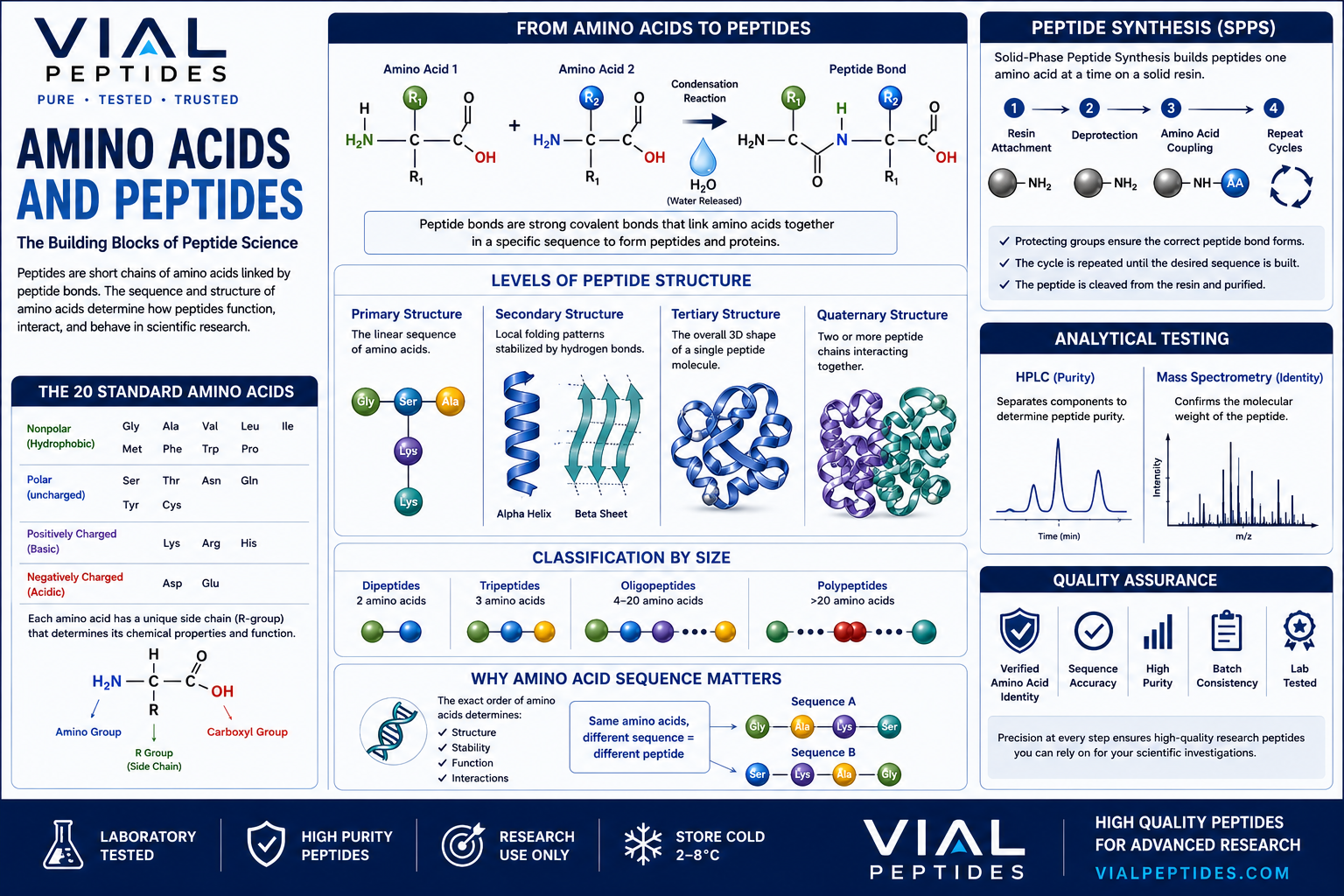
When two amino acids react, the carboxyl group of one amino acid combines with the amino group of another.
During this reaction:
- A molecule of water is released.
- A peptide bond is formed.
- The amino acid chain becomes one unit longer.
Scientists refer to this process as a condensation reaction.
By repeating this reaction many times, increasingly longer peptide chains are produced.
The sequence in which amino acids are joined determines the identity of the final peptide.
Peptide Bonds: The Link Between Amino Acids
Peptide bonds are strong covalent bonds that connect amino acids together.
These bonds are remarkably stable while still allowing sufficient flexibility for peptide chains to fold into complex three-dimensional structures.
Every peptide consists of amino acids connected by peptide bonds.
Without these bonds, peptide chemistry would not exist.
Researchers devote considerable attention to peptide bond formation because it represents one of the most critical stages of peptide synthesis.
Why Amino Acid Sequence Matters
A peptide is much more than a collection of amino acids.
The exact order of amino acids determines:
- Molecular weight
- Chemical properties
- Electrical charge
- Folding behavior
- Structural stability
- Receptor recognition
- Laboratory characteristics
Changing even one amino acid may significantly alter the overall structure of the peptide.
This remarkable precision explains why peptide manufacturing requires carefully controlled synthesis procedures and extensive analytical verification.
Amino Acids in Modern Peptide Research
Today, amino acids remain central to nearly every aspect of peptide science.
Researchers use carefully selected amino acid sequences to manufacture peptides for studies in:
- Molecular biology
- Biochemistry
- Biotechnology
- Analytical chemistry
- Structural biology
- Pharmaceutical research
Advances in peptide synthesis allow scientists to construct highly precise amino acid sequences while maintaining rigorous quality standards throughout the manufacturing process.
As peptide research continues to evolve, amino acids remain the essential foundation upon which every peptide molecule is built.
How Amino Acids Form Peptides
The transformation of individual amino acids into peptides is one of the most fundamental processes in peptide chemistry. Every peptide begins as separate amino acids that become chemically linked together in a precise sequence.
This process is far from random. Researchers carefully control the order in which amino acids are connected because the final sequence determines the peptide’s molecular identity.
When the amino group (-NH₂) of one amino acid reacts with the carboxyl group (-COOH) of another, a molecule of water is released. The remaining atoms form a strong covalent bond known as a peptide bond.
By repeating this reaction many times, scientists can construct peptide chains containing specific amino acid sequences required for laboratory research.
Understanding Peptide Bond Formation
Peptide bond formation is called a condensation reaction because water is removed as the bond forms.
The process follows several simple steps:
- Two amino acids approach one another.
- The amino group of one amino acid reacts with the carboxyl group of the second.
- One molecule of water is released.
- A peptide bond forms between the two amino acids.
- The growing peptide chain becomes one amino acid longer.
Repeating this reaction hundreds of times allows scientists to manufacture increasingly complex peptide molecules with remarkable precision.
From Dipeptides to Polypeptides
Scientists classify peptides according to the number of amino acids they contain.
Dipeptides
Two amino acids joined together form a dipeptide.
Although small, dipeptides demonstrate the basic chemistry involved in peptide formation.
Tripeptides
Three amino acids connected together form a tripeptide.
Researchers often use tripeptides when studying peptide synthesis and analytical chemistry.
Oligopeptides
Short peptide chains containing several amino acids are called oligopeptides.
Many laboratory peptides fall into this category.
Polypeptides
Longer amino acid chains are known as polypeptides.
When these chains become sufficiently large and fold into highly organized three-dimensional structures, they are generally classified as proteins.
Understanding these categories helps researchers distinguish between different classes of biological molecules.
Amino Acid Sequence Determines Peptide Identity
One of the defining characteristics of peptide science is sequence specificity.
Two peptides may contain exactly the same amino acids but behave completely differently if their amino acid order changes.
For example, consider a peptide containing:
- Glycine
- Alanine
- Lysine
Changing the sequence to:
- Lysine
- Glycine
- Alanine
creates a different peptide with different structural properties.
This remarkable sensitivity explains why peptide manufacturers pay such close attention to sequence accuracy throughout production.
Peptide Synthesis in Modern Laboratories
While living organisms naturally produce peptides through biological processes, research laboratories manufacture peptides using advanced chemical synthesis techniques.
The most widely used manufacturing method is Solid-Phase Peptide Synthesis (SPPS).
Developed by Nobel Prize-winning chemist Robert Bruce Merrifield, SPPS transformed peptide manufacturing by allowing scientists to construct amino acid sequences one building block at a time.
Today, SPPS remains the industry standard for producing high-quality research peptides.
Solid-Phase Peptide Synthesis Explained
The synthesis process begins by attaching the first amino acid to a solid resin.
Scientists then repeat a carefully controlled production cycle.
Each cycle includes:
- Removing protective chemical groups.
- Adding the next amino acid.
- Forming a peptide bond.
- Washing away excess reagents.
- Preparing the chain for the following amino acid.
These cycles continue until the desired peptide sequence has been completed.
Because hundreds of chemical reactions may occur during synthesis, every stage requires careful monitoring and quality control.
Protecting Groups: Why They Are Important
During synthesis, amino acids possess multiple reactive sites.
If left unprotected, unwanted chemical reactions could occur.
Manufacturers therefore use temporary protecting groups to block specific portions of amino acids while allowing peptide bonds to form only where intended.
After each synthesis cycle, these protecting groups are carefully removed before adding the next amino acid.
This strategy helps ensure sequence accuracy throughout manufacturing.
Purification After Peptide Synthesis
Once synthesis is complete, the peptide mixture contains much more than the desired product.
Small amounts of incomplete peptide chains, synthesis by-products, and other impurities remain.
Purification removes these unwanted molecules.
The most commonly used purification technique is Reverse-Phase High-Performance Liquid Chromatography (RP-HPLC).
This advanced analytical process separates molecules according to their chemical characteristics, allowing manufacturers to isolate high-purity peptides suitable for laboratory research.
High-Performance Liquid Chromatography (HPLC)
HPLC is one of the most important analytical techniques used throughout peptide manufacturing.
Scientists use HPLC to:
- Estimate peptide purity
- Detect impurities
- Compare production batches
- Verify purification performance
- Support quality assurance
During HPLC analysis, peptides pass through a chromatography column where they separate according to their interactions with the stationary phase.
A detector records the resulting peaks, producing a chromatogram that researchers analyze to evaluate sample quality.
Mass Spectrometry
Purity alone does not confirm that the correct peptide has been manufactured.
Researchers also perform Mass Spectrometry (MS) to verify molecular identity.
Mass spectrometers determine the molecular weight of peptides with remarkable precision.
Scientists compare the measured molecular weight with the theoretical value predicted from the amino acid sequence.
Matching values provide strong evidence that the intended peptide has been successfully synthesized.
Amino Acids Influence Peptide Folding
The amino acid sequence determines much more than molecular identity.
Each amino acid also influences how the peptide folds after synthesis.
Several molecular forces contribute to peptide folding, including:
- Hydrogen bonding
- Hydrophobic interactions
- Electrostatic attractions
- Van der Waals forces
- Disulfide bridge formation
Together, these interactions allow peptide chains to adopt stable three-dimensional structures.
Researchers continue studying peptide folding because molecular shape influences stability, receptor recognition, and analytical behavior.
Why Folding Is Important
A peptide’s final shape determines many of its molecular characteristics.
Correct folding contributes to:
- Structural stability
- Chemical consistency
- Molecular recognition
- Analytical reproducibility
- Manufacturing quality
Improper folding may influence laboratory investigations, which is why researchers devote significant attention to structural analysis during peptide development.
Amino Acids and Peptide Stability
Different amino acids contribute differently to peptide stability.
Some amino acids increase flexibility, while others strengthen structural integrity.
Environmental conditions may also influence stability, including:
- Temperature
- Moisture
- Light exposure
- Oxidation
- pH
- Storage conditions
Manufacturers evaluate these factors during stability studies to better understand how peptides behave over time.
Analytical Quality Control
Quality assurance extends throughout the entire manufacturing process.
Researchers evaluate:
- Amino acid sequence accuracy
- Molecular identity
- Peptide purity
- Batch consistency
- Structural stability
- Manufacturing documentation
These procedures help ensure researchers receive dependable laboratory materials suitable for scientific investigation.
Different Categories of Peptides
As amino acids join together in different sequences, they create peptides with unique molecular structures. Scientists classify peptides according to their size, structure, and biochemical characteristics. Understanding these categories helps researchers organize peptide research and better understand molecular diversity.
Dipeptides
Dipeptides contain two amino acids connected by a single peptide bond. Although simple, they provide valuable insight into peptide bond formation and are frequently used in educational and analytical studies.
Tripeptides
Tripeptides contain three amino acids linked together. Researchers often investigate tripeptides because they demonstrate how small changes in amino acid sequence can influence molecular properties.
Oligopeptides
Oligopeptides consist of relatively short amino acid chains, typically containing between four and twenty amino acids. Many laboratory research peptides belong to this category.
Polypeptides
Polypeptides are longer amino acid chains that may eventually fold into more complex molecular structures. When these chains become sufficiently large and structurally organized, they are generally classified as proteins.
Understanding these classifications helps researchers distinguish between different molecular systems while studying peptide chemistry.
Amino Acids in Peptide Manufacturing
Modern peptide manufacturing depends on accurately assembling amino acids into precise sequences.
Researchers begin by selecting carefully characterized amino acids before initiating synthesis. Each amino acid undergoes quality verification to ensure identity and purity before it becomes part of the manufacturing process.
Throughout production, scientists monitor:
- Amino acid identity
- Sequence accuracy
- Reaction efficiency
- Peptide bond formation
- Purification performance
- Product consistency
This systematic approach helps produce high-quality research peptides suitable for analytical investigations.
Why Amino Acid Quality Matters
Every finished peptide depends upon the quality of its individual amino acids.
If one amino acid contains impurities or is incorrectly incorporated into the sequence, the final peptide may differ from the intended molecular design.
Researchers therefore emphasize:
- High-quality raw materials
- Verified amino acid identity
- Controlled synthesis
- Analytical testing
- Manufacturing consistency
Attention to these details supports reproducible laboratory research and reliable analytical results.
Common Misconceptions About Amino Acids and Peptides
As peptide science has become more widely discussed, several misconceptions have developed. Understanding the science helps separate established knowledge from common misunderstandings.
Misconception 1: Amino Acids and Peptides Are the Same
Amino acids are individual molecules.
Peptides are chains formed when amino acids are chemically linked together.
Although closely related, they are not identical.
Misconception 2: More Amino Acids Always Create Better Peptides
Peptide quality depends on sequence accuracy, molecular structure, and manufacturing precision—not simply on the number of amino acids.
Misconception 3: All Amino Acids Behave the Same
Every amino acid possesses unique chemical characteristics that influence folding, stability, solubility, and molecular interactions.
Misconception 4: Peptide Manufacturing Is Simple
Modern peptide manufacturing requires advanced chemistry, specialized equipment, analytical testing, purification, and comprehensive quality assurance.
Misconception 5: Sequence Accuracy Is Not Important
Even changing a single amino acid may significantly alter the molecular characteristics of an entire peptide.
Sequence accuracy remains one of the most important aspects of peptide manufacturing.
The Future of Amino Acid and Peptide Research
Scientific understanding of amino acids and peptides continues to expand rapidly.
Researchers are developing new synthesis methods, improved purification techniques, and advanced analytical technologies capable of examining molecular structures with extraordinary precision.
Emerging innovations include:
- Artificial intelligence-assisted peptide design
- Automated peptide synthesis
- Machine learning for molecular prediction
- Advanced Mass Spectrometry
- High-resolution Nuclear Magnetic Resonance (NMR)
- Improved chromatography systems
These technologies continue improving manufacturing quality while expanding scientific understanding of peptide chemistry and structural biology.
Frequently Asked Questions
What are amino acids?
Amino acids are organic molecules that serve as the building blocks of peptides and proteins.
How do amino acids form peptides?
Amino acids join together through peptide bonds formed during condensation reactions, creating peptide chains.
What is a peptide bond?
A peptide bond is a strong covalent bond that connects two amino acids into a continuous molecular chain.
How many amino acids are used to build peptides?
Researchers primarily work with twenty standard amino acids that naturally occur in biological systems.
What determines a peptide’s identity?
The exact sequence of amino acids determines the identity and molecular characteristics of every peptide.
Why is amino acid sequence important?
Sequence influences folding, stability, molecular recognition, chemical behavior, and analytical properties.
How are research peptides manufactured?
Most research peptides are produced using Solid-Phase Peptide Synthesis (SPPS), followed by purification and laboratory testing.
Why is HPLC used during peptide manufacturing?
HPLC helps evaluate peptide purity by separating the desired peptide from impurities.
What is Mass Spectrometry used for?
Mass Spectrometry confirms molecular identity by measuring the peptide’s molecular weight.
Why are amino acids important in peptide research?
Without amino acids, peptides cannot be synthesized. They provide the structural foundation of every peptide molecule.
How do researchers verify peptide quality?
Scientists evaluate amino acid sequence accuracy, purity, molecular identity, and batch consistency using advanced analytical techniques.
What affects peptide stability?
Temperature, moisture, oxidation, pH, storage conditions, and amino acid composition all influence peptide stability.
Are all peptides manufactured from the same amino acids?
Most research peptides are built using the same twenty standard amino acids, but their sequences differ depending on the peptide being produced.
Why is manufacturing precision important?
Accurate manufacturing helps ensure researchers receive peptides with the intended molecular structure and consistent analytical quality.
Are VIAL PEPTIDES products intended for research?
Yes. Products supplied by VIAL PEPTIDES are manufactured for research use only.
Conclusion
Amino acids and peptides form the foundation of modern peptide science. Individual amino acids combine through peptide bonds to create precisely ordered chains that give rise to peptides with unique molecular structures and properties. The sequence, chemical characteristics, and interactions of these amino acids determine how peptides fold, behave, and are analyzed in scientific research.
Advances in peptide synthesis, purification, and analytical testing have enabled researchers to manufacture peptides with exceptional precision. Techniques such as Solid-Phase Peptide Synthesis (SPPS), High-Performance Liquid Chromatography (HPLC), and Mass Spectrometry help verify peptide identity, purity, and consistency, supporting reliable laboratory investigations.
At VIAL PEPTIDES, we are committed to supplying premium laboratory-tested research peptides manufactured according to rigorous quality standards. By emphasizing precision, transparency, and comprehensive quality assurance, we strive to provide researchers with dependable materials that support scientific discovery and innovation.
As peptide science continues to evolve, understanding the relationship between amino acids and peptides will remain essential for anyone involved in molecular biology, biotechnology, analytical chemistry, or peptide research.
Suggested Internal Links
Naturally link this article to:
- What Are Peptides?
- How Peptides Work
- Peptide Structure Explained
- Peptide Bonds Explained
- Peptides vs Proteins
- Peptide Chemistry Basics
- Peptide Manufacturing Process
- Understanding Peptide Purity and Testing
- HPLC Testing Explained
- Mass Spectrometry Explained
- Certificate of Analysis Guide
- Laboratory Tested Peptides
- High Purity Peptide Products
- Choosing a Reliable Peptide Supplier
- BPC-157 Peptide
- TB-500 Peptide
- GHK-Cu Peptide
- CJC-1295 Peptide