How Peptides Work: A Complete Scientific Guide
How Peptides Work: A Complete Guide to Peptide Signaling and Scientific Research
How Peptides Work are among the most important biological molecules studied in modern science. Although they are small compared to proteins, peptides participate in countless biological processes by acting as chemical messengers that allow cells to communicate with one another. Researchers investigate peptides because of their highly specific interactions with cells, making them valuable tools for laboratory studies in molecular biology, biochemistry, biotechnology, and pharmaceutical research.
Understanding how peptides work begins with understanding how living cells communicate. Every second, billions of cells throughout a living organism exchange information. Cells receive instructions, respond to environmental changes, regulate internal processes, and coordinate biological activities through complex signaling networks. Peptides are one of the molecules that make this communication possible.
In research laboratories around the world, scientists study peptide structure, receptor interactions, molecular signaling pathways, and analytical testing methods to better understand their biological characteristics. These investigations contribute to advances in peptide chemistry, biotechnology, analytical science, and drug discovery.
This guide explains the scientific principles behind peptide function, explores how peptides interact with receptors, discusses laboratory manufacturing and quality testing, and provides researchers with a clear understanding of why peptide quality is essential for dependable scientific research.
Understanding Peptides Before Learning How They Work
Before exploring peptide function, it is helpful to understand what peptides are.
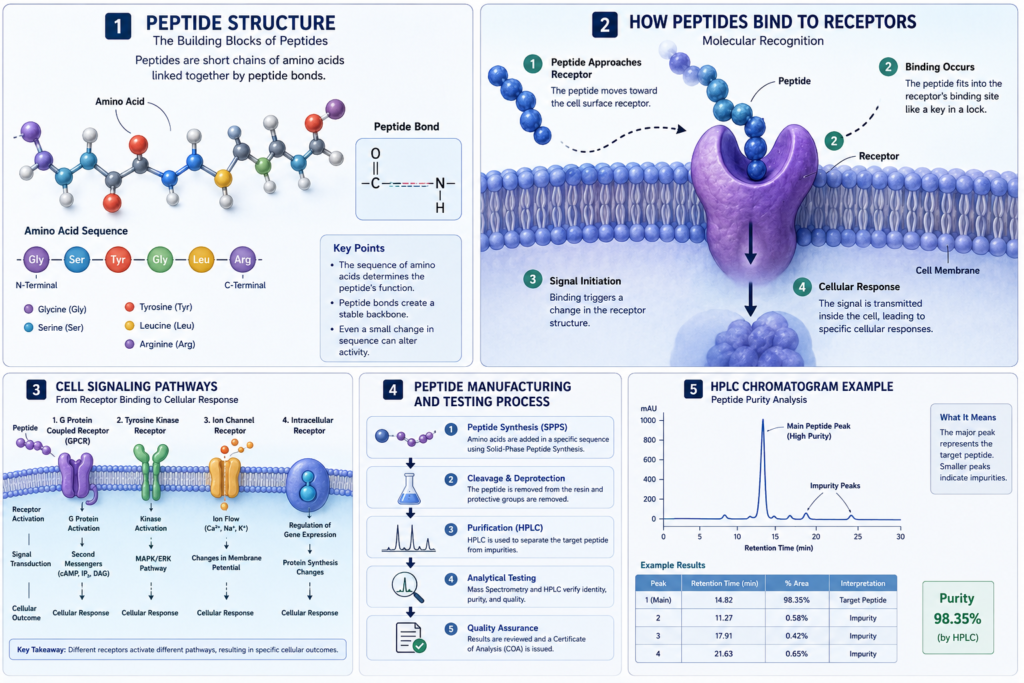
Peptides are short chains of amino acids linked together through peptide bonds. Amino acids are often referred to as the building blocks of proteins because they combine in different sequences to create increasingly complex biological molecules.
A peptide may contain only a few amino acids or several dozen, while proteins are generally much larger and contain longer amino acid chains folded into highly complex three-dimensional structures.
The order of amino acids within a peptide is extremely important. Even changing one amino acid can alter how the peptide behaves, how it interacts with receptors, or whether it functions at all. This precision is one of the reasons peptide research has become such an important area of modern biological science.
Unlike larger proteins, many peptides have relatively simple structures that allow researchers to study molecular interactions with greater precision under controlled laboratory conditions.
The Language of Cellular Communication
To understand how peptides work, imagine a large city with millions of people. Communication keeps the city functioning. Traffic lights coordinate vehicles, emergency services respond to calls, businesses exchange information, and citizens communicate through countless networks.
Cells operate in a similar way.
Rather than speaking with words, cells communicate through chemical signals.
Peptides act as part of this communication system by carrying highly specific molecular messages between cells. Instead of broadcasting a general signal, each peptide interacts only with particular receptors capable of recognizing its unique molecular structure.
This remarkable specificity allows researchers to investigate highly targeted biological pathways during laboratory studies.
The Importance of Amino Acid Sequences
Every peptide begins with amino acids.
There are twenty standard amino acids used by living organisms to construct peptides and proteins. Each amino acid possesses unique chemical properties that influence how a peptide behaves after synthesis.
The exact sequence of amino acids determines:
- Molecular shape
- Electrical charge
- Solubility
- Stability
- Receptor recognition
- Biological specificity
Scientists often compare amino acid sequences to sentences written using a twenty-letter alphabet. Rearranging just one “letter” may completely change the meaning of the sentence. Likewise, altering a single amino acid may significantly change the characteristics of a peptide.
This precise sequence explains why peptide manufacturing requires exceptional accuracy throughout synthesis and purification.
Peptide Shape Determines Function
A peptide is much more than a simple chain of amino acids.
After synthesis, the amino acid chain naturally folds into a three-dimensional structure. This shape determines how the peptide interacts with surrounding molecules.
Researchers often describe this relationship using the “lock and key” concept.
Imagine a lock designed to accept only one specific key.
A receptor behaves like the lock.
The peptide behaves like the key.
If the molecular shapes match, the peptide may bind to the receptor. If they do not match, little or no interaction occurs.
Although modern biology recognizes that receptor interactions are more flexible than a simple lock-and-key model, the analogy remains useful for understanding molecular recognition.
How Peptides Recognize Their Targets
One of the most remarkable characteristics of peptides is their ability to recognize specific targets.
Cells contain specialized receptor proteins positioned on their surfaces or inside the cell itself. These receptors constantly monitor their environment for molecules possessing the correct structural characteristics.
When a compatible peptide approaches, several molecular forces help stabilize the interaction, including:
- Hydrogen bonding
- Electrostatic interactions
- Hydrophobic interactions
- Van der Waals forces
These molecular interactions allow the peptide to temporarily associate with the receptor, forming what scientists call a peptide-receptor complex.
This process represents one of the first steps in peptide signaling.
Peptide Receptors: Nature’s Molecular Sensors
Receptors function as biological sensors.
Every receptor is designed to recognize particular molecular features rather than responding randomly to every chemical encountered.
Some receptors recognize hormones.
Others recognize neurotransmitters.
Some specialize in peptides.
This remarkable specificity helps maintain biological organization by ensuring cells respond only to appropriate signals.
Researchers devote significant attention to receptor biology because receptor behavior influences nearly every aspect of cellular communication.
Studying receptor interactions allows scientists to investigate molecular pathways, cellular responses, and biochemical mechanisms under carefully controlled laboratory conditions.
What Happens After a Peptide Binds?
Binding alone does not complete peptide signaling.
Instead, receptor binding often serves as the beginning of a much larger sequence of molecular events.
After binding occurs, the receptor may undergo subtle structural changes known as conformational changes.
These structural changes can activate additional molecules located inside the cell.
Scientists refer to these events as signaling cascades because one molecular interaction triggers another, creating an organized chain of biochemical communication.
Rather than producing a single reaction, one peptide may initiate dozens or even hundreds of interconnected molecular processes.
This amplification helps explain why peptide signaling is such an important area of scientific investigation.
Signal Amplification Inside Cells
Cells possess remarkable efficiency.
Instead of requiring thousands of peptide molecules to produce a measurable response, a single successful receptor interaction may activate multiple signaling proteins.
Each activated protein can influence additional proteins.
Those proteins may activate enzymes.
Enzymes may influence other signaling pathways.
Eventually, one receptor interaction may generate an extensive network of molecular communication inside the cell.
Researchers investigate these signaling networks using advanced laboratory techniques to better understand how biological systems coordinate complex activities.
Because signaling pathways are interconnected, peptide research often overlaps with molecular biology, genetics, biochemistry, structural biology, and pharmaceutical sciences.
Why Specificity Matters in Peptide Research
Specificity is one of the greatest advantages of peptides in laboratory investigations.
Unlike many larger biological molecules, peptides frequently demonstrate highly selective interactions with defined molecular targets.
This allows researchers to design carefully controlled experiments that investigate individual pathways while minimizing unwanted variables.
The greater the specificity, the easier it becomes to examine molecular mechanisms under reproducible laboratory conditions.
For this reason, peptide purity, manufacturing quality, and analytical testing are especially important.
Even small impurities or structural variations may influence receptor interactions and experimental outcomes.
Maintaining consistent peptide quality therefore becomes essential for producing reliable research data.
Cell Signaling: How Peptides Deliver Biological Messages
Cells constantly receive information from their environment. Temperature changes, nutrient availability, chemical signals, and interactions with neighboring cells all influence how a cell behaves. Peptides are among the signaling molecules that researchers study because they can participate in these communication networks.
When a peptide binds to its corresponding receptor, it does not simply attach and stop. Instead, the binding event can initiate a series of biochemical reactions inside the cell. This process is known as cell signaling.
Cell signaling allows information to move from the surface of a cell to its interior, where proteins, enzymes, and other molecules coordinate biological activities. Scientists study these signaling pathways to better understand cellular communication, molecular biology, and biochemical regulation.
Different peptides may interact with different receptors, which is why researchers investigate peptide-receptor interactions individually rather than assuming all peptides behave in the same manner.
Types of Peptide Signaling
Biological communication occurs through several signaling mechanisms. Understanding these pathways helps explain why peptides are important tools in laboratory research.
Endocrine Signaling
In endocrine signaling, molecules are released into the bloodstream and travel to distant cells. Researchers investigate how peptides participate in long-distance biological communication through endocrine systems.
Paracrine Signaling
Paracrine signaling occurs between nearby cells. Instead of traveling throughout the body, signaling molecules influence neighboring cells located within the same tissue.How Peptides Work
Autocrine Signaling
Some cells respond to signals they produce themselves. This process, known as autocrine signaling, allows researchers to study cellular self-regulation under controlled laboratory conditions.
Intracellular Signaling
Not all peptide interactions begin on the cell surface. Some signaling pathways continue inside the cell after receptor activation, where additional proteins transmit information throughout complex biochemical networks.
Each of these signaling mechanisms contributes to the intricate communication systems that researchers investigate every day.
Receptor Specificity and Molecular Recognition
One reason peptides are so valuable in scientific research is their remarkable specificity.
Receptors do not recognize molecules randomly. Instead, they identify particular structural characteristics based on molecular shape, charge distribution, and chemical properties.
Scientists often describe this process as molecular recognition.
Only peptides possessing compatible structural features can interact effectively with a given receptor. This selectivity allows researchers to study highly specific biological pathways while reducing unwanted interactions.
Understanding receptor specificity is fundamental in peptide chemistry, structural biology, and pharmaceutical research.
What Determines Peptide Activity?
Researchers investigate several characteristics that influence how peptides behave during laboratory studies.
Amino Acid Sequence
The sequence of amino acids determines the peptide’s identity. Even small changes may alter molecular recognition and receptor interactions.How Peptides Work
Molecular Structure
The three-dimensional structure affects how peptides interact with receptors and surrounding molecules.
Purity
High-purity peptides help reduce unwanted contaminants that could interfere with analytical research.
Stability
Some peptides remain stable under appropriate storage conditions, while others may gradually degrade if exposed to moisture, heat, or repeated freeze-thaw cycles.
Solubility
Researchers carefully evaluate peptide solubility before beginning laboratory investigations because different peptides dissolve differently depending on their chemical properties.
Together, these factors influence how peptides perform during scientific experiments.
How Research Peptides Are Manufactured
Before researchers can study peptides, they must first be manufactured with exceptional precision.
Modern peptide production generally begins with Solid-Phase Peptide Synthesis (SPPS), one of the most widely used methods for constructing peptide chains.
During synthesis, amino acids are added sequentially to a growing chain attached to a solid support material.
After each amino acid is added, unwanted reactive groups are removed, allowing the next amino acid to attach in the correct position.
This cycle repeats until the desired peptide sequence has been completed.
Because peptide manufacturing involves numerous chemical reactions, quality control becomes essential throughout the production process.
Purification After Synthesis
Once synthesis is complete, the crude peptide mixture contains not only the desired product but also small amounts of by-products produced during manufacturing.
Researchers therefore rely on purification techniques to isolate the target peptide.
One of the most widely used purification methods is High-Performance Liquid Chromatography (HPLC).
HPLC separates molecules according to their chemical characteristics, allowing scientists to isolate peptides with high levels of purity.
Purification represents one of the most important steps in producing dependable research peptides.How Peptides Work
Why Peptide Purity Is Important
Peptide purity directly influences laboratory research.
Impurities may include incomplete peptide chains, synthesis by-products, or chemically modified molecules.
Although these impurities may represent only a small percentage of the final product, they can introduce unwanted variables into scientific experiments.
Researchers therefore evaluate peptide purity carefully before beginning laboratory investigations.
High-purity peptides help improve consistency, reproducibility, and confidence in analytical results.
For this reason, reputable peptide manufacturers devote significant attention to purification, analytical testing, and quality assurance.
Laboratory Testing of Research Peptides
Manufacturing alone does not guarantee quality.
After synthesis and purification, peptides undergo analytical evaluation using advanced laboratory instrumentation.
These analytical procedures help verify the identity, purity, and consistency of every production batch.
Several testing methods are commonly used throughout the peptide industry.
High-Performance Liquid Chromatography (HPLC)
HPLC is one of the most important analytical techniques used during peptide quality evaluation.
This method separates molecules according to their interactions with a stationary phase and a liquid mobile phase.
As molecules travel through the analytical system, they separate into individual peaks.
Scientists analyze these peaks to estimate peptide purity and identify possible impurities.
HPLC has become one of the standard methods used for quality verification because it provides highly reproducible analytical data.
Mass Spectrometry
While HPLC measures purity, Mass Spectrometry (MS) helps verify molecular identity.
Mass spectrometers determine the molecular mass of a peptide with remarkable precision.
Researchers compare the measured molecular weight with the theoretical value expected from the amino acid sequence.
Agreement between these values provides additional confidence that the correct peptide has been synthesized.
Mass Spectrometry and HPLC are frequently used together because they provide complementary analytical information.
Certificate of Analysis (COA)
Following analytical testing, manufacturers often prepare a Certificate of Analysis, commonly known as a COA.
A COA summarizes important information about the production batch, including:
- Batch identification
- Analytical methods used
- Purity results
- Molecular identity
- Manufacturing date
- Storage recommendations
- Laboratory documentation
Researchers frequently review Certificates of Analysis before selecting materials for laboratory investigations.
Transparent documentation contributes to quality assurance and scientific confidence.
Batch-to-Batch Consistency
Consistency is one of the defining characteristics of reliable peptide manufacturing.
Researchers often repeat experiments over weeks, months, or even years. Significant variation between peptide batches could introduce additional variables into experimental results.
Manufacturers therefore monitor batch consistency through standardized production procedures, analytical testing, and quality management systems.
Maintaining consistent quality allows researchers to compare experimental observations more confidently over time.
Storage Conditions Matter
Even a well-manufactured peptide requires appropriate storage.
Environmental conditions may gradually influence peptide stability.
Researchers generally consider factors such as:How Peptides Work
- Temperature
- Moisture
- Light exposure
- Oxygen
- Repeated freeze-thaw cycles
Proper storage practices help preserve product integrity before laboratory use.
For this reason, storage recommendations often accompany analytical documentation provided with research peptides.
Choosing a Reliable Research Peptide Supplier
Selecting a supplier involves much more than comparing prices.
Researchers frequently evaluate manufacturers based on:
- Quality management procedures
- Manufacturing consistency
- Analytical testing
- Certificate of Analysis availability
- Transparency
- Customer support
- Product documentation
- Reputation within the scientific community
Reliable suppliers emphasize manufacturing precision, laboratory verification, and comprehensive quality assurance throughout the production process.
The Future of Peptide Research
Peptide science continues to expand as researchers develop new analytical techniques, manufacturing technologies, and molecular biology tools. Advances in peptide synthesis, purification methods, computational modeling, and structural analysis have made it possible to investigate increasingly complex peptide molecules with remarkable precision.
Modern laboratories are using artificial intelligence, molecular simulations, and high-resolution analytical instruments to better understand peptide behavior, molecular interactions, and receptor binding. These innovations continue to improve peptide design, manufacturing efficiency, and quality control while supporting scientific discovery across numerous research disciplines.
As biotechnology evolves, peptides are expected to remain an important focus in molecular biology, pharmaceutical development, biochemistry, and analytical chemistry. Continued investment in manufacturing standards and laboratory testing helps ensure researchers have access to high-quality materials for scientific investigations.
Common Research Peptides
Researchers investigate a wide variety of peptides depending on the objectives of their studies. Each peptide possesses its own amino acid sequence, molecular characteristics, and research applications.
Some of the most widely studied research peptides include:
BPC-157
BPC-157 is one of the most recognized research peptides and is frequently investigated in laboratory settings because of its unique amino acid sequence and stability characteristics.
TB-500
TB-500 continues to attract scientific interest in molecular biology and peptide research due to its structural relationship with naturally occurring peptide fragments.
GHK-Cu
GHK-Cu is a naturally occurring copper-binding peptide that has become an important subject in peptide chemistry and laboratory investigations.
CJC-1295
CJC-1295 is commonly included in peptide research involving molecular signaling and receptor interaction studies.
Ipamorelin
Researchers frequently investigate Ipamorelin because of its selective receptor-binding characteristics and peptide structure.
Hexarelin
Hexarelin has become another widely studied peptide within laboratory environments where receptor specificity and molecular signaling are areas of scientific interest.
Tesamorelin
Tesamorelin continues to be evaluated in peptide research because of its distinct molecular structure and biological characteristics.
Each peptide should be understood individually because molecular structure, receptor interactions, and biological behavior vary from one peptide to another.
Common Misconceptions About Peptides
As peptide science has grown in popularity, several misconceptions have also emerged. Understanding the facts helps researchers make informed decisions when selecting laboratory materials.
Misconception 1: All Peptides Are the Same
Every peptide has a unique amino acid sequence and molecular structure. Even small differences in sequence can produce completely different molecular characteristics.
Misconception 2: Higher Quantity Means Better Quality
Quality depends on manufacturing precision, purity, analytical testing, and consistency—not simply the amount of material provided.
Misconception 3: Purity Is Unimportant
Peptide purity is one of the most important considerations in laboratory research because impurities may influence experimental reproducibility.
Misconception 4: Manufacturing Ends After Synthesis
Manufacturing includes synthesis, purification, analytical testing, documentation, packaging, and quality assurance before products are released.
Misconception 5: Certificates of Analysis Are Optional
Transparent analytical documentation helps researchers evaluate product quality before laboratory use.
Why Quality Matters in Peptide Research
Scientific research depends on consistency.
Reliable manufacturing processes, validated analytical testing, and transparent documentation all contribute to dependable laboratory materials.
When selecting research peptides, investigators often consider:
- Manufacturing procedures
- Analytical testing methods
- Purity verification
- Certificate of Analysis availability
- Batch consistency
- Storage recommendations
- Packaging quality
- Supplier transparency
These factors help researchers minimize unnecessary variables during scientific investigations.
Frequently Asked Questions
What are peptides?
Peptides are short chains of amino acids connected through peptide bonds. They are studied extensively in molecular biology, biochemistry, biotechnology, and pharmaceutical research.
How do peptides work?
Peptides interact with specific molecular receptors. These interactions can initiate cellular signaling pathways that researchers investigate to better understand biological communication.How Peptides Work
Why is peptide purity important?
High-purity peptides help reduce unwanted impurities that may interfere with laboratory experiments and analytical research.
What is HPLC testing?
High-Performance Liquid Chromatography (HPLC) is an analytical method used to evaluate peptide purity by separating molecules based on their chemical properties.
What does Mass Spectrometry do?
Mass Spectrometry verifies molecular identity by measuring the molecular weight of a peptide with high precision.
What is a Certificate of Analysis?
A Certificate of Analysis (COA) summarizes laboratory testing results, batch information, purity analysis, and product identification.
Why is batch consistency important?
Consistent manufacturing helps researchers compare experimental observations while reducing unnecessary variation between production lots.
How should research peptides be stored?
Researchers generally follow manufacturer storage recommendations to help preserve peptide stability and product quality.
Are all peptides manufactured the same way?
Although many peptides are produced using similar synthesis techniques, manufacturing procedures, purification methods, and quality standards may differ between suppliers.
Why are receptor interactions important?
Receptor interactions help researchers understand how cells recognize molecular signals and coordinate biological communication.
What makes a reliable peptide supplier?
Reliable suppliers emphasize quality manufacturing, analytical testing, transparent documentation, and comprehensive quality assurance.
Why do researchers request Certificates of Analysis?
Certificates of Analysis provide documented laboratory information regarding analytical testing and production batches.
What factors influence peptide stability?
Temperature, moisture, oxidation, light exposure, and storage conditions may all influence peptide stability.
How are peptides tested after manufacturing?
Manufacturers typically perform analytical testing such as HPLC, Mass Spectrometry, identity verification, and quality control before product release.
Are VIAL PEPTIDES products intended for research?
Yes. Products supplied by VIAL PEPTIDES are intended for research use only.
Conclusion
Understanding how peptides work is fundamental to modern biological and biochemical research. These small chains of amino acids play an important role in cellular communication, molecular recognition, and receptor interactions, making them valuable tools for laboratory investigations. From their precise amino acid sequences to their ability to participate in complex signaling pathways, peptides continue to advance scientific understanding across numerous research disciplines.
Equally important is the quality of the peptides used in research. Manufacturing precision, purification, analytical testing, and comprehensive quality assurance help ensure that researchers receive dependable materials for laboratory studies. Techniques such as High-Performance Liquid Chromatography (HPLC), Mass Spectrometry, and detailed Certificates of Analysis provide transparency and confidence throughout the manufacturing process.
At VIAL PEPTIDES, we are committed to supplying premium laboratory-tested research peptides manufactured to rigorous quality standards. By combining precision manufacturing, analytical verification, and comprehensive documentation, we support researchers with products designed to meet the demands of modern scientific research.
Whether you are expanding your understanding of peptide biology, exploring receptor interactions, or evaluating peptide quality, developing a solid understanding of how peptides work provides an essential foundation for successful laboratory investigations.
Suggested Internal Links
Link naturally to these articles:
- What Are Peptides?
- Peptide Structure Explained
- Peptides vs Proteins
- Peptide Manufacturing Process
- Understanding Peptide Purity and Testing
- HPLC Testing Explained
- Mass Spectrometry Explained
- Peptide Certificate of Analysis
- Laboratory Tested Peptides
- High Purity Peptide Products
- Peptide Storage Best Practices
- Choosing a Reliable Peptide Supplier
- Third-Party Tested Peptides
- Research Peptides
- BPC-157 Peptide
- TB-500 Peptide
- GHK-Cu Peptide
- CJC-1295 Peptide
- Ipamorelin Peptide
- Hexarelin Peptide
- How Peptides Work