HPLC Testing for Research Peptides: Understanding Laboratory Quality Analysis
Table of Contents
- What Is HPLC Testing?
- Why HPLC Is Used for Research Peptides
- Understanding Chromatograms
- Purity Analysis
- Quality Control Procedures
- Frequently Asked Questions
- Conclusion
PART 1
HPLC Testing for Research Peptides: Understanding Laboratory Quality Analysis
HPLC Testing for Research Peptides is one of the most important analytical procedures used in modern peptide science. Researchers depend on this technique to evaluate sample purity, identify manufacturing impurities, and verify that laboratory-produced materials meet established quality standards. Because reliable analytical data supports reproducible scientific investigations, HPLC has become a routine part of peptide manufacturing and quality assurance.
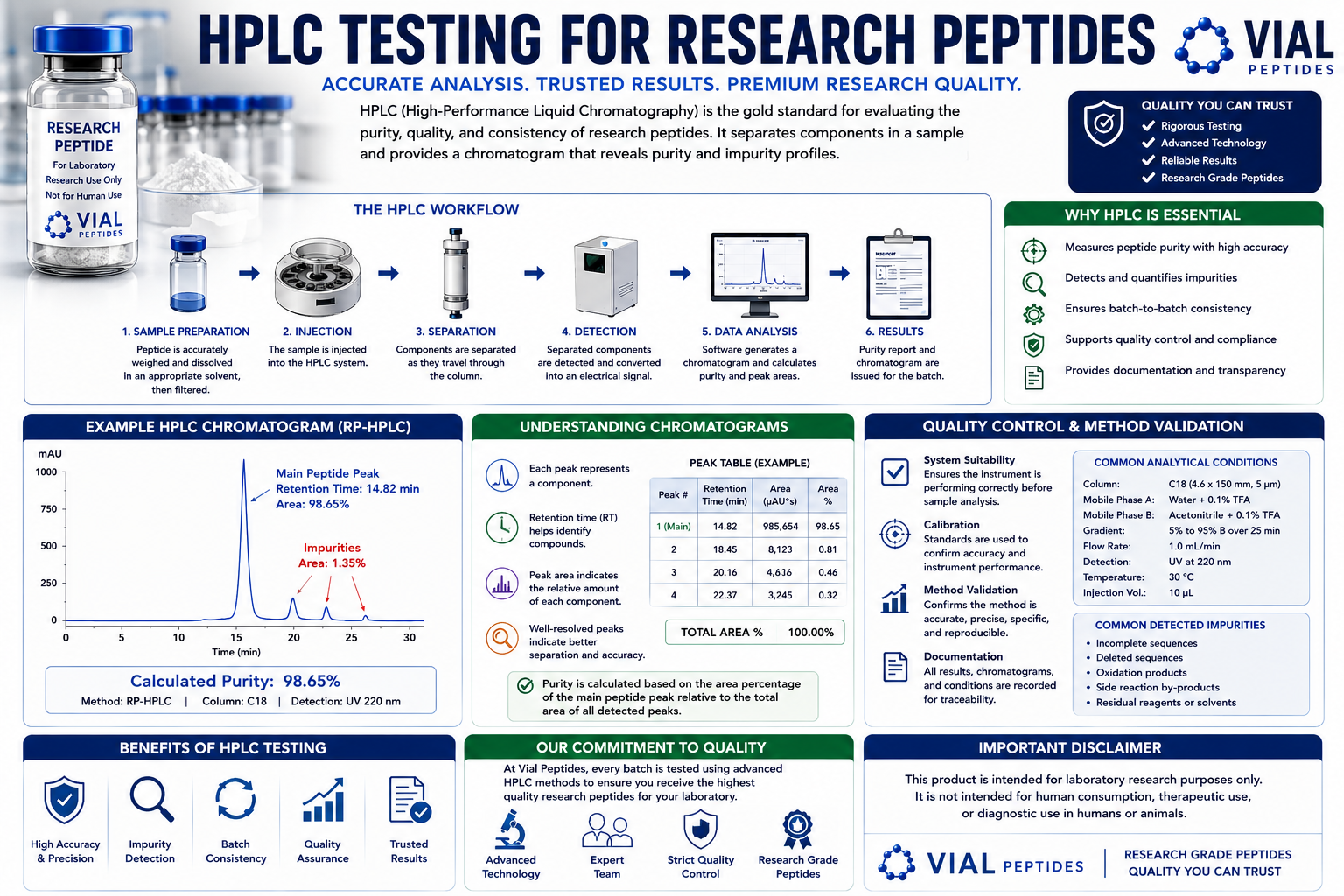
High-Performance Liquid Chromatography (HPLC) separates individual components within a sample based on their chemical properties. As different molecules move through the chromatographic system, they are detected individually, producing a chromatogram that allows researchers to evaluate sample composition in detail.
Although HPLC is frequently associated with purity testing, its role extends much further. Scientists also use chromatographic analysis to monitor purification efficiency, compare production batches, validate manufacturing processes, and support overall laboratory quality management.
This guide explains HPLC Testing for Research Peptides, how chromatographic analysis works, what chromatograms reveal, and why HPLC remains one of the most valuable analytical tools in peptide research.
What Is High-Performance Liquid Chromatography?
High-Performance Liquid Chromatography is an analytical technique that separates molecules according to their interactions with a stationary phase and a liquid mobile phase.
As a prepared sample passes through the chromatographic column, individual components travel at different rates depending on their chemical characteristics.
This separation allows scientists to identify and evaluate different substances contained within the sample.
The resulting chromatogram provides valuable analytical information regarding overall sample composition.
Why Researchers Use HPLC
Researchers rely on chromatographic analysis because it provides detailed information about sample quality while supporting standardized laboratory procedures.
Common objectives include:
- Measuring purity
- Detecting impurities
- Comparing production batches
- Evaluating purification efficiency
- Supporting quality assurance
- Monitoring manufacturing consistency
These analytical capabilities make HPLC an essential part of modern peptide laboratories.
Basic Components of an HPLC System
Every chromatographic system contains several essential components that work together during analysis.
These include:
- Solvent reservoirs
- High-pressure pumps
- Sample injector
- Chromatographic column
- Detector
- Data processing software
Each component contributes to accurate separation and reliable analytical results.
How Separation Occurs
After a sample enters the system, molecules begin traveling through the chromatographic column.
Different chemical properties cause each component to interact differently with the stationary phase.
As a result, individual compounds leave the column at different times.
This difference in retention time allows researchers to distinguish one component from another.
Careful separation forms the basis of chromatographic analysis.
Reverse-Phase HPLC
The most commonly used method in peptide laboratories is Reverse-Phase High-Performance Liquid Chromatography (RP-HPLC).
In this approach:
- The stationary phase is hydrophobic.
- The mobile phase is more polar.
- Molecules separate according to their hydrophobic interactions.
RP-HPLC provides excellent resolution for many synthetic peptide sequences and has become the standard analytical technique for purity evaluation.
What Is a Chromatogram?
A chromatogram is the graphical output produced during HPLC analysis.
Each peak represents a component detected within the analyzed sample.
Researchers evaluate chromatograms by examining:
- Peak location
- Peak height
- Peak width
- Peak symmetry
- Peak separation
- Relative peak area
These measurements help scientists interpret sample composition and manufacturing quality.
Why HPLC Is Trusted Worldwide
Research laboratories around the world continue relying on chromatographic analysis because it offers:
- Excellent reproducibility
- High analytical precision
- Reliable impurity detection
- Consistent quality assessment
- Well-established laboratory standards
These advantages explain why HPLC remains one of the most widely accepted analytical methods in peptide science.
Key Takeaways
- HPLC Testing for Research Peptides provides detailed information about sample purity and composition.
- High-Performance Liquid Chromatography separates molecules based on their chemical interactions.
- RP-HPLC is the preferred analytical method for evaluating many synthetic peptide samples.
- Chromatograms provide valuable insight into purity, impurity profiles, and manufacturing quality.
- Standardized chromatographic procedures support reliable laboratory research and reproducible scientific results.
Chromatogram Interpretation, Method Validation, and Laboratory Quality Standards
Chromatographic analysis provides far more information than a simple purity percentage. Scientists carefully evaluate every stage of the analytical process, from sample preparation to data interpretation, to ensure reliable and reproducible results. Modern laboratories follow standardized procedures so that analytical findings remain consistent across different production batches and research facilities.
Understanding how chromatographic data are generated and interpreted helps researchers evaluate the quality of laboratory materials with greater confidence.
Preparing Samples for Analysis
Accurate analysis begins before the sample enters the chromatographic system.
Researchers carefully prepare each sample to reduce variability and improve measurement accuracy.
Preparation commonly includes:
- Selecting an appropriate solvent
- Achieving complete dissolution
- Filtering particulate matter
- Measuring accurate concentrations
- Labeling samples correctly
- Preventing cross-contamination
Careful preparation helps ensure reliable chromatographic performance and consistent analytical results.
The Role of the Mobile Phase
The mobile phase is the liquid that transports sample components through the chromatographic system.
Its composition plays a significant role in achieving effective molecular separation.
Scientists carefully optimize the mobile phase to improve:
- Peak resolution
- Separation efficiency
- Retention behavior
- Analytical reproducibility
- Detection sensitivity
Small adjustments in solvent composition can noticeably influence chromatographic performance.
Understanding the Stationary Phase
Inside the chromatographic column is a stationary phase that interacts differently with each molecule.
As compounds travel through the column, these interactions determine how quickly each component moves.
Researchers evaluate the stationary phase because it influences:
- Separation quality
- Peak shape
- Retention time
- Resolution
- Overall analytical performance
Selecting the appropriate column is an important part of developing reliable analytical methods.
Retention Time
Retention time is the amount of time required for a particular component to travel through the chromatographic system and reach the detector.
Scientists compare observed retention times with validated reference data to help confirm sample identity.
Although retention time alone does not prove identity, it provides valuable supporting information when combined with other analytical techniques.
Peak Resolution
A successful chromatographic analysis depends on clearly separated peaks.
Good resolution allows researchers to distinguish the desired compound from closely related impurities.
Factors influencing resolution include:
- Column selection
- Mobile phase composition
- Flow rate
- Temperature
- Sample concentration
- Instrument performance
Well-resolved chromatograms improve analytical confidence and simplify interpretation.
Detector Technologies
Different detectors can be used depending on the analytical objective.
Common detector types include:
- Ultraviolet (UV) detectors
- Photodiode Array (PDA) detectors
- Fluorescence detectors
- Mass Spectrometry interfaces
Each detector provides different analytical information while contributing to overall quality assessment.
Method Validation
Before an analytical procedure becomes part of routine laboratory operations, researchers perform method validation.
Validation demonstrates that the analytical method consistently produces reliable and reproducible results.
Typical validation parameters include:
- Accuracy
- Precision
- Specificity
- Linearity
- Detection limits
- Robustness
Validated methods improve confidence in analytical data and support consistent laboratory practices.
System Suitability Testing
Laboratories often perform system suitability tests before analyzing research samples.
These checks confirm that the chromatographic system is functioning correctly.
Researchers evaluate:
- Peak symmetry
- Resolution
- Detector response
- Retention consistency
- Instrument stability
- Baseline quality
Only after these requirements are met does routine sample analysis begin.
Quality Control During Routine Analysis
Quality control continues throughout every analytical sequence.
Laboratories routinely monitor:
- Calibration standards
- Reference materials
- Blank samples
- Replicate analyses
- Instrument performance
- Environmental conditions
Continuous monitoring helps identify potential issues before they affect analytical results.
Documentation and Data Integrity
Reliable laboratory research depends on complete and accurate documentation.
Analytical records typically include:
- Sample identification
- Instrument settings
- Chromatograms
- Calibration records
- Quality control results
- Analyst observations
Maintaining detailed documentation supports traceability, quality management, and long-term data reliability.
Why HPLC Is Combined with Other Methods
Although chromatography provides extensive information about sample purity, researchers frequently combine it with additional analytical techniques.
Complementary methods include:
- Mass Spectrometry (MS)
- Nuclear Magnetic Resonance (NMR)
- Amino Acid Analysis
- Sequence Verification
- Capillary Electrophoresis
Together, these approaches provide a comprehensive evaluation of molecular identity, structure, and composition.
Key Takeaways
- Reliable chromatographic analysis begins with careful sample preparation and optimized analytical conditions.
- Mobile phase composition, stationary phase selection, and retention time all influence separation quality.
- Method validation and system suitability testing ensure analytical reliability.
- Continuous quality control and complete documentation strengthen confidence in laboratory data.
- Combining chromatography with complementary analytical techniques provides a more comprehensive assessment of research materials.
Future Developments, Frequently Asked Questions, and Conclusion
High-performance liquid chromatography remains one of the most trusted analytical techniques in peptide science, but the technology continues to evolve. Improvements in instrumentation, software, automation, and data analysis are enabling laboratories to perform faster, more sensitive, and more reproducible analyses than ever before.
As scientific research expands, chromatographic methods will continue to play an essential role in evaluating research materials, supporting quality assurance, and maintaining confidence in laboratory findings.
The Future of Chromatographic Analysis
Analytical laboratories are constantly refining testing procedures to improve efficiency and accuracy.
Several technological developments are shaping the next generation of chromatographic analysis.
Artificial Intelligence in Data Interpretation
Artificial intelligence is beginning to assist laboratories with analytical data review.
Researchers use AI-supported software to:
- Identify unusual chromatographic patterns.
- Detect subtle peak variations.
- Compare historical analytical data.
- Improve trend analysis.
- Support automated quality monitoring.
- Reduce manual review time.
These systems complement laboratory expertise while improving workflow efficiency.
High-Resolution Chromatography
Modern chromatographic instruments continue to achieve higher analytical performance.
New technologies provide:
- Improved peak separation
- Greater detection sensitivity
- Faster analytical run times
- Enhanced reproducibility
- Better impurity characterization
These improvements allow researchers to examine increasingly complex samples with greater confidence.
Integrated Laboratory Systems
Many facilities now connect analytical instruments to digital laboratory management platforms.
These systems improve:
- Sample traceability
- Electronic record keeping
- Instrument monitoring
- Automated reporting
- Quality documentation
- Long-term data management
Digital integration supports efficient laboratory operations while strengthening data integrity.
Sustainable Laboratory Practices
Research organizations are also working to reduce the environmental impact of analytical testing.
Current initiatives focus on:
- Lower solvent consumption.
- More efficient chromatography columns.
- Reduced laboratory waste.
- Energy-efficient instrumentation.
- Improved recycling procedures.
These improvements help laboratories maintain high analytical standards while promoting sustainability.
Frequently Asked Questions
What is HPLC?
High-Performance Liquid Chromatography (HPLC) is an analytical technique used to separate, identify, and evaluate the individual components within a sample. It is widely used in peptide laboratories to assess purity and manufacturing quality.
Why is HPLC important in peptide research?
Chromatographic analysis helps researchers evaluate sample composition, detect impurities, compare manufacturing batches, and support reproducible scientific investigations.
What is RP-HPLC?
Reverse-Phase High-Performance Liquid Chromatography (RP-HPLC) is the most commonly used chromatographic method for evaluating synthetic peptide samples because it provides excellent molecular separation and reliable purity assessment.
What does a chromatogram show?
A chromatogram displays the components detected during analysis. Each peak corresponds to a different substance, allowing researchers to evaluate sample composition and analytical quality.
Does HPLC confirm molecular identity?
HPLC provides valuable analytical information but is often combined with Mass Spectrometry, Nuclear Magnetic Resonance, and other techniques to confirm molecular identity and structural characteristics.
Why are chromatograms important?
Chromatograms allow researchers to observe separation quality, identify impurities, compare production batches, and document analytical results for quality assurance.
Can chromatographic results vary?
Minor variation may occur because of instrument settings, sample preparation, column condition, or mobile phase composition. Standardized laboratory procedures help minimize these differences.
How is chromatographic analysis expected to evolve?
Future developments are expected to include greater automation, artificial intelligence, enhanced chromatography systems, improved digital data management, and more environmentally sustainable laboratory practices.
Conclusion
HPLC Testing for Research Peptides is a cornerstone of modern analytical chemistry and laboratory quality assurance. By separating sample components and generating detailed chromatographic data, HPLC allows researchers to evaluate purity, monitor manufacturing consistency, and identify potential impurities with a high degree of precision.
When combined with complementary techniques such as Mass Spectrometry (MS), Nuclear Magnetic Resonance (NMR), amino acid analysis, and sequence verification, chromatographic analysis provides a comprehensive understanding of research materials before they are used in scientific investigations.
As laboratory technologies continue to improve, HPLC will remain one of the most valuable analytical methods for supporting peptide manufacturing, biotechnology, molecular biology, and analytical research. Ongoing advances in instrumentation, automation, and digital laboratory management will continue strengthening quality assurance and scientific reproducibility across the global research community.