
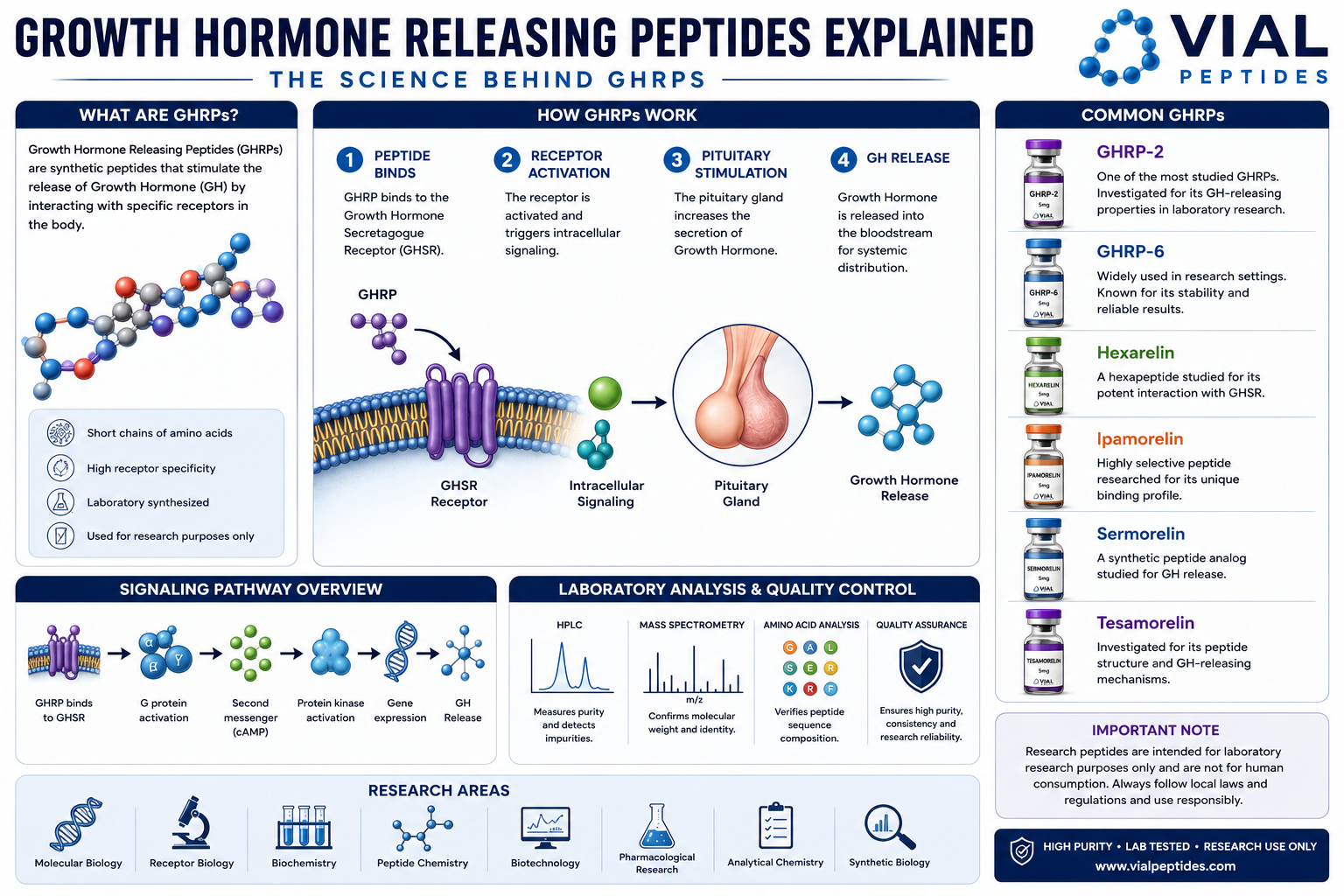
Growth Hormone Releasing Peptides Explained: Understanding the Science Behind GHRPs
Growth Hormone Releasing Peptides Explained begins with understanding a unique family of synthetic peptide molecules commonly referred to as GHRPs. These short chains of amino acids are widely investigated in peptide science because they interact with specific biological receptors involved in cellular signaling pathways. Their well-defined molecular structures and reproducible synthesis have made them valuable research tools in biotechnology and molecular biology laboratories.
Unlike larger proteins, GHRPs are relatively small molecules composed of carefully arranged amino acid sequences. Researchers investigate these compounds to understand receptor recognition, signal transduction, molecular interactions, and peptide chemistry. Continued advances in analytical technology have made it possible to study these interactions with increasing precision while expanding scientific knowledge of peptide biology.
Modern laboratories use techniques such as High-Performance Liquid Chromatography (HPLC), Mass Spectrometry (MS), Nuclear Magnetic Resonance (NMR), and sequence verification to characterize research materials before they are used in experimental studies. These quality-control procedures help ensure consistency, reproducibility, and reliable analytical results.
This comprehensive guide explains the biology of growth hormone releasing peptides, how researchers study them, the different peptide families within this category, and their importance in modern scientific research.
What Are Growth Hormone Releasing Peptides?
Growth hormone releasing peptides are synthetic peptide molecules designed for scientific investigation of specific cellular signaling pathways and receptor interactions. They belong to a broader group of research peptides that are studied to improve understanding of molecular communication, peptide chemistry, and biological regulation.
Scientists investigate these molecules because they demonstrate highly selective interactions with particular receptors, allowing researchers to examine signaling mechanisms under carefully controlled laboratory conditions.
Although individual compounds differ in amino acid sequence and molecular characteristics, they share several common features:
- Short amino acid chains
- Precisely defined molecular structures
- Laboratory synthesis using standardized methods
- High analytical purity
- Well-characterized chemical properties
- Compatibility with advanced laboratory research
These characteristics make them valuable subjects for biochemical and molecular investigations.
Why Researchers Study GHRPs
Scientists continue investigating these peptide molecules because they provide valuable insight into cellular communication and receptor biology.
Current areas of investigation include:
- Receptor recognition
- Signal transduction
- Molecular interactions
- Protein signaling
- Peptide chemistry
- Structural biology
- Biotechnology
- Analytical chemistry
Research in these areas continues to improve our understanding of molecular communication within biological systems.
How These Peptides Are Produced
Most research-grade materials are manufactured using Solid-Phase Peptide Synthesis (SPPS).
This highly controlled production method allows researchers to:
- Assemble amino acids in precise sequences
- Maintain excellent batch consistency
- Introduce controlled chemical modifications
- Produce high-purity materials
- Support reproducible laboratory investigations
Following synthesis, each batch undergoes analytical testing to verify quality before use in scientific studies.
Molecular Structure
The biological properties of these compounds are influenced by several structural characteristics.
Researchers evaluate:
- Amino acid sequence
- Molecular weight
- Three-dimensional conformation
- Chemical stability
- Charge distribution
- Hydrophobic and hydrophilic regions
Even small structural changes may influence receptor recognition and molecular behavior, making accurate characterization an essential part of peptide research.
Receptor Recognition
One of the most important areas of investigation involves understanding how these molecules recognize and bind to specific receptors.
Scientists examine:
- Binding affinity
- Structural compatibility
- Receptor activation
- Molecular specificity
- Signal initiation
- Protein interactions
These studies improve knowledge of receptor biology while supporting broader research in molecular signaling.
Laboratory Characterization
Before experimental use, research materials undergo extensive analytical evaluation.
Common quality-control procedures include:
- HPLC purity testing
- Mass Spectrometry
- Sequence verification
- Amino acid analysis
- Identity confirmation
- Stability assessment
These analytical methods improve confidence in experimental reproducibility and data quality.
Importance in Modern Peptide Science
These synthetic molecules have become important tools for laboratory research because they combine structural precision with reliable manufacturing methods.
Researchers value them for:
- Consistent molecular composition
- High analytical quality
- Flexible experimental applications
- Compatibility with modern analytical instruments
- Reliable reproducibility
- Well-defined chemical properties
These advantages continue to support advances in peptide chemistry and molecular biology.
Key Takeaways
- Growth Hormone Releasing Peptides Explained introduces a family of synthetic peptides widely investigated in molecular biology and biotechnology.
- Researchers study these compounds to understand receptor biology, signal transduction, and peptide chemistry.
- Modern laboratories rely on SPPS, HPLC, Mass Spectrometry, and NMR to synthesize and characterize research materials.
- Structural precision and analytical quality contribute to reliable laboratory investigations.
- Continued research expands scientific understanding of peptide signaling and molecular communication.
Receptor Biology, Peptide Families, Laboratory Analysis, and Scientific Research
Scientific interest in these signaling molecules has grown because of their highly specific interactions with cellular receptors and their well-defined molecular structures. Researchers continue investigating how these compounds participate in biological communication, how receptor activation influences intracellular signaling, and how structural differences affect molecular behavior.
Advances in peptide chemistry, biotechnology, and analytical science have provided laboratories with powerful tools for examining these mechanisms while maintaining rigorous quality standards.
Understanding Receptor Biology
Cellular communication depends on specialized proteins known as receptors.
These proteins recognize particular molecular structures and initiate communication inside the cell after successful binding.
Researchers investigate receptor biology to better understand:
- Molecular recognition
- Binding affinity
- Structural compatibility
- Signal initiation
- Protein interactions
- Cellular communication
Because receptor binding is highly selective, even minor differences in amino acid sequence may influence molecular behavior.
The Growth Hormone Secretagogue Receptor
One of the primary receptors investigated in this field is the Growth Hormone Secretagogue Receptor (GHSR).
Scientists study this receptor because it serves as an important model for understanding peptide–receptor interactions and intracellular signaling mechanisms.
Current areas of investigation include:
- Receptor structure
- Ligand recognition
- Signal transduction
- Protein coupling
- Molecular regulation
- Cellular responses
Research into GHSR continues to expand knowledge of receptor biology and peptide chemistry.
Signal Transduction Pathways
After receptor recognition occurs, a sequence of intracellular events begins.
This process, known as signal transduction, converts an external molecular signal into coordinated cellular activity.
Researchers investigate several components involved in these pathways, including:
- G proteins
- Protein kinases
- Second messenger molecules
- Regulatory enzymes
- Transcription factors
- Protein phosphorylation
Understanding these signaling networks helps scientists explain how cells process molecular information with remarkable precision.
Major Families of Growth Hormone Releasing Peptides
Researchers have developed several peptide families for laboratory investigation.
Some of the most widely studied include:
GHRP-2
Investigated for its receptor-binding characteristics and molecular signaling properties.
GHRP-6
Frequently studied in peptide chemistry and receptor biology because of its well-characterized molecular structure.
Hexarelin
A synthetic peptide investigated for its structural characteristics and receptor interactions in laboratory settings.
Ipamorelin
Researchers examine this peptide because of its highly selective receptor-binding profile and peptide chemistry.
Sermorelin
A synthetic peptide commonly investigated in molecular biology and peptide signaling research.
Tesamorelin
Studied for its structural properties, peptide sequence, and receptor biology.
Each compound contributes valuable information to scientific understanding while demonstrating unique molecular characteristics.
Laboratory Synthesis
Most research-grade materials are produced using Solid-Phase Peptide Synthesis (SPPS).
This manufacturing method provides several advantages:
- Precise amino acid assembly
- High reproducibility
- Consistent batch quality
- Efficient production
- Flexible molecular design
These characteristics support reliable laboratory investigations and standardized research protocols.
Analytical Characterization
Every research batch undergoes detailed analytical evaluation before experimental use.
Scientists commonly verify:
- Molecular identity
- Peptide purity
- Amino acid sequence
- Molecular weight
- Structural integrity
- Chemical stability
Comprehensive characterization improves confidence in research findings and experimental reproducibility.
High-Performance Liquid Chromatography (HPLC)
HPLC remains one of the most important analytical techniques in peptide science.
Researchers use this method to:
- Measure purity
- Separate molecular components
- Detect impurities
- Verify manufacturing consistency
- Support quality assurance
Well-characterized research materials contribute to more reliable laboratory data.
Mass Spectrometry (MS)
Mass Spectrometry allows scientists to confirm molecular identity and determine molecular weight with exceptional accuracy.
Researchers use MS to:
- Verify peptide mass
- Confirm sequence composition
- Detect trace impurities
- Support structural characterization
- Improve analytical confidence
When combined with HPLC, MS provides a comprehensive analytical profile.
Nuclear Magnetic Resonance (NMR)
NMR spectroscopy provides detailed structural information about molecular conformation.
Scientists investigate:
- Three-dimensional structure
- Atomic interactions
- Chemical environments
- Molecular flexibility
- Conformational stability
These analyses improve understanding of peptide structure and receptor recognition.
Computational Modeling
Modern laboratories increasingly combine experimental work with computational biology.
Researchers use advanced software to:
- Predict molecular structures
- Simulate receptor interactions
- Analyze amino acid sequences
- Compare peptide conformations
- Visualize molecular dynamics
Computational tools complement laboratory experiments while improving research efficiency.
Scientific Research Applications
Knowledge generated from these investigations contributes to multiple scientific disciplines.
Current areas of research include:
- Molecular biology
- Structural biology
- Protein chemistry
- Biochemistry
- Biotechnology
- Analytical chemistry
- Synthetic biology
- Biomolecular engineering
Each discipline benefits from a deeper understanding of receptor biology, molecular communication, and peptide structure.
Key Takeaways
- Specialized receptors recognize peptide molecules through highly selective molecular interactions.
- Signal transduction converts receptor binding into coordinated intracellular communication.
- Several synthetic peptide families provide valuable research models for studying receptor biology.
- SPPS, HPLC, MS, and NMR remain essential technologies for synthesis and analytical characterization.
- Computational biology and standardized laboratory methods continue to improve scientific understanding and research reproducibility.
Receptor Biology, Peptide Families, Laboratory Analysis, and Scientific Research
Scientific interest in these signaling molecules has grown because of their highly specific interactions with cellular receptors and their well-defined molecular structures. Researchers continue investigating how these compounds participate in biological communication, how receptor activation influences intracellular signaling, and how structural differences affect molecular behavior.
Advances in peptide chemistry, biotechnology, and analytical science have provided laboratories with powerful tools for examining these mechanisms while maintaining rigorous quality standards.
Understanding Receptor Biology
Cellular communication depends on specialized proteins known as receptors.
These proteins recognize particular molecular structures and initiate communication inside the cell after successful binding.
Researchers investigate receptor biology to better understand:
- Molecular recognition
- Binding affinity
- Structural compatibility
- Signal initiation
- Protein interactions
- Cellular communication
Because receptor binding is highly selective, even minor differences in amino acid sequence may influence molecular behavior.
The Growth Hormone Secretagogue Receptor
One of the primary receptors investigated in this field is the Growth Hormone Secretagogue Receptor (GHSR).
Scientists study this receptor because it serves as an important model for understanding peptide–receptor interactions and intracellular signaling mechanisms.
Current areas of investigation include:
- Receptor structure
- Ligand recognition
- Signal transduction
- Protein coupling
- Molecular regulation
- Cellular responses
Research into GHSR continues to expand knowledge of receptor biology and peptide chemistry.
Signal Transduction Pathways
After receptor recognition occurs, a sequence of intracellular events begins.
This process, known as signal transduction, converts an external molecular signal into coordinated cellular activity.
Researchers investigate several components involved in these pathways, including:
- G proteins
- Protein kinases
- Second messenger molecules
- Regulatory enzymes
- Transcription factors
- Protein phosphorylation
Understanding these signaling networks helps scientists explain how cells process molecular information with remarkable precision.
Major Families of Growth Hormone Releasing Peptides
Researchers have developed several peptide families for laboratory investigation.
Some of the most widely studied include:
GHRP-2
Investigated for its receptor-binding characteristics and molecular signaling properties.
GHRP-6
Frequently studied in peptide chemistry and receptor biology because of its well-characterized molecular structure.
Hexarelin
A synthetic peptide investigated for its structural characteristics and receptor interactions in laboratory settings.
Ipamorelin
Researchers examine this peptide because of its highly selective receptor-binding profile and peptide chemistry.
Sermorelin
A synthetic peptide commonly investigated in molecular biology and peptide signaling research.
Tesamorelin
Studied for its structural properties, peptide sequence, and receptor biology.
Each compound contributes valuable information to scientific understanding while demonstrating unique molecular characteristics.
Laboratory Synthesis
Most research-grade materials are produced using Solid-Phase Peptide Synthesis (SPPS).
This manufacturing method provides several advantages:
- Precise amino acid assembly
- High reproducibility
- Consistent batch quality
- Efficient production
- Flexible molecular design
These characteristics support reliable laboratory investigations and standardized research protocols.
Analytical Characterization
Every research batch undergoes detailed analytical evaluation before experimental use.
Scientists commonly verify:
- Molecular identity
- Peptide purity
- Amino acid sequence
- Molecular weight
- Structural integrity
- Chemical stability
Comprehensive characterization improves confidence in research findings and experimental reproducibility.
High-Performance Liquid Chromatography (HPLC)
HPLC remains one of the most important analytical techniques in peptide science.
Researchers use this method to:
- Measure purity
- Separate molecular components
- Detect impurities
- Verify manufacturing consistency
- Support quality assurance
Well-characterized research materials contribute to more reliable laboratory data.
Mass Spectrometry (MS)
Mass Spectrometry allows scientists to confirm molecular identity and determine molecular weight with exceptional accuracy.
Researchers use MS to:
- Verify peptide mass
- Confirm sequence composition
- Detect trace impurities
- Support structural characterization
- Improve analytical confidence
When combined with HPLC, MS provides a comprehensive analytical profile.
Nuclear Magnetic Resonance (NMR)
NMR spectroscopy provides detailed structural information about molecular conformation.
Scientists investigate:
- Three-dimensional structure
- Atomic interactions
- Chemical environments
- Molecular flexibility
- Conformational stability
These analyses improve understanding of peptide structure and receptor recognition.
Computational Modeling
Modern laboratories increasingly combine experimental work with computational biology.
Researchers use advanced software to:
- Predict molecular structures
- Simulate receptor interactions
- Analyze amino acid sequences
- Compare peptide conformations
- Visualize molecular dynamics
Computational tools complement laboratory experiments while improving research efficiency.
Scientific Research Applications
Knowledge generated from these investigations contributes to multiple scientific disciplines.
Current areas of research include:
- Molecular biology
- Structural biology
- Protein chemistry
- Biochemistry
- Biotechnology
- Analytical chemistry
- Synthetic biology
- Biomolecular engineering
Each discipline benefits from a deeper understanding of receptor biology, molecular communication, and peptide structure.
Key Takeaways
- Specialized receptors recognize peptide molecules through highly selective molecular interactions.
- Signal transduction converts receptor binding into coordinated intracellular communication.
- Several synthetic peptide families provide valuable research models for studying receptor biology.
- SPPS, HPLC, MS, and NMR remain essential technologies for synthesis and analytical characterization.
- Computational biology and standardized laboratory methods continue to improve scientific understanding and research reproducibility.