Common Types of Peptides: Understanding the Major Classes of Peptides
Table of Contents
- What Are the Common Types of Peptides?
- How Peptides Are Classified
- Naturally Occurring Peptides
- Synthetic Peptides
- Major Types of Peptides
- Research Applications
- Frequently Asked Questions
- Conclusion
PART 1
Common Types of Peptides: Understanding the Major Classes of Peptides
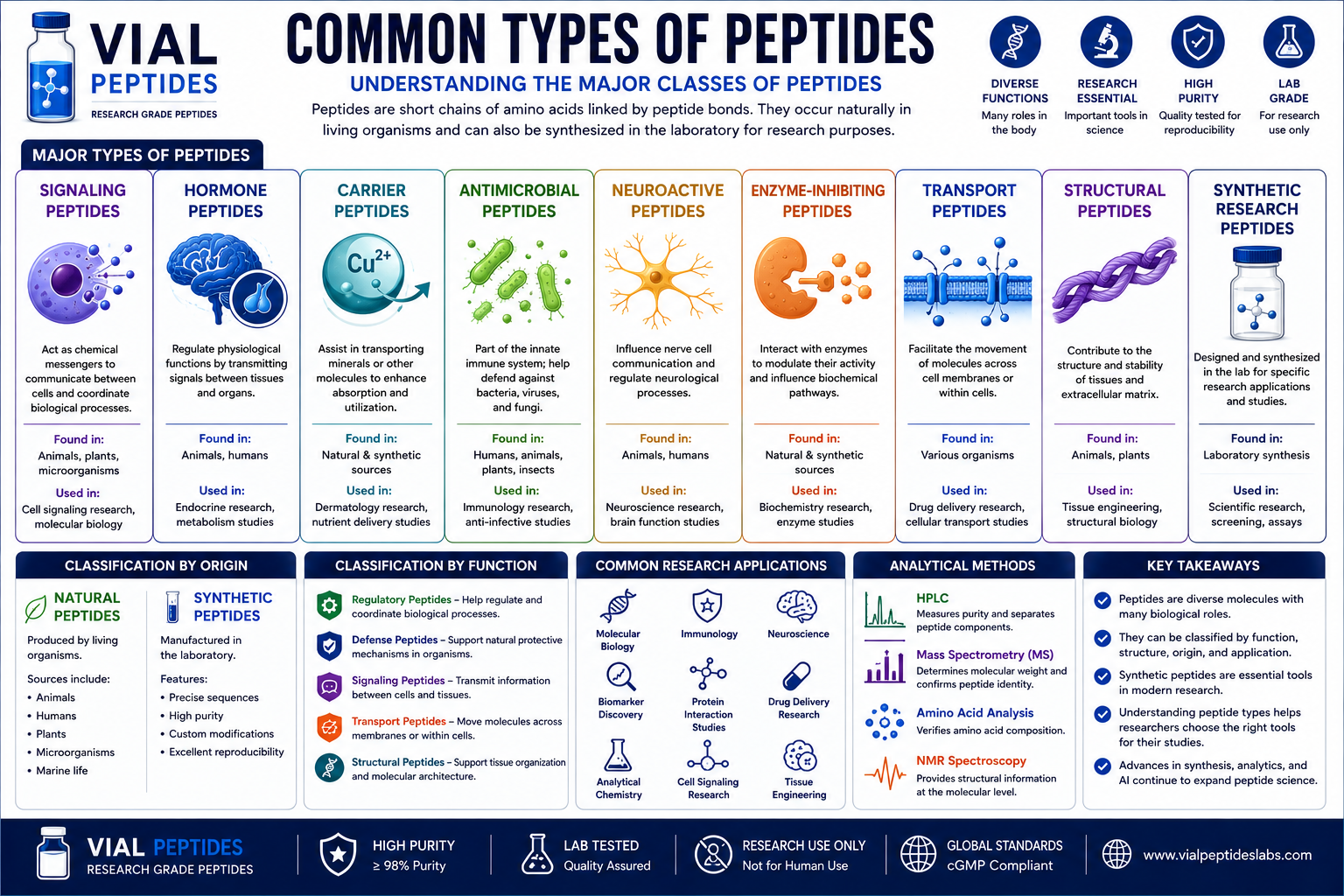
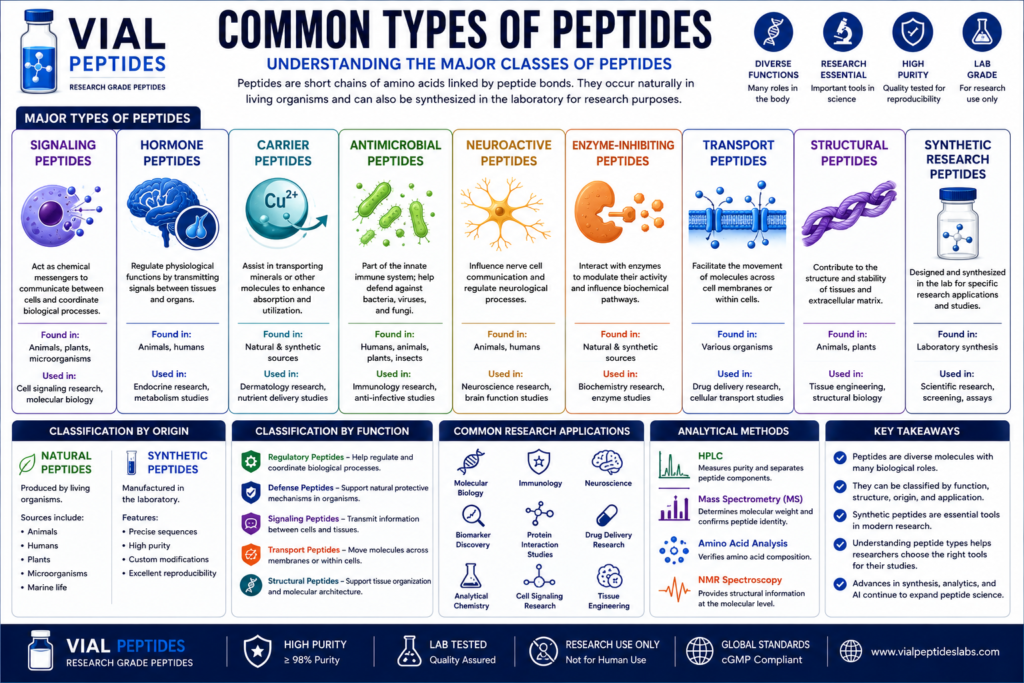
The Common Types of Peptides include a diverse group of molecules that perform essential roles in biological systems and scientific research. Although all peptides are made from amino acids joined by peptide bonds, they differ in their structure, origin, biological function, and research applications.
Understanding the Common Types of Peptides helps researchers classify peptides according to how they function and where they occur. Some peptides act as chemical messengers, while others participate in immune responses, cellular communication, or structural support. In research laboratories, synthetic peptides are also designed to investigate biological processes and molecular interactions.
As peptide science has advanced, scientists have identified thousands of peptides with unique properties. These molecules are now widely studied in molecular biology, biotechnology, analytical chemistry, and life science research.
In this guide, we explore the Common Types of Peptides, how they are classified, and why they are important in modern scientific research.
Why Understanding Common Types of Peptides Matters
Learning about the Common Types of Peptides provides a strong foundation for understanding peptide biology and peptide chemistry.
It helps researchers:
- Classify peptide molecules.
- Understand biological functions.
- Compare peptide structures.
- Select appropriate research tools.
- Interpret scientific literature.
- Organize peptide databases.
A clear understanding of peptide classification also supports accurate communication across research laboratories and scientific publications.
How Are Peptides Classified?
Scientists classify the Common Types of Peptides using several different criteria.
The most common classification methods include:
- Biological function
- Molecular structure
- Amino acid sequence
- Origin
- Chemical properties
- Research application
Because peptides are highly diverse, a single peptide may belong to more than one classification category.
Naturally Occurring Peptides
One major category within the Common Types of Peptides is naturally occurring peptides.
These peptides are produced by living organisms through normal biological processes.
Natural peptides are found in:
- Humans
- Animals
- Plants
- Bacteria
- Fungi
- Marine organisms
They participate in many biological activities, including cell signaling, immune regulation, metabolism, and communication between tissues.
Researchers study naturally occurring peptides to better understand biological systems and molecular mechanisms.
Synthetic Peptides
Another major group among the Common Types of Peptides is synthetic peptides.
Unlike natural peptides, synthetic peptides are produced in laboratories using chemical synthesis techniques such as Solid-Phase Peptide Synthesis (SPPS).
Synthetic peptides may:
- Replicate naturally occurring sequences.
- Include chemical modifications.
- Contain non-natural amino acids.
- Be designed specifically for laboratory research.
Because synthetic production offers excellent sequence control and reproducibility, these peptides are widely used in biotechnology and molecular biology.
Signaling Peptides
Signaling peptides are among the best-known Common Types of Peptides.
They function as molecular messengers that allow cells to communicate with one another.
Signaling peptides participate in processes such as:
- Hormone signaling
- Cell communication
- Tissue regulation
- Growth signaling
- Immune coordination
These peptides help coordinate complex biological activities throughout living organisms.
Hormone Peptides
Hormone peptides are another important class within the Common Types of Peptides.
These molecules function as hormones that regulate physiological processes by transmitting signals between different tissues and organs.
Examples include naturally occurring peptide hormones involved in metabolism, growth, and other biological processes.
Researchers continue to investigate hormone peptides to better understand endocrine signaling and cellular regulation.
Carrier Peptides
Carrier peptides assist in transporting molecules or facilitating interactions between biological components.
They are particularly well known in peptide-based cosmetic research because some carrier peptides help transport trace elements or support molecular interactions within biological systems.
Their unique transport capabilities make them valuable subjects for laboratory investigations.
Antimicrobial Peptides
Antimicrobial peptides represent one of the oldest groups among the Common Types of Peptides.
These naturally occurring molecules form part of the innate defense systems of many organisms.
They have been identified in:
- Humans
- Mammals
- Amphibians
- Insects
- Plants
- Marine organisms
Researchers study antimicrobial peptides to understand how organisms naturally respond to microbial challenges.
Key Takeaways
- The Common Types of Peptides can be classified by origin, structure, biological function, chemical properties, and research applications.
- Naturally occurring peptides are produced by living organisms.
- Synthetic peptides are manufactured using laboratory synthesis techniques such as SPPS.
- Signaling peptides, hormone peptides, carrier peptides, and antimicrobial peptides are among the most widely studied peptide classes.
- Understanding peptide classification supports peptide chemistry, biotechnology, and molecular biology research.
Common Types of Peptides – Classification, Functions, and Research Applications
Understanding the Common Types of Peptides is essential for anyone studying peptide science. While all peptides consist of amino acids joined by peptide bonds, each class has unique structural features and biological roles. Scientists classify peptides based on how they function, where they originate, and how they are used in laboratory research.
In this section, we explore additional Common Types of Peptides, their characteristics, and why they are important in biotechnology and molecular biology.
Signal Peptides
Signal peptides are short amino acid sequences that direct newly synthesized proteins to their correct location within a cell.
They act like biological “address labels,” guiding proteins to cellular compartments such as the endoplasmic reticulum, cell membrane, or extracellular space.
Researchers study signal peptides to better understand:
- Protein transport
- Cellular organization
- Protein secretion
- Intracellular signaling
- Molecular targeting
Signal peptides are essential for maintaining normal cellular function.
Neuroactive Peptides
Neuroactive peptides are another important group within the Common Types of Peptides.
These peptides participate in communication between nerve cells and help regulate many neurological processes.
Scientists investigate neuroactive peptides to better understand:
- Cell-to-cell signaling
- Neural communication
- Brain physiology
- Sensory pathways
- Neurobiology
Because they influence complex signaling networks, neuroactive peptides remain an active area of scientific research.
Enzyme-Inhibiting Peptides
Some peptides interact with enzymes by influencing their activity.
These are commonly known as enzyme-inhibiting peptides.
Researchers use these peptides to investigate:
- Enzyme regulation
- Molecular recognition
- Protein interactions
- Cellular pathways
- Biochemical reactions
Studying these peptides helps scientists better understand enzyme function under controlled laboratory conditions.
Structural Peptides
Structural peptides contribute to the organization and stability of biological tissues.
Although larger structural proteins provide most mechanical support, certain peptides also participate in maintaining cellular architecture and extracellular organization.
Researchers continue to study structural peptides to better understand tissue biology and molecular interactions.
Transport Peptides
Transport peptides help move molecules between different cellular compartments or assist in transporting specific compounds across biological membranes.
Scientists investigate transport peptides for their role in:
- Cellular uptake
- Molecular delivery
- Membrane transport
- Protein trafficking
- Intracellular communication
Understanding these mechanisms contributes to broader knowledge of cell biology.
Synthetic Research Peptides
Synthetic research peptides represent one of the fastest-growing categories among the Common Types of Peptides.
Unlike naturally occurring peptides, these molecules are manufactured using Solid-Phase Peptide Synthesis (SPPS) and other laboratory techniques.
Researchers value synthetic peptides because they provide:
- High sequence accuracy
- Excellent reproducibility
- Defined purity
- Custom amino acid sequences
- Flexible chemical modifications
These characteristics make synthetic peptides indispensable tools in biotechnology and molecular biology research.
Functional Classification of Peptides
Scientists often organize the Common Types of Peptides according to their primary biological function.
Regulatory Peptides
Regulatory peptides help coordinate biological signaling pathways and maintain cellular communication.
Defense Peptides
Defense peptides contribute to the natural protective systems found in many organisms.
Signaling Peptides
Signaling peptides transmit information between cells and tissues, helping coordinate physiological processes.
Transport Peptides
Transport peptides facilitate the movement of molecules within cells or across biological membranes.
Structural Peptides
Structural peptides support tissue organization and contribute to molecular architecture.
Classification by Origin
Another important way to organize the Common Types of Peptides is by their origin.
Natural Peptides
Produced naturally by living organisms.
Sources include:
- Humans
- Animals
- Plants
- Microorganisms
- Marine species
Synthetic Peptides
Manufactured in laboratories using controlled chemical synthesis.
Researchers may design synthetic peptides to:
- Replicate natural sequences
- Introduce specific modifications
- Investigate biological mechanisms
- Improve experimental reproducibility
Why Peptide Classification Is Important
Accurate classification benefits both researchers and biotechnology professionals.
Understanding the Common Types of Peptides helps scientists:
- Select appropriate laboratory tools.
- Organize peptide databases.
- Interpret scientific literature.
- Compare peptide functions.
- Design research studies.
- Communicate findings consistently.
As peptide libraries continue to grow, standardized classification systems become increasingly valuable.
Peptides in Modern Biotechnology
Biotechnology has expanded the study of the Common Types of Peptides across many research disciplines.
Current applications include:
- Molecular biology
- Structural biology
- Cell signaling research
- Immunology
- Analytical chemistry
- Protein interaction studies
- Biomarker discovery
- Synthetic biology
The versatility of peptides continues to drive innovation throughout the life sciences.
Key Takeaways
- The Common Types of Peptides can be classified according to function, origin, structure, and research application.
- Signal peptides guide proteins to their correct cellular destinations.
- Neuroactive peptides support communication between nerve cells.
- Enzyme-inhibiting peptides help researchers investigate enzyme activity.
- Structural and transport peptides contribute to cellular organization and molecular movement.
- Synthetic research peptides play an increasingly important role in biotechnology and molecular biology.
Common Types of Peptides – Future Trends, FAQs, and Conclusion
The Common Types of Peptides continue to play an increasingly important role in scientific research. As peptide chemistry, biotechnology, and molecular biology advance, researchers are identifying new peptide classes and developing innovative ways to study their structures and biological functions.
Today, peptides are indispensable research tools that support laboratory investigations across multiple scientific disciplines. Understanding the Common Types of Peptides allows researchers to select appropriate peptide classes for specific studies while improving communication through standardized classification systems.
Emerging Trends in Peptide Science
The study of the Common Types of Peptides continues to evolve rapidly. Modern laboratories are expanding peptide libraries, developing improved synthesis methods, and using advanced computational tools to analyze peptide sequences.
Several trends are shaping the future of peptide research.
Artificial Intelligence and Peptide Design
Artificial intelligence is helping researchers analyze peptide sequences more efficiently.
Scientists use AI to:
- Predict peptide structures.
- Compare amino acid sequences.
- Model peptide-protein interactions.
- Design synthetic peptides.
- Analyze large biological datasets.
These technologies improve research efficiency and accelerate scientific discovery.
Expanded Synthetic Peptide Libraries
Advances in peptide synthesis allow researchers to create increasingly diverse peptide libraries.
Modern synthetic peptides may include:
- Non-natural amino acids
- Fluorescent labels
- Stable isotope labels
- Cyclic peptide structures
- PEGylated peptides
- Lipid-modified peptides
These modifications expand the range of laboratory applications available to researchers.
Improved Quality Control
High-quality research depends on well-characterized peptides.
Modern laboratories routinely use advanced analytical techniques such as:
- High-Performance Liquid Chromatography (HPLC)
- Mass Spectrometry (MS)
- Amino Acid Analysis
- Sequence Verification
- Nuclear Magnetic Resonance (NMR)
These methods help confirm peptide identity, purity, and molecular integrity before peptides are used in laboratory investigations.
Sustainable Peptide Manufacturing
Researchers are also working to improve the environmental sustainability of peptide synthesis.
Current efforts include:
- Reducing solvent use
- Improving reaction efficiency
- Minimizing chemical waste
- Developing greener synthesis technologies
These improvements support responsible scientific research while maintaining high manufacturing standards.
Choosing the Right Peptide Class for Research
Understanding the Common Types of Peptides helps researchers choose peptides that align with their experimental objectives.
Factors often considered include:
- Biological function
- Amino acid sequence
- Molecular structure
- Chemical stability
- Required purity
- Laboratory application
Selecting an appropriate peptide class contributes to more reliable and reproducible research outcomes.
Frequently Asked Questions About Common Types of Peptides
What are the Common Types of Peptides?
The Common Types of Peptides include signaling peptides, hormone peptides, carrier peptides, antimicrobial peptides, signal peptides, neuroactive peptides, transport peptides, structural peptides, enzyme-inhibiting peptides, and synthetic research peptides.
How are peptides classified?
Scientists classify peptides according to their biological function, molecular structure, origin, amino acid sequence, chemical properties, and research applications.
What is the difference between natural and synthetic peptides?
Natural peptides are produced by living organisms, while synthetic peptides are manufactured in laboratories using techniques such as Solid-Phase Peptide Synthesis (SPPS).
Why are synthetic peptides widely used?
Synthetic peptides provide precise amino acid sequences, high purity, reproducibility, scalability, and the flexibility to introduce specific chemical modifications for laboratory research.
What are signaling peptides?
Signaling peptides act as molecular messengers that help cells communicate with one another and coordinate biological processes.
What are antimicrobial peptides?
Antimicrobial peptides are naturally occurring molecules found in many organisms. Researchers study them to better understand innate defense mechanisms and peptide biology.
Why is peptide classification important?
Classification helps researchers organize peptide information, compare biological functions, interpret scientific literature, and communicate findings accurately.
Which analytical techniques are commonly used to evaluate peptides?
Researchers commonly use High-Performance Liquid Chromatography (HPLC), Mass Spectrometry (MS), Nuclear Magnetic Resonance (NMR), Amino Acid Analysis, and sequence verification methods.
Conclusion
The Common Types of Peptides represent a diverse and expanding group of molecules that are fundamental to peptide science. Although every peptide is composed of amino acids linked by peptide bonds, different peptide classes possess unique structures, properties, and biological functions.
From signaling peptides and hormone peptides to antimicrobial peptides, transport peptides, and synthetic research peptides, each category contributes valuable insights into molecular biology, biotechnology, and analytical science. Advances in peptide synthesis, computational biology, and analytical chemistry continue to broaden the range of peptide classes available for scientific investigation.
As peptide research evolves, understanding the Common Types of Peptides will remain essential for researchers, students, and biotechnology professionals. A solid understanding of peptide classification supports accurate scientific communication, improves laboratory organization, and strengthens the foundation for future discoveries in peptide science.
Key Takeaways
- The Common Types of Peptides can be classified by function, origin, structure, chemical properties, and research applications.
- Major peptide classes include signaling peptides, hormone peptides, carrier peptides, antimicrobial peptides, signal peptides, neuroactive peptides, transport peptides, structural peptides, enzyme-inhibiting peptides, and synthetic research peptides.
- Synthetic peptides provide flexibility, reproducibility, and precise sequence control for laboratory research.
- Modern analytical techniques such as HPLC, MS, and NMR help verify peptide identity and purity.
- Advances in artificial intelligence, automation, and sustainable synthesis continue to expand peptide science.