History of Peptide Research: The Evolution of Peptide Science
Table of Contents
- What Is the History of Peptide Research?
- Early Discoveries in Peptide Science
- The Birth of Peptide Chemistry
- Milestones in Peptide Research
- Modern Peptide Technology
- The Future of Peptide Research
- Frequently Asked Questions
- Conclusion
PART 1
History of Peptide Research: The Evolution of Peptide Science
The History of Peptide Research is a remarkable story of scientific curiosity, technological innovation, and decades of discovery. From the earliest investigations into proteins and amino acids to today’s advanced peptide synthesis techniques, peptide research has transformed our understanding of biology, chemistry, and molecular science.
Today, peptides play a vital role in laboratory research, biotechnology, analytical chemistry, and molecular biology. However, the History of Peptide Research began long before modern laboratories had the sophisticated instruments available today.
Scientists spent more than a century studying amino acids, proteins, and chemical bonds before fully understanding how peptides function within living organisms. Their discoveries laid the foundation for many advances in modern peptide science.
In this guide, we explore the major milestones that shaped the History of Peptide Research, highlighting the scientists, discoveries, and technologies that continue to influence peptide research today.
Why the History of Peptide Research Matters
Understanding the History of Peptide Research provides valuable context for modern scientific developments.
Every improvement in peptide synthesis, purification, characterization, and analytical chemistry builds upon discoveries made by earlier researchers.
Studying this history helps researchers appreciate:
- How peptide chemistry evolved.
- Why peptide synthesis became possible.
- How analytical methods improved.
- Why standardized peptide nomenclature was developed.
- How biotechnology accelerated peptide research.
- Where peptide science may be heading in the future.
The History of Peptide Research demonstrates how scientific progress often occurs through many small discoveries rather than a single breakthrough.
The Early Foundations of Peptide Science
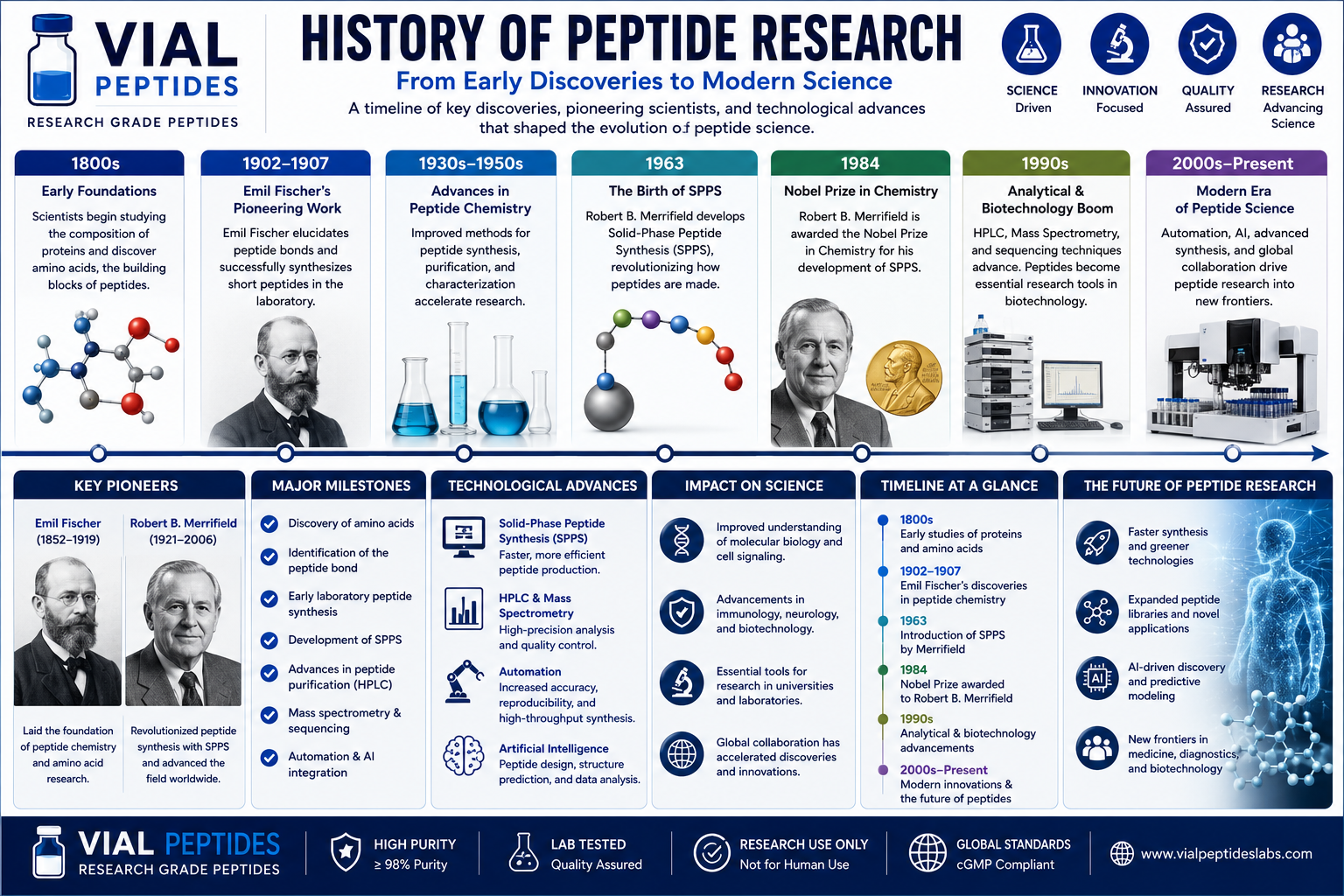
The roots of the History of Peptide Research can be traced to the nineteenth century, when scientists began investigating the chemical composition of proteins.
At the time, researchers understood that proteins were essential for life, but their molecular structure remained largely unknown.
Advances in analytical chemistry gradually revealed that proteins were composed of smaller building blocks known as amino acids.
This realization marked the beginning of a new era in biochemical research.
As scientists identified additional amino acids, they started investigating how these molecules connected to form larger biological structures.
These early studies eventually led to the discovery of peptide bonds and the concept of peptide chains.
The Discovery of Amino Acids
The identification of amino acids was one of the first major milestones in the History of Peptide Research.
Throughout the nineteenth century, chemists isolated and characterized several naturally occurring amino acids.
Each discovery expanded scientific understanding of protein composition and molecular biology.
Researchers soon realized that amino acids were not isolated compounds but components of much larger biological molecules.
This insight encouraged further investigation into how amino acids linked together.
Emil Fischer and the Birth of Peptide Chemistry
One of the most influential figures in the History of Peptide Research was Emil Fischer.
During the late nineteenth and early twentieth centuries, Fischer made groundbreaking contributions to peptide chemistry.
His research demonstrated that amino acids are connected through chemical bonds now known as peptide bonds.
He also successfully synthesized short peptides in the laboratory, proving that peptide molecules could be constructed artificially.
These achievements revolutionized peptide science.
Fischer’s work established many of the principles that continue to guide peptide chemistry today.
Because of these contributions, he is widely regarded as one of the founders of modern peptide chemistry.
The Discovery of the Peptide Bond
Another landmark event in the History of Peptide Research was understanding the peptide bond itself.
Scientists determined that amino acids connect when the amino group of one amino acid reacts with the carboxyl group of another.
This reaction forms a stable covalent bond while releasing a molecule of water.
The discovery of peptide bonds explained how simple amino acids could assemble into increasingly complex biological molecules.
It also provided the chemical foundation for peptide synthesis and protein chemistry.
Early Laboratory Peptide Synthesis
Following Fischer’s pioneering work, researchers continued developing methods for producing peptides in laboratories.
Early synthesis techniques were slow and technically challenging.
Scientists often required weeks or months to produce relatively small peptide sequences.
Despite these limitations, each success expanded the possibilities of peptide research.
These early experiments demonstrated that peptides could be manufactured outside living organisms while maintaining defined amino acid sequences.
This marked a turning point in the History of Peptide Research, opening the door to modern peptide manufacturing and analytical science.
The Expansion of Peptide Research During the Twentieth Century
The twentieth century brought rapid progress in peptide chemistry.
Researchers developed improved purification methods, discovered additional naturally occurring peptides, and gained a better understanding of peptide structure and biological function.
Advances in chromatography, spectroscopy, and analytical instrumentation enabled scientists to study peptides with increasing precision.
These developments accelerated discoveries across biochemistry, molecular biology, and biotechnology.
By the middle of the twentieth century, peptide research had become a major field of scientific investigation.
Key Takeaways
- The History of Peptide Research began with studies of proteins and amino acids in the nineteenth century.
- Discovering amino acids and peptide bonds laid the foundation for modern peptide science.
- Emil Fischer played a central role in establishing peptide chemistry.
- Early laboratory peptide synthesis demonstrated that peptides could be manufactured artificially.
- Twentieth-century advances in analytical chemistry significantly expanded peptide research.
History of Peptide Research – Major Discoveries and Scientific Breakthroughs
The History of Peptide Research entered a new era during the twentieth century. Scientists developed better laboratory techniques, discovered biologically active peptides, and created more reliable methods for peptide synthesis and analysis. These breakthroughs transformed peptide science from a small area of chemistry into a major field of biological and biochemical research.
In this section, we examine the key milestones that shaped the History of Peptide Research and continue to influence modern peptide science.
The Discovery of Biologically Active Peptides
One of the most significant developments in the History of Peptide Research was the discovery that many peptides function as natural signaling molecules within living organisms.
Researchers found that peptides help regulate numerous biological processes, including:
- Cell communication
- Hormone signaling
- Nervous system activity
- Immune responses
- Growth and development
- Metabolic regulation
These discoveries demonstrated that peptides were far more than simple chemical chains. They were essential biological messengers involved in maintaining normal physiological functions.
As additional peptides were identified, scientists gained a deeper understanding of how cells communicate and respond to their environment.
Advances in Peptide Chemistry
The History of Peptide Research closely follows the evolution of peptide chemistry.
During the early and mid-twentieth century, chemists improved methods for assembling amino acids into peptide chains. Better laboratory techniques reduced synthesis errors and increased the reliability of experimental results.
Researchers also developed improved strategies for:
- Protecting reactive chemical groups
- Controlling peptide bond formation
- Reducing unwanted side reactions
- Purifying synthesized peptides
- Confirming peptide identity
These advances laid the groundwork for today’s highly efficient peptide manufacturing processes.
The Introduction of Solid-Phase Peptide Synthesis
A major turning point in the History of Peptide Research occurred in the 1960s with the introduction of Solid-Phase Peptide Synthesis (SPPS) by Robert Bruce Merrifield.
Before SPPS, peptide synthesis was labor-intensive and time-consuming. Each reaction required extensive purification before the next amino acid could be added.
SPPS changed this process by attaching the growing peptide chain to an insoluble resin. This allowed researchers to wash away unwanted by-products after each step while keeping the peptide securely attached.
The advantages of SPPS included:
- Faster synthesis
- Higher purity
- Better reproducibility
- Reduced contamination
- Easier automation
- Improved manufacturing efficiency
Today, SPPS remains the standard method for producing synthetic research peptides.
Nobel Prize Recognition
The impact of SPPS on the History of Peptide Research was so significant that Robert Bruce Merrifield received the 1984 Nobel Prize in Chemistry for developing this revolutionary synthesis technique.
His work fundamentally changed peptide chemistry and made it possible to manufacture increasingly complex peptide sequences for scientific research.
Modern peptide laboratories continue to build upon the principles established by Merrifield’s pioneering research.
Improvements in Peptide Purification
As peptide synthesis improved, purification methods also became more sophisticated.
Scientists introduced advanced analytical techniques capable of separating peptides from impurities with exceptional accuracy.
One of the most widely used methods is High-Performance Liquid Chromatography (HPLC).
HPLC allows researchers to:
- Separate peptide molecules
- Measure purity
- Remove synthesis by-products
- Improve research consistency
High-quality purification is now considered an essential part of peptide manufacturing and quality assurance.
Mass Spectrometry and Peptide Identification
Another milestone in the History of Peptide Research was the widespread adoption of Mass Spectrometry (MS).
Mass spectrometry allows researchers to determine the molecular weight and identity of peptides with remarkable precision.
Combined with HPLC, MS provides scientists with reliable methods for:
- Confirming peptide identity
- Detecting impurities
- Verifying amino acid sequences
- Supporting quality control
These analytical techniques have become standard tools in peptide research laboratories around the world.
Growth of Biotechnology
During the late twentieth century, biotechnology accelerated the History of Peptide Research even further.
Universities, research institutes, and biotechnology companies began producing specialized peptides for laboratory investigations.
This period saw significant growth in:
- Molecular biology
- Protein research
- Immunology
- Cell signaling studies
- Structural biology
- Analytical chemistry
Peptides became indispensable research tools across many scientific disciplines.
Computer Technology and Peptide Research
Computing technology also played a major role in advancing the History of Peptide Research.
Researchers developed software capable of:
- Predicting peptide structures
- Comparing amino acid sequences
- Modeling molecular interactions
- Managing peptide databases
- Designing synthetic peptides
These computational tools increased research efficiency and improved the accuracy of peptide design.
Expansion of Global Collaboration
Another important chapter in the History of Peptide Research has been the growth of international scientific collaboration.
Researchers from universities, biotechnology companies, pharmaceutical organizations, and research institutes now work together across national borders.
Shared databases, standardized peptide nomenclature, and improved communication have accelerated scientific discovery and strengthened global research efforts.
Why These Discoveries Matter Today
Modern peptide science depends on the breakthroughs made throughout the History of Peptide Research.
Without these discoveries, researchers would not have access to:
- Reliable peptide synthesis
- High-purity research peptides
- Advanced analytical testing
- Automated manufacturing
- Global peptide databases
- Standardized peptide nomenclature
Each advancement has contributed to the development of today’s sophisticated peptide research environment.
Key Takeaways
- The discovery of biologically active peptides expanded scientific understanding of cellular communication.
- Advances in peptide chemistry improved synthesis accuracy and reproducibility.
- Robert Bruce Merrifield revolutionized peptide production through Solid-Phase Peptide Synthesis (SPPS).
- High-Performance Liquid Chromatography (HPLC) and Mass Spectrometry (MS) became essential tools for peptide purification and identification.
- Biotechnology, computing, and international collaboration continue to drive progress in peptide science.
History of Peptide Research – Modern Advances, Future Directions, FAQs, and Conclusion
The History of Peptide Research continues to evolve as scientists develop new technologies, improve peptide synthesis, and deepen our understanding of molecular biology. What began with the discovery of amino acids and peptide bonds has grown into a global field of research that supports biotechnology, analytical chemistry, structural biology, and many other scientific disciplines.
Today, peptide research is advancing faster than ever. Improvements in automation, artificial intelligence, and analytical instrumentation continue to expand what researchers can achieve with peptides.
Modern Advances in the History of Peptide Research
The modern era of the History of Peptide Research is defined by precision, efficiency, and innovation. Scientists now have access to advanced tools that were unimaginable to early peptide researchers.
These technologies have significantly improved peptide synthesis, purification, analysis, and characterization.
Some of the most important advances include:
- Automated peptide synthesizers
- High-resolution mass spectrometry
- Advanced chromatography systems
- Artificial intelligence for peptide design
- Computational molecular modeling
- High-throughput peptide screening
- Improved quality control techniques
Together, these innovations have transformed peptide science into one of the fastest-growing areas of molecular research.
Artificial Intelligence in Peptide Research
Artificial intelligence (AI) is becoming an increasingly valuable tool in peptide science.
Researchers use AI to:
- Predict peptide structures.
- Analyze amino acid sequences.
- Model peptide-protein interactions.
- Identify promising research candidates.
- Optimize synthetic peptide design.
As AI technology improves, it is expected to accelerate discoveries and reduce the time required to analyze complex peptide data.
Automation in Peptide Synthesis
Automation represents another major milestone in the History of Peptide Research.
Modern peptide synthesizers can produce highly complex peptide sequences with remarkable speed and consistency.
Automation offers several advantages:
- Improved sequence accuracy
- Reduced production time
- Better reproducibility
- Lower risk of manual errors
- Increased manufacturing efficiency
These systems have become essential in laboratories conducting peptide research around the world.
Advances in Analytical Technology
Analytical chemistry continues to play a central role in the History of Peptide Research.
Today’s laboratories use highly sophisticated instruments to verify peptide quality.
Common analytical techniques include:
- High-Performance Liquid Chromatography (HPLC)
- Mass Spectrometry (MS)
- Nuclear Magnetic Resonance (NMR)
- Amino Acid Analysis
- Capillary Electrophoresis
- Sequence Verification
These methods help researchers confirm peptide identity, purity, and structural integrity before peptides are used in laboratory studies.
Expanding Research Applications
As peptide science has advanced, researchers have explored new applications across many scientific fields.
Current areas of investigation include:
- Molecular biology
- Structural biology
- Biotechnology
- Immunology
- Neuroscience
- Biomarker discovery
- Analytical chemistry
- Protein interaction studies
- Regenerative biology
- Agricultural biotechnology
The growing diversity of applications demonstrates how far the History of Peptide Research has progressed since its early beginnings.
Looking to the Future
The future of the History of Peptide Research promises continued innovation.
Researchers are working to develop:
- Faster peptide synthesis methods
- More environmentally friendly manufacturing processes
- Improved computational design tools
- Enhanced analytical technologies
- New peptide libraries for scientific research
- More efficient quality control systems
As these technologies mature, peptide research is expected to become even more precise, scalable, and accessible to laboratories worldwide.
Frequently Asked Questions About the History of Peptide Research
What is the History of Peptide Research?
The History of Peptide Research traces the scientific discoveries that led to our understanding of peptides, including amino acids, peptide bonds, peptide synthesis, purification, and modern analytical techniques.
Who is considered the founder of peptide chemistry?
Emil Fischer is widely regarded as one of the founders of peptide chemistry because of his pioneering work on amino acids, peptide bonds, and laboratory peptide synthesis.
Who developed Solid-Phase Peptide Synthesis?
Robert Bruce Merrifield developed Solid-Phase Peptide Synthesis (SPPS), a breakthrough that revolutionized peptide manufacturing and earned him the 1984 Nobel Prize in Chemistry.
Why is peptide research important?
Peptide research helps scientists understand molecular biology, protein interactions, cell signaling, biotechnology, and many other areas of life science.
What analytical methods are commonly used in peptide research?
Researchers frequently use High-Performance Liquid Chromatography (HPLC), Mass Spectrometry (MS), Nuclear Magnetic Resonance (NMR), Amino Acid Analysis, and sequence verification techniques.
How has technology changed peptide research?
Automation, artificial intelligence, advanced chromatography, and high-resolution analytical instruments have significantly improved peptide synthesis, purification, and characterization.
What role does biotechnology play in peptide research?
Biotechnology supports the development of synthetic peptides, analytical methods, molecular biology tools, and laboratory research technologies that continue to expand peptide science.
What does the future of peptide research look like?
Future advances are expected to include improved peptide synthesis, AI-assisted molecular design, greener manufacturing methods, better quality control, and expanded research applications.
Conclusion
The History of Peptide Research reflects more than a century of scientific discovery and technological progress. From the earliest investigations into amino acids and peptide bonds to today’s advanced peptide synthesis platforms and analytical technologies, each breakthrough has contributed to the growth of modern peptide science.
Pioneers such as Emil Fischer and Robert Bruce Merrifield established the foundations of peptide chemistry, while later innovations in biotechnology, automation, and computational science have expanded the possibilities of peptide research.
As new technologies continue to emerge, the History of Peptide Research will keep evolving, providing researchers with increasingly powerful tools to investigate biological systems, improve analytical methods, and advance scientific knowledge. Understanding this history helps researchers appreciate both the achievements of the past and the exciting opportunities that lie ahead.
Key Takeaways
- The History of Peptide Research spans more than a century of scientific progress.
- Early discoveries of amino acids and peptide bonds established the foundations of peptide chemistry.
- Emil Fischer and Robert Bruce Merrifield made landmark contributions that transformed peptide science.
- Modern technologies such as SPPS, HPLC, MS, NMR, automation, and AI continue to advance peptide research.
- Peptide science remains a rapidly growing field supporting biotechnology, molecular biology, analytical chemistry, and laboratory research.