Peptide Bonds Explained: The Chemical Foundation of Every Peptide
Every peptide, regardless of its size or complexity, begins with one essential chemical connection—the peptide bond. Although invisible to the naked eye, this microscopic bond is responsible for linking amino acids into organized chains that eventually become peptides and proteins. Without peptide bonds, peptide science as we know it would not exist.
Scientists consider peptide bonds one of the most important chemical structures in molecular biology because they provide both strength and flexibility. They create stable molecular chains capable of folding into highly organized three-dimensional structures while maintaining the integrity required for scientific research.
Modern peptide manufacturing depends upon the accurate formation of peptide bonds. During synthesis, researchers carefully connect amino acids in a precise order, ensuring that every peptide matches its intended molecular design. Even a single incorrect bond may alter the identity of the finished peptide, making quality control an essential part of peptide production.
In this comprehensive guide, you’ll discover what peptide bonds are, how they form, why they are remarkably stable, and how researchers analyze peptide bond chemistry using advanced laboratory techniques.
What Is a Peptide Bond?
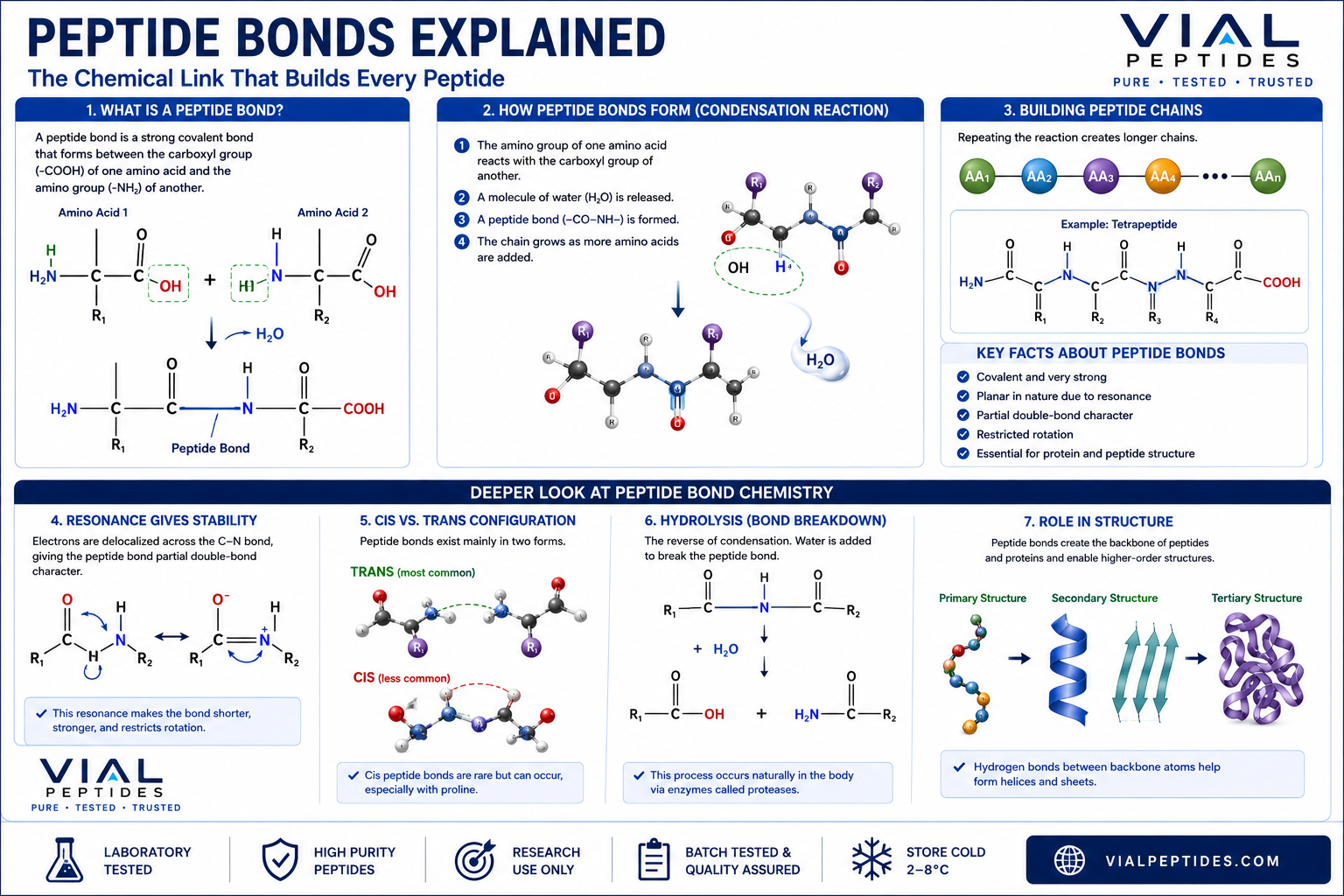
A peptide bond is a strong covalent chemical bond that joins one amino acid to another.
Specifically, it forms between:
- The carboxyl group (-COOH) of one amino acid
- The amino group (-NH₂) of another amino acid
When these two functional groups react, they create a new molecular connection while releasing one molecule of water.
The newly formed linkage is called a peptide bond.
Repeating this process creates increasingly longer amino acid chains that eventually become peptides and proteins.
Although peptide bonds are chemically small, they provide the framework upon which every peptide molecule is constructed.
Why Peptide Bonds Matter
Peptide bonds are far more than simple molecular connectors.
They determine:
- Peptide length
- Amino acid sequence
- Molecular stability
- Structural organization
- Folding potential
- Chemical properties
- Manufacturing accuracy
Researchers devote considerable attention to peptide bond chemistry because every aspect of peptide behavior begins with these connections.
Whether studying molecular biology, peptide synthesis, biotechnology, or analytical chemistry, understanding peptide bonds remains essential.
The Chemistry Behind Peptide Bond Formation
Peptide bond formation occurs through a chemical reaction known as a condensation reaction.
During this reaction:
- The amino group of one amino acid approaches the carboxyl group of another.
- A hydrogen atom from the amino group combines with a hydroxyl group from the carboxyl group.
- These atoms form a molecule of water (H₂O).
- The remaining atoms create a strong covalent bond.
This process links the two amino acids into a single molecular chain.
Because water is removed during bond formation, scientists also refer to this process as dehydration synthesis.
Understanding Condensation Reactions
Condensation reactions play a central role in peptide chemistry.
Each time a new amino acid is added to a growing peptide chain:
- One peptide bond forms.
- One water molecule is released.
- The chain increases by one amino acid.
This cycle continues until the desired amino acid sequence has been completed.
Researchers carefully monitor each condensation reaction during peptide synthesis to ensure proper sequence formation and manufacturing accuracy.
Peptide Bond Formation During Biological Processes
Living organisms naturally create peptide bonds every second.
Inside cells, highly specialized molecular machinery assembles amino acids according to genetic instructions.
Ribosomes read messenger RNA (mRNA) and connect amino acids in the correct sequence, forming peptide bonds one at a time.
This remarkable biological process allows organisms to produce thousands of different peptides and proteins with extraordinary precision.
Scientists continue studying natural peptide bond formation because it provides valuable insight into molecular biology and protein synthesis.
Peptide Bond Formation in Research Laboratories
Unlike living cells, research laboratories manufacture peptides using carefully controlled chemical methods.
The most widely used technique is Solid-Phase Peptide Synthesis (SPPS).
During SPPS:
- The first amino acid is attached to a solid resin.
- Protective chemical groups control unwanted reactions.
- New amino acids are added sequentially.
- Peptide bonds form one at a time.
- The cycle repeats until the desired sequence is complete.
This systematic process allows scientists to manufacture highly precise research peptides suitable for laboratory investigations.
Why Peptide Bonds Are So Strong
Peptide bonds possess remarkable chemical stability.
Unlike many weaker molecular interactions, peptide bonds are covalent bonds formed through shared electrons.
Breaking these bonds requires significant energy.
This strength allows peptide chains to remain intact during purification, analytical testing, packaging, and storage.
At the same time, peptide bonds maintain enough flexibility to allow peptide chains to fold into complex three-dimensional structures.
This combination of stability and flexibility makes peptide bonds uniquely suited for biological molecules.
Resonance: The Secret Behind Peptide Bond Stability
One of the reasons peptide bonds are unusually stable is a chemical phenomenon known as resonance.
In simple terms, the electrons within a peptide bond are shared over several atoms rather than remaining fixed in a single location.
This electron sharing gives the bond partial double-bond character.
As a result:
- The bond becomes stronger.
- Rotation around the bond becomes restricted.
- Molecular geometry becomes more predictable.
- Peptide structures become more stable.
Researchers study resonance because it explains many of the unique properties observed in peptide chemistry.
Why Peptide Bonds Do Not Rotate Freely
Most single covalent bonds allow atoms to rotate relatively easily.
Peptide bonds behave differently.
Because resonance gives the peptide bond partial double-bond character, rotation becomes highly restricted.
This restriction plays an important role in determining:
- Peptide shape
- Folding patterns
- Secondary structure
- Molecular recognition
- Structural stability
Scientists carefully consider peptide bond geometry when studying peptide folding and structural biology.
Peptide Bond Geometry
Peptide bonds adopt a highly organized arrangement.
Most atoms participating in the bond lie within the same geometric plane.
Researchers describe this as the planar nature of peptide bonds.
This flat arrangement contributes to:
- Predictable folding
- Stable molecular architecture
- Consistent analytical behavior
- Accurate structural modeling
Understanding peptide bond geometry allows researchers to better predict how peptide chains fold into biologically relevant structures.
Building Longer Peptide Chains
Each newly formed peptide bond extends the amino acid chain.
Researchers classify peptide chains according to their length:
- Dipeptides – two amino acids connected by one peptide bond.
- Tripeptides – three amino acids connected by two peptide bonds.
- Oligopeptides – several amino acids linked together.
- Polypeptides – longer chains that may eventually form proteins.
Regardless of chain length, every peptide depends upon correctly formed peptide bonds.
Without them, amino acids would remain isolated molecules incapable of forming the complex structures studied in modern peptide science.
Hydrolysis: Breaking Peptide Bonds
While condensation reactions create peptide bonds, another important chemical process can break them apart. This process is known as hydrolysis.
Hydrolysis is essentially the reverse of condensation.
Instead of removing water to create a bond, hydrolysis uses water to split an existing peptide bond.
During hydrolysis:
- A water molecule is added.
- The peptide bond breaks.
- The original amino acids, or shorter peptide fragments, are released.
Scientists study hydrolysis because it helps explain peptide degradation, stability, and long-term storage behavior.
Understanding both peptide bond formation and breakdown provides researchers with a complete picture of peptide chemistry.
Why Peptide Bonds Resist Hydrolysis
Although hydrolysis can break peptide bonds, these bonds do not break easily under normal conditions.
Their remarkable stability is due to:
- Strong covalent bonding
- Resonance stabilization
- Planar molecular geometry
- Electron delocalization
In living organisms, specialized enzymes known as proteases or peptidases accelerate peptide bond hydrolysis.
Without these enzymes, peptide bonds remain relatively stable.
This stability is one reason peptides can be manufactured, purified, tested, transported, and stored successfully under appropriate laboratory conditions.
Cis and Trans Peptide Bonds
One fascinating aspect of peptide chemistry is that peptide bonds can exist in two geometric arrangements:
Trans Configuration
The trans configuration is by far the most common.
In this arrangement, the side chains of neighboring amino acids are positioned on opposite sides of the peptide bond.
Advantages include:
- Reduced steric interference
- Greater structural stability
- More predictable folding
- Improved molecular organization
Most naturally occurring peptides contain peptide bonds in the trans configuration.
Cis Configuration
The cis configuration places neighboring amino acid side chains on the same side of the peptide bond.
This arrangement is much less common because the side chains may interfere with one another.
However, certain amino acids, particularly proline, are more likely to form cis peptide bonds.
Researchers investigate these unusual structures because they may influence peptide folding and molecular behavior.
Peptide Bonds and Protein Folding
Peptide bonds provide more than structural stability—they also influence how peptide chains fold.
Because peptide bonds cannot rotate freely, they help define the angles available to the amino acid chain.
This restriction guides the peptide toward specific folding patterns that determine its final three-dimensional structure.
Scientists continue investigating peptide folding because molecular shape influences:
- Structural stability
- Chemical interactions
- Receptor recognition
- Laboratory behavior
- Analytical characteristics
Understanding peptide bond geometry is therefore essential for structural biology.
Hydrogen Bonding and Secondary Structure
Although peptide bonds hold amino acids together, hydrogen bonds help organize the chain into more complex structures.
Hydrogen bonds form between atoms located along the peptide backbone.
These interactions create organized structural elements such as:
Alpha Helices
Alpha helices resemble tightly wound springs.
Hydrogen bonds stabilize these spiral structures while allowing flexibility.
Beta Sheets
Beta sheets consist of neighboring peptide strands connected through hydrogen bonding.
These sheet-like structures contribute significantly to molecular stability.
Random Coil Regions
Not every section of a peptide adopts an organized arrangement.
Some regions remain flexible, allowing peptides to interact more effectively with surrounding molecules.
Researchers analyze secondary structures because they strongly influence peptide function and stability.
Peptide Bonds in Modern Peptide Manufacturing
Every stage of peptide manufacturing depends on accurate peptide bond formation.
Manufacturers carefully monitor:
- Amino acid identity
- Bond formation efficiency
- Sequence accuracy
- Reaction completion
- Purification performance
- Final product consistency
Even one incorrectly formed peptide bond may alter the identity of the finished peptide.
For this reason, manufacturers implement rigorous quality assurance procedures throughout production.
Analytical Techniques Used to Evaluate Peptide Bonds
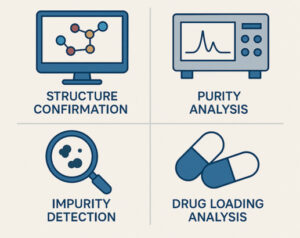
Modern laboratories use several analytical techniques to verify successful peptide synthesis.
High-Performance Liquid Chromatography (HPLC)
HPLC separates molecules according to their chemical properties.
Researchers use HPLC to:
- Estimate purity
- Detect impurities
- Compare manufacturing batches
- Evaluate purification efficiency
Although HPLC does not directly visualize peptide bonds, it provides valuable evidence that synthesis has proceeded correctly.
Mass Spectrometry
Mass Spectrometry confirms molecular identity by measuring molecular weight.
Scientists compare the measured molecular weight with the theoretical value expected from the amino acid sequence.
Agreement between these values indicates successful peptide bond formation throughout the peptide chain.
Liquid Chromatography-Mass Spectrometry (LC-MS)
LC-MS combines chromatography with Mass Spectrometry.
This integrated approach allows researchers to evaluate:
- Molecular identity
- Peptide purity
- Structural consistency
- Manufacturing quality
LC-MS has become one of the most important analytical techniques used in peptide manufacturing.
Quality Assurance During Peptide Synthesis
Manufacturing quality depends on much more than producing the correct amino acid sequence.
Scientists also verify:
- Correct peptide bond formation
- Sequence accuracy
- Molecular identity
- Purity
- Batch consistency
- Analytical documentation
Every production batch undergoes careful evaluation before being released for laboratory research.
Comprehensive quality assurance helps researchers obtain dependable materials suitable for reproducible scientific investigations.
Peptide Bond Errors and Manufacturing Challenges
Although peptide synthesis is highly advanced, manufacturers continually monitor for potential challenges.
These may include:
- Incomplete amino acid coupling
- Side reactions
- Sequence deletions
- Impurities
- Incorrect bond formation
Advanced purification methods and analytical testing help identify and remove these unwanted products.
Continuous monitoring improves manufacturing reliability and supports consistent product quality.
Why Peptide Bond Chemistry Matters in Research
Peptide bond chemistry is one of the foundations of molecular biology and peptide science.
Researchers study peptide bonds because they influence:
- Molecular architecture
- Structural stability
- Folding behavior
- Chemical properties
- Laboratory reproducibility
- Manufacturing precision
Every peptide investigated in modern laboratories depends on accurately formed peptide bonds.
Understanding this chemistry enables researchers to better interpret analytical data, improve manufacturing methods, and design increasingly sophisticated peptide molecules.
Common Misconceptions About Peptide Bonds
As peptide science has become more widely discussed, several misconceptions have developed regarding peptide bonds. Understanding the chemistry behind these molecular connections helps researchers better appreciate their importance in peptide manufacturing and scientific research.
Misconception 1: Peptide Bonds Are Weak
One of the most common misunderstandings is that peptide bonds are fragile because peptides are relatively small molecules.
In reality, peptide bonds are strong covalent bonds with partial double-bond character due to resonance. They provide exceptional stability while allowing peptide chains to maintain the flexibility required for proper folding.
Misconception 2: Peptide Bonds Form Randomly
Peptide bonds never form randomly during professional peptide manufacturing.
Modern laboratories carefully control every stage of synthesis to ensure amino acids are joined in the exact order specified by the desired peptide sequence.
Even a single incorrect peptide bond may produce a completely different molecule.
Misconception 3: Every Peptide Bond Behaves the Same
Although peptide bonds share common chemical properties, the surrounding amino acids influence how each bond contributes to folding, stability, and molecular interactions.
The local chemical environment affects the overall behavior of the peptide chain.
Misconception 4: Manufacturing Ends Once Peptide Bonds Form
Peptide bond formation represents only one stage of peptide manufacturing.
After synthesis, manufacturers continue with:
- Purification
- Analytical testing
- HPLC evaluation
- Mass Spectrometry
- Documentation
- Packaging
- Stability assessment
- Quality assurance
Each step helps verify that the finished peptide meets established quality standards.
Misconception 5: Peptide Bond Accuracy Is Easy to Achieve
Although modern peptide synthesis has become highly advanced, accurate peptide bond formation requires specialized equipment, experienced scientists, carefully selected reagents, and rigorous quality control.
Sequence verification remains one of the most important aspects of peptide manufacturing.
Why Peptide Bond Accuracy Matters
Every peptide is defined by the order in which amino acids are connected.
If one peptide bond forms incorrectly, several important molecular properties may change, including:
- Amino acid sequence
- Molecular weight
- Three-dimensional structure
- Folding behavior
- Chemical stability
- Solubility
- Analytical profile
For this reason, manufacturers continuously verify synthesis quality throughout production.
Reliable peptide research begins with reliable molecular construction.
Peptide Bonds and Quality Assurance
Quality assurance is an ongoing process that extends from raw materials to the finished product.
Researchers evaluate:
- Amino acid identity
- Peptide bond formation
- Sequence accuracy
- Purity
- Molecular identity
- Batch consistency
- Stability studies
- Documentation
Each stage contributes to the overall quality of research peptides.
Comprehensive quality assurance helps ensure researchers receive dependable materials suitable for reproducible laboratory investigations.
The Future of Peptide Bond Research
Peptide chemistry continues to evolve as new technologies improve scientists’ ability to study molecular structures with unprecedented precision.
Researchers are currently advancing:
- Automated peptide synthesis
- Artificial intelligence-assisted sequence design
- Machine learning for molecular prediction
- Ultra-high-resolution Mass Spectrometry
- Advanced chromatography systems
- Improved structural imaging
- Computational peptide modeling
- Next-generation quality control systems
These innovations are helping scientists manufacture peptides with greater efficiency, improved accuracy, and enhanced analytical confidence.
As peptide science expands, understanding peptide bond chemistry will remain fundamental to advances in molecular biology, biotechnology, pharmaceutical research, and analytical chemistry.
Frequently Asked Questions
What is a peptide bond?
A peptide bond is a covalent chemical bond that joins the carboxyl group of one amino acid to the amino group of another, forming the backbone of peptides and proteins.
How are peptide bonds formed?
Peptide bonds form during a condensation (dehydration) reaction in which a molecule of water is released as two amino acids join together.
Why are peptide bonds important?
They connect amino acids into specific sequences that determine the structure and properties of peptides.
Are peptide bonds strong?
Yes. Peptide bonds are highly stable covalent bonds with partial double-bond character, making them resistant to spontaneous breakdown under normal laboratory conditions.
Can peptide bonds be broken?
Yes. Peptide bonds can be broken through hydrolysis, a reaction in which water is used to split the bond. In biological systems, enzymes such as proteases and peptidases often catalyze this process.
What is the difference between condensation and hydrolysis?
Condensation forms peptide bonds while releasing water. Hydrolysis breaks peptide bonds by adding water.
Why can’t peptide bonds rotate freely?
Resonance gives peptide bonds partial double-bond character, restricting rotation and contributing to stable molecular geometry.
What is the trans configuration?
The trans configuration places neighboring amino acid side chains on opposite sides of the peptide bond. This is the most common arrangement in naturally occurring peptides.
What is the cis configuration?
The cis configuration places neighboring side chains on the same side of the peptide bond. It is less common but may occur more frequently near certain amino acids such as proline.
How do researchers verify peptide bond formation?
Scientists use analytical techniques such as High-Performance Liquid Chromatography (HPLC), Mass Spectrometry (MS), Liquid Chromatography–Mass Spectrometry (LC-MS), and other quality control procedures to verify successful peptide synthesis.
Why is peptide bond accuracy important?
Accurate peptide bond formation ensures the amino acid sequence matches the intended design, supporting consistent molecular identity and reliable research results.
What analytical methods are commonly used?
Researchers frequently use:
- HPLC
- Mass Spectrometry
- LC-MS
- Nuclear Magnetic Resonance (NMR)
- Circular Dichroism (CD)
These methods help evaluate purity, identity, and structural characteristics.
Why are peptide bonds essential in manufacturing?
Every stage of peptide manufacturing depends on correctly linking amino acids in the intended order. Accurate peptide bond formation is fundamental to producing high-quality research peptides.
Are VIAL PEPTIDES products intended for research?
Yes. All products supplied by VIAL PEPTIDES are manufactured for research use only.
Conclusion
Peptide bonds are the chemical foundation of every peptide. By linking amino acids together through strong covalent connections, these bonds create the molecular backbone that gives peptides their structure, stability, and identity. From the first condensation reaction during synthesis to the final analytical tests that verify quality, peptide bonds play a central role in every stage of peptide manufacturing and scientific research.
Their unique properties—including resonance stabilization, restricted rotation, and predictable geometry—allow peptide chains to fold into organized molecular structures that researchers investigate across molecular biology, biotechnology, analytical chemistry, and pharmaceutical science.
At VIAL PEPTIDES, we recognize that precise peptide bond formation is essential for producing reliable research materials. Through carefully controlled manufacturing, advanced purification, rigorous analytical testing, and comprehensive quality assurance, we are committed to supplying premium research peptides that meet the demands of modern laboratories.
As peptide science continues to advance, a solid understanding of peptide bond chemistry will remain fundamental for researchers seeking to explore molecular interactions, improve peptide synthesis, and expand the frontiers of scientific discovery.
Suggested Internal Links
Link naturally to these articles:
- What Are Peptides?
- How Peptides Work
- Amino Acids and Peptides
- Peptide Structure Explained
- Peptides vs. Proteins
- Peptide Chemistry Basics
- Peptide Synthesis Explained
- Understanding Peptide Purity and Testing
- HPLC Testing Explained
- Mass Spectrometry Explained
- Certificate of Analysis Guide
- Laboratory Tested Peptides
- High Purity Peptide Products
- Choosing a Reliable Peptide Supplier
- Research Peptides