
Kisspeptin and Reproductive Hormones
Understanding the Relationship Between Kisspeptin and Reproductive Hormones
Kisspeptin and reproductive hormones have become an important focus of scientific research due to the peptide’s role in cellular signaling pathways involved in endocrine regulation. Researchers study Kisspeptin because it interacts with the KISS1 receptor (KISS1R/GPR54) and is involved in signaling processes that influence hormone-regulating systems. These laboratory investigations continue to expand knowledge of reproductive biology, neuroendocrinology, and molecular signaling.
At VIAL PEPTIDES LABS, high-purity Kisspeptin is manufactured exclusively for research use only and is supplied for laboratory and analytical applications. Researchers use this peptide to investigate receptor interactions and hormone-related signaling pathways under controlled experimental conditions.
Research Use Only: Kisspeptin products from VIAL PEPTIDES LABS are intended solely for laboratory research and are not intended for human or veterinary use.
What Is Kisspeptin?
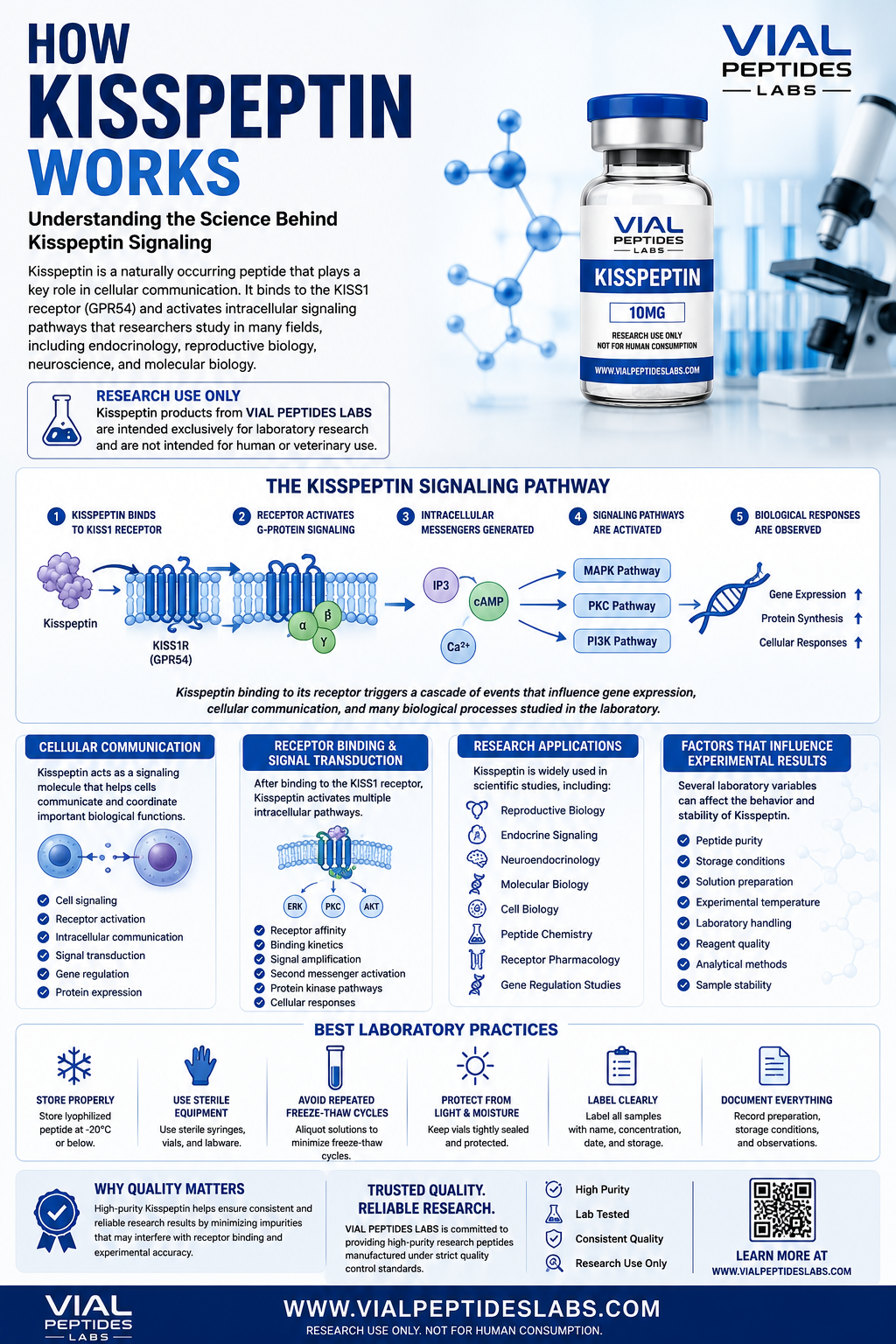
Kisspeptin is a naturally occurring peptide encoded by the KISS1 gene. It binds to the KISS1 receptor (GPR54) and activates intracellular signaling pathways that researchers study to better understand cellular communication and endocrine regulation.
Because of these signaling properties, Kisspeptin has become an important model peptide in reproductive biology research.
Kisspeptin and Hormone Signaling Research
Scientists investigate how Kisspeptin participates in signaling pathways associated with reproductive hormone regulation. Laboratory studies explore how activation of the KISS1 receptor influences communication between cells involved in endocrine function.
Research commonly focuses on:
- Receptor activation
- Cell signaling pathways
- Neuroendocrine communication
- Hormone regulation mechanisms
- Gene expression
- Molecular signaling networks
These investigations help researchers better understand the biological systems involved in reproductive physiology.
Why Researchers Study Kisspeptin
Kisspeptin has attracted significant scientific interest because it serves as a valuable research tool for investigating complex hormone signaling systems.
Areas of ongoing research include:
- Reproductive biology
- Endocrinology
- Neuroendocrinology
- Molecular biology
- Cell signaling
- Receptor pharmacology
- Peptide chemistry
- Developmental biology
These studies contribute to a broader understanding of peptide-mediated communication within biological systems.
Importance of High-Purity Research Peptides
Accurate laboratory investigations depend on consistent peptide quality. High-purity Kisspeptin helps reduce interference from impurities that could affect receptor-binding studies and analytical results.
At VIAL PEPTIDES LABS, every batch undergoes rigorous quality control procedures, including analytical verification for:
- Identity
- Purity
- Peptide content
- Batch consistency
- Manufacturing quality
These measures support reliable and reproducible laboratory research.
Laboratory Handling Considerations
Maintaining peptide integrity is essential when studying hormone-related signaling pathways.
Recommended laboratory practices include:
- Store lyophilized peptide at recommended temperatures.
- Protect samples from moisture and direct light.
- Use sterile laboratory equipment.
- Avoid repeated freeze-thaw cycles.
- Label all prepared samples clearly.
- Follow institutional laboratory protocols.
Proper handling helps preserve peptide stability throughout research.
Research Applications
Researchers use Kisspeptin in laboratory settings to investigate:
- Endocrine signaling mechanisms
- Receptor biology
- Hormone communication pathways
- Cellular signaling
- Molecular interactions
- Peptide pharmacology
- Gene regulation studies
- Experimental laboratory models
These applications continue to advance scientific knowledge in reproductive and endocrine research.
Frequently Asked Questions
What is the relationship between Kisspeptin and reproductive hormones?
Kisspeptin is widely studied because it participates in signaling pathways associated with endocrine regulation and reproductive biology. Researchers investigate these interactions to better understand hormone-related cellular communication.
Why is Kisspeptin important in reproductive research?
Its interaction with the KISS1 receptor makes Kisspeptin a valuable research tool for studying neuroendocrine signaling, receptor biology, and molecular mechanisms involved in reproductive physiology.
Why is peptide purity important?
High-purity Kisspeptin helps improve the consistency and reliability of laboratory experiments by minimizing unwanted impurities that could influence analytical results.
Is Kisspeptin intended for therapeutic use?
The Kisspeptin products supplied by VIAL PEPTIDES LABS are intended exclusively for laboratory research and are not approved for human or veterinary use.
Conclusion
Research into Kisspeptin and reproductive hormones continues to provide valuable insights into endocrine signaling and cellular communication. Through its interaction with the KISS1 receptor, Kisspeptin serves as an important research peptide for scientists studying reproductive biology, molecular signaling, and neuroendocrine systems. By using high-quality research materials from VIAL PEPTIDES LABS and following established laboratory practices, researchers can support reliable and reproducible scientific investigations.
SEO Title
Kisspeptin and Reproductive Hormones | Endocrine Research Guide
Meta Description
URL Slug
/kisspeptin-and-reproductive-hormones
Focus Keyword
Kisspeptin and Reproductive Hormones
Related SEO Keywords
- Kisspeptin and Reproductive Hormones
- Kisspeptin Hormone Signaling
- Kisspeptin Endocrine Research
- KISS1 Receptor
- Kisspeptin Research Peptide
- Reproductive Biology Research
- Neuroendocrine Signaling
- Hormone Regulation Research
- High-Purity Kisspeptin
- Kisspeptin Laboratory Research
Image Alt Text
Scientific illustration showing Kisspeptin interacting with hormone signaling pathways and the KISS1 receptor in a modern laboratory setting – VIAL PEPTIDES LABS.
Internal Linking Opportunities
Link from this article to:
| Anchor Text | Target Page |
|---|---|
| What is Kisspeptin | /Kisspeptin Structure |
| How Kisspeptin Works | /how-kisspeptin-works |
| Kisspeptin Structure | /kisspeptin-structure |
| Kisspeptin Molecular Characteristics | /kisspeptin-molecular-characteristics |
| Kisspeptin Manufacturing Process | /kisspeptin-manufacturing-process |
| Kisspeptin Laboratory Handling Guidelines | /kisspeptin-laboratory-handling-guidelines |
| Kisspeptin Stability | /kisspeptin-stability |
| Kisspeptin Storage Guidelines | /kisspeptin-storage-guidelines |
| Kisspeptin Quality Control Standards | /kisspeptin-quality-control-standards |
| Kisspeptin Certificate of Analysis (COA) | /kisspeptin-certificate-of-analysis |
| Kisspeptin Research Applications | /kisspeptin-research-applications |
| Research Peptides | /research-peptides |
| Buy Kisspeptin | /buy-kisspeptin |
Suggested External Authority References
For additional scientific background, reference peer-reviewed publications and educational resources from organizations such as:
- National Center for Biotechnology Information (NCBI)
- PubMed
- Endocrine Society
- Nature Reviews Endocrinology
These sources can complement your article while reinforcing credibility through evidence-based scientific literature.