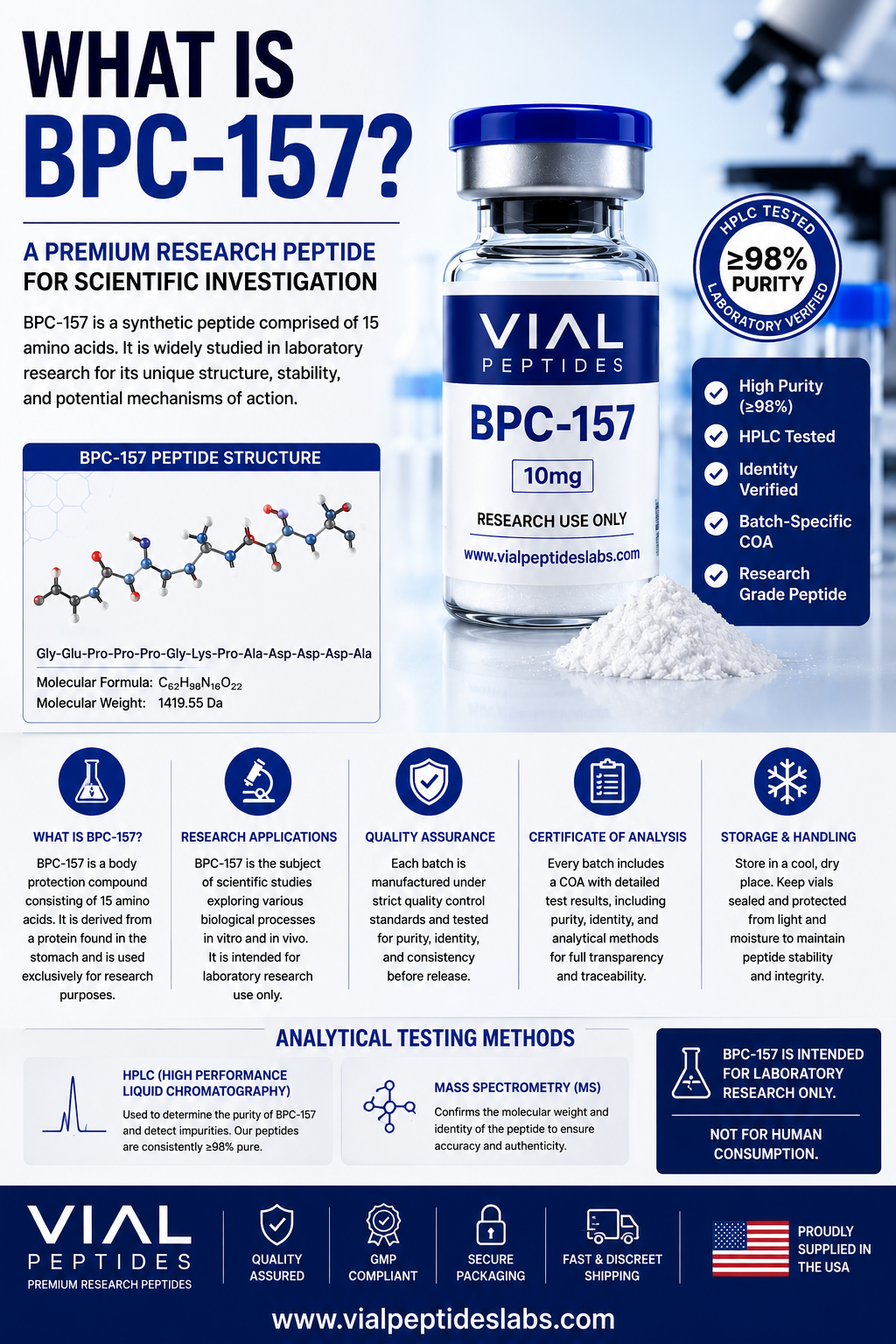
BPC-157 Certificate of Analysis | Complete COA Guide for Research Peptides
BPC-157 Certificate of Analysis
A BPC-157 Certificate of Analysis (COA) is an essential quality assurance document that provides detailed laboratory testing results for a specific production batch of a research peptide. The COA allows researchers to verify important quality characteristics such as analytical purity, identity confirmation, batch traceability, and testing methods before using the material in laboratory research.
At VIAL PEPTIDES, every production batch of BPC-157 is supported by a batch-specific Certificate of Analysis to promote transparency, consistency, and confidence in the quality of our research peptides.
What Is a Certificate of Analysis?
A Certificate of Analysis is an official laboratory document prepared after quality testing has been completed. It summarizes the analytical results obtained from a specific production batch and confirms that the material has been evaluated according to established quality control procedures.
Because every manufacturing batch is unique, each Certificate of Analysis is specific to the batch it represents.
Why a Certificate of Analysis Is Important
Researchers rely on Certificates of Analysis to verify that a peptide has undergone appropriate laboratory testing before use.
A COA helps laboratories:
- Verify product identity
- Review analytical purity
- Confirm batch consistency
- Maintain product traceability
- Support laboratory documentation
- Strengthen quality assurance programs
- Improve research reproducibility
Comprehensive documentation contributes to confidence in research materials.
Information Included in a BPC-157 COA
Although formats may differ between manufacturers, most Certificates of Analysis contain similar information.
Product Identification
The document generally includes:
- Product name
- Peptide designation
- Batch or lot number
- Manufacturing date
- Certificate issue date
These details ensure the Certificate of Analysis corresponds to the correct production batch.
Batch Number
Each manufacturing run receives a unique batch number that allows laboratories to identify and trace the material throughout storage and research.
Batch numbers support:
- Inventory management
- Laboratory record keeping
- Product traceability
- Quality assurance documentation
Analytical Purity
Purity is one of the most important sections of a Certificate of Analysis.
Analytical purity is commonly measured using High-Performance Liquid Chromatography (HPLC), which separates the target peptide from synthesis-related impurities.
The reported purity result reflects the analytical quality of the tested batch.
Identity Verification
Identity confirmation verifies that the peptide corresponds to the expected molecular structure.
This analysis commonly includes:
- Mass spectrometry
- Molecular weight verification
- Structural confirmation
Identity verification complements purity testing and supports overall quality assurance.
Appearance
Many Certificates of Analysis include a visual description of the peptide.
For lyophilized BPC-157, this section may describe characteristics such as:
- White powder
- Off-white powder
- Uniform lyophilized cake
Visual inspection is one part of a comprehensive quality control program.
Storage Recommendations
A Certificate of Analysis often includes laboratory storage guidance designed to help preserve peptide stability.
Recommendations may address:
- Temperature conditions
- Moisture protection
- Light protection
- General laboratory handling
Following these recommendations helps maintain product quality during storage.
Laboratory Testing Methods
Several analytical methods are commonly referenced within a BPC-157 Certificate of Analysis.
High-Performance Liquid Chromatography (HPLC)
HPLC measures analytical purity by separating the desired peptide from impurities generated during synthesis.
Mass Spectrometry (MS)
Mass spectrometry verifies molecular identity by confirming the expected molecular weight of the peptide.
Additional Quality Assessments
Quality assurance programs may also include:
- Batch consistency evaluations
- Stability studies
- Visual inspection
- Documentation review
These procedures contribute to comprehensive product evaluation.
How Researchers Use a Certificate of Analysis
Research laboratories use COAs for multiple quality assurance purposes.
Typical applications include:
- Product verification
- Laboratory documentation
- Batch traceability
- Inventory management
- Internal quality audits
- Research protocol documentation
Maintaining COAs alongside laboratory records supports organized and reproducible scientific research.
Characteristics of a High-Quality COA
A professional Certificate of Analysis should be:
- Batch-specific
- Clearly dated
- Easy to interpret
- Accurate
- Traceable
- Complete
- Supported by analytical testing
Comprehensive documentation reflects a strong commitment to manufacturing quality and transparency.
Choosing a Supplier That Provides Batch-Specific COAs
When selecting a BPC-157 supplier, researchers should consider whether the manufacturer provides:
- Batch-specific Certificates of Analysis
- HPLC purity testing
- Identity verification
- Transparent quality control procedures
- Secure laboratory packaging
- Consistent manufacturing standards
These features help support confidence in research materials.
Why Choose VIAL PEPTIDES?
VIAL PEPTIDES is committed to providing premium research peptides supported by rigorous laboratory testing.
Our quality commitment includes:
- High-purity research peptides
- Batch-specific Certificates of Analysis
- HPLC purity testing
- Identity verification
- Comprehensive quality control
- Secure laboratory packaging
- Reliable customer support
- Consistent manufacturing standards
Every production batch is carefully reviewed before release to help support high-quality scientific research.
Conclusion
A BPC-157 Certificate of Analysis is an essential document that helps researchers evaluate the quality, identity, purity, and traceability of a research peptide. By reviewing batch-specific laboratory documentation, scientists can make informed decisions about the materials used in their research. At VIAL PEPTIDES, every batch of BPC-157 is supported by comprehensive analytical testing and transparent documentation to help maintain the highest standards of laboratory quality.
Disclaimer: BPC-157 products supplied by VIAL PEPTIDES are intended for laboratory research purposes only. They are not approved for human consumption, therapeutic use, or diagnostic use.
Frequently Asked Questions
What is a BPC-157 Certificate of Analysis?
A Certificate of Analysis is a batch-specific laboratory document that summarizes analytical testing results, including purity, identity verification, and other quality characteristics.
Why is a COA important?
A COA provides documented evidence of the laboratory testing performed on a specific production batch, supporting traceability, quality assurance, and research documentation.
What analytical methods are commonly listed on a COA?
Certificates of Analysis often reference High-Performance Liquid Chromatography (HPLC), mass spectrometry, visual inspection, and additional quality control procedures used during product evaluation.