Research Peptide Lab: Research-Grade Peptides Supported by Laboratory Standards
Table of Contents
- Inside Our Research Peptide Lab
- Laboratory Manufacturing Standards
- Analytical Testing and Quality Assurance
- Research Peptide Production
- Technical Documentation
- Frequently Asked Questions
- Conclusion
PART 1
Research Peptide Lab: Research-Grade Peptides Supported by Laboratory Standards
A professional Research Peptide Lab is built on precision, consistency, and scientific quality. Researchers depend on laboratories that follow standardized manufacturing procedures, apply rigorous analytical testing, and maintain detailed technical documentation throughout every stage of production. These practices help support confidence in research-grade peptide products used in laboratory investigations.
At Vial Peptides, our laboratory-focused approach emphasizes quality assurance from raw material selection through final analytical evaluation. Every production batch follows carefully controlled processes designed to support consistency, transparency, and dependable research materials.
Modern peptide production combines advanced synthesis, purification, and analytical characterization. Manufacturing commonly begins with Solid-Phase Peptide Synthesis (SPPS) and is followed by analytical techniques such as Reverse-Phase High-Performance Liquid Chromatography (RP-HPLC) and Mass Spectrometry (MS). These methods help verify molecular identity, evaluate purity, and support batch-to-batch consistency.
Our goal is to provide researchers with research-grade peptide products supported by laboratory-quality manufacturing practices and detailed technical information that assists scientific investigations.
Laboratory Standards
Every laboratory process contributes to product quality.
Our workflow emphasizes:
- Standardized manufacturing procedures
- Carefully verified raw materials
- Controlled synthesis processes
- Advanced purification techniques
- Continuous process monitoring
- Comprehensive documentation
These standards help support reliable manufacturing and consistent research-grade peptide products.
Quality Assurance
Quality assurance extends throughout the manufacturing process.
Our quality systems focus on:
- Batch consistency
- Analytical verification
- Product traceability
- Documentation accuracy
- Process monitoring
- Continuous improvement
Maintaining quality at every stage helps support dependable laboratory materials.
Advanced Analytical Testing
Every production batch undergoes detailed laboratory evaluation before release.
Analytical methods may include:
- Reverse-Phase High-Performance Liquid Chromatography (RP-HPLC)
- Mass Spectrometry (MS)
- Molecular identity verification
- Purity assessment
- Sequence verification
- Batch review
Using multiple analytical techniques provides researchers with comprehensive information regarding product quality.
Research Peptide Production
Our laboratory supports the production of research peptides across multiple scientific disciplines.
Categories include:
- Growth hormone research peptides
- Recovery research peptides
- Cosmetic research peptides
- Metabolic research peptides
- Cognitive research peptides
- Experimental peptide analogues
Each product is supported by technical specifications, laboratory guidance, and quality documentation.
Transparency and Documentation
Laboratory transparency helps researchers evaluate products before ordering.
Supporting information may include:
- Product specifications
- Molecular information
- Purity data
- Storage recommendations
- Laboratory handling guidance
- Batch documentation
Providing comprehensive documentation supports informed purchasing decisions and laboratory planning.
Key Takeaways
- A Research Peptide Lab emphasizes standardized manufacturing, analytical testing, and quality assurance.
- Laboratory procedures help support consistent research-grade peptide products.
- Advanced analytical testing provides detailed product characterization.
- Transparent technical documentation strengthens researcher confidence.
- Vial Peptides is committed to laboratory-quality manufacturing and scientific transparency.
Laboratory Equipment, Manufacturing Processes, Analytical Testing, and Scientific Standards
A modern Research Peptide Lab combines specialized laboratory equipment, standardized manufacturing procedures, and comprehensive analytical testing to produce research-grade peptide products. Researchers often evaluate a laboratory’s technical capabilities, quality assurance systems, and documentation before selecting a trusted source for research materials. A laboratory that consistently applies scientific standards helps support reliable research and reproducible experimental results.
At Vial Peptides, our laboratory operations are designed to emphasize precision, consistency, and transparency throughout every stage of peptide production.
Advanced Laboratory Equipment
Modern peptide laboratories rely on specialized equipment to support accurate manufacturing and product characterization.
Laboratory equipment may include:
- Automated peptide synthesizers
- High-performance purification systems
- RP-HPLC analytical instruments
- Mass spectrometry systems
- Precision laboratory balances
- Temperature-controlled storage equipment
Using advanced laboratory technology helps maintain consistent production while supporting detailed analytical evaluation.
Standardized Manufacturing Procedures
Reliable peptide production begins with carefully controlled manufacturing.
Our production workflow emphasizes:
- Carefully verified raw materials
- Standardized peptide synthesis
- Controlled purification
- Continuous process monitoring
- Batch consistency
- Comprehensive quality documentation
These procedures help produce well-characterized research-grade peptide products suitable for laboratory investigation.
Comprehensive Analytical Testing
Every production batch undergoes detailed analytical evaluation before release.
Analytical testing may include:
- Reverse-Phase High-Performance Liquid Chromatography (RP-HPLC)
- Mass Spectrometry (MS)
- Sequence verification
- Molecular weight confirmation
- Purity assessment
- Batch review
Using multiple complementary analytical techniques provides researchers with detailed information regarding product identity and quality.
Laboratory Quality Assurance
Quality assurance is integrated into every stage of production.
Our laboratory quality system focuses on:
- Batch traceability
- Process verification
- Documentation accuracy
- Analytical consistency
- Equipment monitoring
- Continuous quality improvement
Maintaining these quality systems helps support dependable research materials across multiple production batches.
Technical Documentation
Accurate documentation supports transparency and laboratory confidence.
Researchers may review:
- Product specifications
- Molecular information
- Batch identification
- Purity results
- Storage recommendations
- Laboratory handling guidance
Detailed technical documentation allows researchers to evaluate products before ordering.
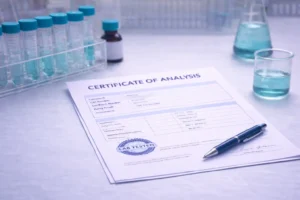
Certificates of Analysis
Analytical documentation provides valuable insight into production quality.
A Certificate of Analysis (COA) may include:
- Product identification
- Batch number
- Purity results
- Molecular weight
- Analytical methods
- Quality review information
These documents help researchers better understand the analytical characteristics of each production batch.
Secure Storage and Packaging
Proper storage and packaging help preserve product quality throughout handling and transportation.
Our procedures emphasize:
- Temperature-controlled storage
- Securely sealed containers
- Protective packaging materials
- Clear product labeling
- Batch identification
These practices help maintain product integrity from production through delivery.
Educational Scientific Resources
Our laboratory is supported by an expanding educational resource center.
Researchers can explore articles covering:
- Peptide chemistry
- Manufacturing methods
- Analytical testing
- Quality control
- Peptide purity
- Storage and handling
These educational resources help researchers strengthen their understanding of peptide science while supporting informed purchasing decisions.
Scientific Support
Professional support is an important part of the laboratory experience.
Our team can assist with:
- Product information
- Technical documentation
- Laboratory guidance
- Order assistance
- General research product questions
Responsive support helps researchers obtain the information they need quickly and efficiently.
Why Researchers Trust the Vial Peptides Laboratory
Researchers value laboratories that consistently demonstrate quality, transparency, and scientific expertise.
Our laboratory emphasizes:
- Research-grade peptide manufacturing
- Standardized laboratory procedures
- Advanced analytical testing
- Comprehensive technical documentation
- Educational scientific resources
- Responsive customer support
These principles help position Vial Peptides as a trusted research peptide laboratory.
Key Takeaways
- Modern research peptide laboratories rely on advanced equipment, standardized manufacturing, and analytical testing.
- Comprehensive quality assurance supports consistent research-grade peptide products.
- Technical documentation and Certificates of Analysis improve transparency.
- Secure storage and packaging help preserve product integrity.
- Vial Peptides combines laboratory expertise, quality systems, and scientific resources to support researchers worldwide.
Laboratory Excellence, Frequently Asked Questions, and Conclusion
A trusted Research Peptide Lab is defined by consistent scientific standards, rigorous analytical testing, and a commitment to quality throughout the manufacturing process. Researchers often rely on laboratories that provide transparent documentation, standardized production procedures, and dependable technical support. These elements help create confidence in research materials while supporting reproducible laboratory investigations.
At Vial Peptides, our laboratory operations are designed to combine precision manufacturing with comprehensive quality assurance and scientific transparency. Every stage of production is guided by established laboratory practices that help support the consistent production of research-grade peptide products.
Our Commitment to Laboratory Excellence
Quality begins with carefully managed laboratory procedures.
Our laboratory standards emphasize:
- Carefully verified raw materials
- Standardized peptide synthesis
- Advanced purification methods
- Comprehensive analytical testing
- Batch-specific documentation
- Continuous quality improvement
These practices help maintain consistent quality across every production batch.
Transparency and Scientific Documentation
Researchers benefit from access to detailed technical information before selecting research materials.
Available resources include:
- Product specifications
- Molecular information
- Batch documentation
- Storage recommendations
- Laboratory handling guidance
- Educational scientific resources
Providing accurate technical documentation helps researchers evaluate products with confidence.
Supporting Scientific Research
The Vial Peptides laboratory supports the scientific community through both products and education.
Our knowledge center continues expanding with articles covering:
- Peptide chemistry
- Peptide manufacturing
- Analytical testing
- Quality control
- Peptide purity
- HPLC analysis
- Storage and handling
These educational resources help researchers remain informed while strengthening their understanding of peptide science.
Continuous Laboratory Improvement
Scientific research continues to evolve, and our laboratory evolves with it.
Our ongoing priorities include:
- Expanding research peptide production
- Improving laboratory quality systems
- Enhancing analytical capabilities
- Strengthening technical documentation
- Publishing additional educational resources
- Improving customer experience
Continuous improvement helps us better serve laboratories and research professionals worldwide.
Frequently Asked Questions
What is a research peptide lab?
A research peptide lab is a laboratory that manufactures, analyzes, and documents research-grade peptide products using standardized scientific procedures and analytical testing methods.
How are research peptides produced?
Most research peptides are produced using Solid-Phase Peptide Synthesis (SPPS) followed by purification and analytical characterization before release.
Which analytical methods are commonly used?
Laboratory evaluation commonly includes:
- Reverse-Phase High-Performance Liquid Chromatography (RP-HPLC)
- Mass Spectrometry (MS)
- Sequence verification
- Purity assessment
- Molecular weight confirmation
These analytical techniques help characterize each production batch before release.
What technical information is available?
Researchers can typically review:
- Product descriptions
- Molecular information
- Product specifications
- Purity details
- Storage recommendations
- Laboratory handling guidance
These resources support informed laboratory purchasing decisions.
Why is laboratory quality assurance important?
Quality assurance helps maintain consistency throughout production by supporting standardized manufacturing procedures, analytical verification, and detailed documentation.
Where can I learn more about peptide science?
The Vial Peptides knowledge center includes comprehensive educational guides covering peptide chemistry, manufacturing, purification, analytical testing, quality control, stability, and laboratory best practices.
Conclusion
Selecting a trusted Research Peptide Lab is an important part of obtaining dependable research materials for scientific investigation. Laboratories that emphasize standardized manufacturing, comprehensive analytical testing, transparent documentation, and continuous quality improvement help researchers work with greater confidence and consistency.
At Vial Peptides, we are committed to producing research-grade peptide products using established laboratory procedures supported by analytical methods such as Reverse-Phase High-Performance Liquid Chromatography (RP-HPLC) and Mass Spectrometry (MS). Combined with detailed technical documentation, educational resources, and responsive customer support, our laboratory is dedicated to serving the needs of researchers and scientific organizations.
As our laboratory capabilities, product catalog, and educational resources continue to expand, we remain focused on quality, transparency, and scientific excellence. Whether you are sourcing research materials for a single project or building a long-term laboratory partnership, Vial Peptides strives to provide dependable research-grade peptide solutions.
Why Researchers Trust the Vial Peptides Laboratory
- Research-grade peptide manufacturing
- Standardized laboratory procedures
- Comprehensive analytical testing
- Batch-specific documentation
- Transparent technical information
- Secure packaging and shipping
- Educational peptide knowledge center
- Expanding laboratory capabilities
- Responsive customer support
- Commitment to scientific quality
Internal Linking Strategy
Strengthen this page by linking naturally to:
Cornerstone educational articles
- Research Peptides Guide
- What Are Peptides?
- Peptide Chemistry Basics
- How Peptides Are Synthesized
- Peptide Manufacturing Process
- Peptide Quality Control
- Peptide Purity Explained
- HPLC Testing for Research Peptides
- Peptide Stability and Storage
- Bioactive Peptides
- Cell Signaling and Peptides
Product categories
- Growth Hormone Research Peptides
- Recovery Research Peptides
- Cosmetic Research Peptides
- Metabolic Research Peptides
- Cognitive Research Peptides
- Experimental Research Peptides
Individual product pages
- BPC-157
- TB-500
- CJC-1295
- Ipamorelin
- GHK-Cu
- Tesamorelin
- GHRP-2
- GHRP-6
- Hexarelin
- Semax
- Selank
- MOTS-c
- Epitalon
- AOD-9604
- IGF-1 LR3
- AICAR
- LL-37
- KPV
- Melanotan II
- DSIP