
Evolution of Peptide Science: From Early Discovery to Modern Innovation
Table of Contents
- What Is the Evolution of Peptide Science?
- Early Foundations of Peptide Science
- The Growth of Peptide Chemistry
- Scientific Breakthroughs
- Modern Peptide Technologies
- The Future of Peptide Science
- Frequently Asked Questions
- Conclusion
PART 1
Evolution of Peptide Science: From Early Discovery to Modern Innovation
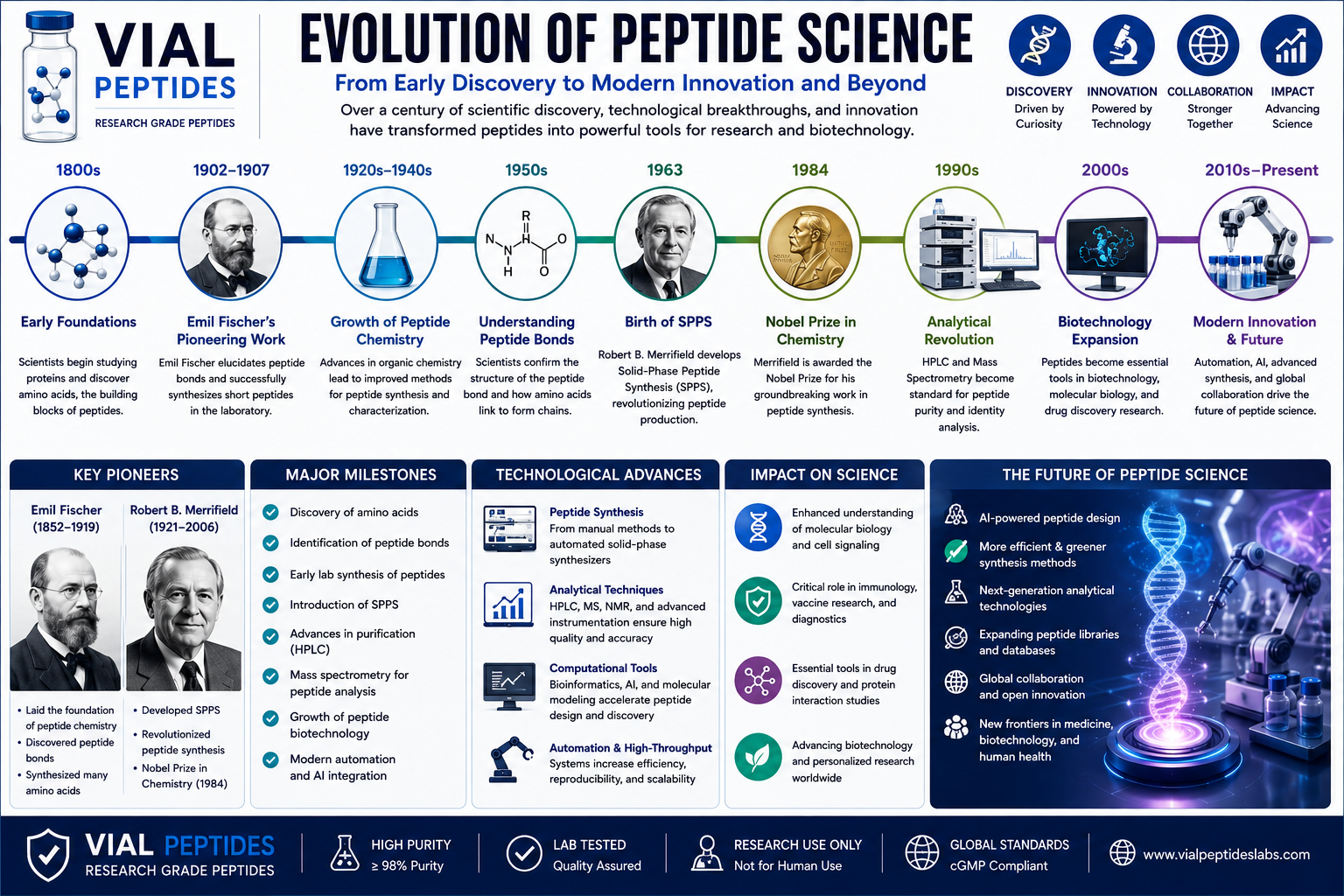
The Evolution of Peptide Science represents one of the most significant journeys in modern chemistry and molecular biology. Over more than a century, scientists have transformed peptides from little-understood chemical compounds into some of the most extensively studied molecules in life science research.
Today, peptides are central to biotechnology, analytical chemistry, structural biology, molecular biology, and many other research disciplines. This progress did not happen overnight. Instead, the Evolution of Peptide Science has been shaped by countless discoveries, technological breakthroughs, and the contributions of pioneering scientists across generations.
Understanding how peptide science has evolved provides valuable insight into why peptides are so important in modern research. It also helps explain how improvements in peptide synthesis, purification, analytical testing, and computational biology continue to expand scientific possibilities.
In this guide, we examine the major milestones in the Evolution of Peptide Science, beginning with the earliest discoveries of amino acids and ending with today’s cutting-edge technologies that are driving peptide research forward.
Why the Evolution of Peptide Science Matters
Studying the Evolution of Peptide Science helps researchers appreciate the scientific progress that has made modern peptide research possible.
Each advancement has contributed to:
- Better understanding of peptide chemistry.
- Improved peptide synthesis methods.
- More accurate analytical techniques.
- Higher-quality research peptides.
- Expanded biotechnology applications.
- Greater international scientific collaboration.
Without these developments, many of today’s laboratory techniques would not exist.
The Early Origins of Peptide Science
The Evolution of Peptide Science began during the nineteenth century when scientists first investigated the chemical composition of proteins.
Researchers recognized that proteins played essential biological roles, but their structure remained largely unknown.
As analytical chemistry advanced, scientists isolated several amino acids and discovered that proteins were composed of smaller molecular building blocks.
This breakthrough fundamentally changed biological chemistry.
Researchers soon began investigating how amino acids were connected, eventually leading to the discovery of peptide bonds and peptide chains.
The Discovery of Amino Acids
One of the earliest milestones in the Evolution of Peptide Science was the identification of amino acids.
Throughout the nineteenth century, chemists isolated and characterized individual amino acids from natural sources.
Each discovery expanded scientific understanding of protein composition and molecular structure.
Scientists gradually realized that amino acids served as the fundamental components of peptides and proteins.
This realization provided the chemical foundation for future peptide research.
Emil Fischer and Modern Peptide Chemistry
No discussion of the Evolution of Peptide Science is complete without recognizing the contributions of Emil Fischer.
During the late nineteenth and early twentieth centuries, Fischer demonstrated how amino acids connect through peptide bonds and successfully synthesized short peptide chains in the laboratory.
His pioneering work established many of the principles that still guide peptide chemistry today.
Because of these achievements, Fischer is widely regarded as one of the founders of modern peptide chemistry.
Understanding Peptide Bonds
The discovery of peptide bonds marked another major step in the Evolution of Peptide Science.
Scientists learned that amino acids join together through covalent bonds formed between amino and carboxyl groups.
This discovery explained how simple amino acids could assemble into increasingly complex biological molecules.
Understanding peptide bonds also laid the groundwork for synthetic peptide production.
Early Peptide Synthesis
Following Fischer’s discoveries, researchers began developing laboratory methods for synthesizing peptides.
Although these early techniques were time-consuming, they demonstrated that peptides could be manufactured outside living organisms while maintaining precise amino acid sequences.
This achievement represented a major milestone in the Evolution of Peptide Science, opening new opportunities for peptide chemistry and molecular biology.
The Expansion of Peptide Science
During the first half of the twentieth century, peptide science expanded rapidly.
Researchers identified new peptides, improved purification techniques, and developed increasingly sophisticated analytical methods.
Advances in chromatography, spectroscopy, and biochemical analysis allowed scientists to investigate peptide structure and function with greater precision than ever before.
By the middle of the century, peptide research had become an established scientific discipline with growing importance in biology and chemistry.
Key Takeaways
- The Evolution of Peptide Science began with studies of proteins and amino acids in the nineteenth century.
- Discoveries of amino acids and peptide bonds established the foundations of peptide chemistry.
- Emil Fischer made pioneering contributions to peptide synthesis and peptide chemistry.
- Early peptide synthesis demonstrated that peptides could be produced in laboratory settings.
- Advances in analytical chemistry accelerated the growth of peptide science.
Evolution of Peptide Science – Breakthroughs That Shaped Modern Research
The Evolution of Peptide Science accelerated during the twentieth century as researchers developed new technologies, identified biologically active peptides, and improved methods for peptide synthesis and analysis. These advances transformed peptide science from a specialized area of chemistry into one of the most important disciplines in biotechnology and molecular biology.
Today, scientists continue to build on these discoveries, using increasingly sophisticated tools to explore peptide structure, function, and molecular interactions.
The Discovery of Biologically Active Peptides
One of the most important milestones in the Evolution of Peptide Science was the discovery that peptides act as biological messengers throughout living organisms.
Researchers found that peptides help regulate numerous physiological processes, including:
- Cell communication
- Hormone signaling
- Immune system activity
- Nervous system function
- Growth and development
- Metabolic regulation
- Tissue maintenance
These discoveries fundamentally changed scientific understanding of peptide biology.
Instead of viewing peptides as simple chemical chains, researchers recognized them as highly specialized molecules that play critical roles in cellular communication.
Growth of Peptide Chemistry
As the Evolution of Peptide Science continued, peptide chemistry became increasingly sophisticated.
Scientists developed improved methods for:
- Building peptide chains
- Protecting reactive amino acid groups
- Forming peptide bonds efficiently
- Reducing unwanted chemical reactions
- Purifying synthesized peptides
- Confirming peptide identity
Each improvement increased the accuracy and reproducibility of peptide research.
These developments also made it possible to manufacture increasingly complex peptide sequences for laboratory investigations.
The Revolution of Solid-Phase Peptide Synthesis
A defining moment in the Evolution of Peptide Science came in 1963 when Robert Bruce Merrifield introduced Solid-Phase Peptide Synthesis (SPPS).
Before SPPS, synthesizing peptides required extensive purification after nearly every reaction step, making the process slow and labor-intensive.
SPPS changed peptide manufacturing by attaching the growing peptide chain to a solid resin.
This innovation offered several advantages:
- Faster synthesis
- Higher purity
- Improved reproducibility
- Easier purification
- Greater automation
- Better scalability
Because of these benefits, SPPS quickly became the standard method for manufacturing synthetic peptides used in scientific research.
Nobel Prize Recognition
The significance of SPPS in the Evolution of Peptide Science was recognized internationally when Robert Bruce Merrifield received the 1984 Nobel Prize in Chemistry.
His work transformed peptide chemistry and established the foundation for modern peptide manufacturing.
Today, nearly every peptide synthesis laboratory relies on principles introduced through Merrifield’s groundbreaking research.
Advances in Peptide Purification
High-quality peptide research depends on accurate purification.
As peptide synthesis improved, scientists also developed better methods for separating target peptides from impurities and synthesis by-products.
The most widely used purification technique is High-Performance Liquid Chromatography (HPLC).
HPLC enables researchers to:
- Measure peptide purity
- Separate closely related molecules
- Remove impurities
- Improve experimental consistency
- Support quality control
These capabilities have made HPLC an essential tool in peptide laboratories worldwide.
Mass Spectrometry and Peptide Analysis
Another major advancement in the Evolution of Peptide Science was the widespread adoption of Mass Spectrometry (MS).
Mass spectrometry allows scientists to determine the molecular weight and identity of peptides with exceptional precision.
When combined with HPLC, MS provides researchers with powerful analytical capabilities.
Scientists use these methods to:
- Confirm peptide identity
- Detect impurities
- Verify molecular weight
- Support sequence confirmation
- Improve research reproducibility
Modern peptide research depends heavily on these analytical technologies.
Biotechnology Expands Peptide Science
During the late twentieth century, biotechnology dramatically accelerated the Evolution of Peptide Science.
Universities, biotechnology companies, and research institutes began developing specialized peptides for a wide range of scientific applications.
Areas of growth included:
- Molecular biology
- Structural biology
- Protein chemistry
- Immunology
- Cell signaling research
- Analytical chemistry
- Biomarker discovery
These advances expanded the role of peptides across many scientific disciplines.
Computational Biology and Peptide Design
Computer technology has become another driving force in the Evolution of Peptide Science.
Researchers now use computational tools to:
- Predict peptide structures
- Compare amino acid sequences
- Simulate molecular interactions
- Analyze peptide databases
- Design synthetic peptide sequences
Computational biology has significantly improved both research efficiency and molecular design.
Standardization and Global Collaboration
Scientific collaboration has also shaped the Evolution of Peptide Science.
International standards for peptide nomenclature, analytical methods, and quality control have improved communication between laboratories around the world.
Global collaboration enables researchers to:
- Share experimental data
- Compare peptide sequences
- Develop common analytical standards
- Improve reproducibility
- Accelerate scientific discovery
As peptide science continues to expand, international cooperation remains essential.
The Impact of These Breakthroughs
The scientific breakthroughs described above have transformed peptide research.
Modern researchers now benefit from:
- Reliable peptide synthesis
- High-purity research peptides
- Advanced analytical technologies
- Automated manufacturing systems
- Powerful computational tools
- Standardized scientific practices
Each innovation has contributed to the remarkable Evolution of Peptide Science over the past century.
Key Takeaways
- The discovery of biologically active peptides changed our understanding of cellular communication.
- Advances in peptide chemistry improved synthesis, purification, and quality control.
- Robert Bruce Merrifield revolutionized peptide production with Solid-Phase Peptide Synthesis (SPPS).
- HPLC and Mass Spectrometry became essential analytical tools in peptide science.
- Biotechnology, computational biology, and international collaboration continue to drive the Evolution of Peptide Science.
Evolution of Peptide Science – Modern Innovations, Future Trends, FAQs, and Conclusion
The Evolution of Peptide Science is an ongoing journey driven by scientific curiosity, technological innovation, and international collaboration. What began as the study of amino acids and peptide bonds has developed into a sophisticated field that supports biotechnology, molecular biology, analytical chemistry, structural biology, and many other areas of research.
Today, researchers continue to expand peptide science through advances in automation, artificial intelligence, computational modeling, and analytical instrumentation. These innovations are helping scientists investigate peptides with greater precision while opening new opportunities for future discoveries.
Modern Innovations in the Evolution of Peptide Science
The modern phase of the Evolution of Peptide Science is characterized by faster research methods, improved laboratory technologies, and increasingly accurate analytical techniques.
Scientists now have access to tools that allow them to design, synthesize, purify, and analyze peptides more efficiently than ever before.
Important innovations include:
- Automated peptide synthesizers
- High-resolution Mass Spectrometry (MS)
- Advanced High-Performance Liquid Chromatography (HPLC)
- Nuclear Magnetic Resonance (NMR) spectroscopy
- Artificial intelligence-assisted peptide design
- Computational molecular modeling
- High-throughput peptide screening
- Improved peptide quality control systems
These technologies have significantly increased the speed and reliability of peptide research.
Artificial Intelligence and Computational Biology
Artificial intelligence is playing an increasingly important role in the Evolution of Peptide Science.
Researchers use AI and computational tools to:
- Predict peptide structures.
- Analyze amino acid sequences.
- Model peptide–protein interactions.
- Identify promising peptide candidates.
- Optimize synthetic peptide design.
- Process large biological datasets.
These technologies reduce research time and help scientists explore complex molecular systems more efficiently.
Automation and Advanced Manufacturing
Automation has transformed peptide manufacturing by improving consistency and reducing human error.
Modern automated peptide synthesizers offer several advantages:
- Greater sequence accuracy
- Faster production
- Improved reproducibility
- Reduced contamination risk
- Higher manufacturing efficiency
- Better scalability for research
Automation continues to shape the Evolution of Peptide Science, allowing laboratories to produce increasingly complex peptide sequences with greater precision.
Expanding Research Applications
As peptide science continues to evolve, researchers are exploring new scientific applications across many disciplines.
Current research areas include:
- Molecular biology
- Structural biology
- Immunology
- Neuroscience
- Biomarker discovery
- Protein interaction studies
- Analytical chemistry
- Agricultural biotechnology
- Regenerative biology
- Synthetic biology
These expanding applications demonstrate the growing importance of peptide science in modern research.
Sustainability in Peptide Science
Researchers are also working to make peptide synthesis more environmentally sustainable.
Modern laboratories are investigating ways to:
- Reduce solvent consumption.
- Improve reaction efficiency.
- Minimize chemical waste.
- Develop greener synthesis methods.
- Optimize manufacturing processes.
Sustainable laboratory practices are expected to become increasingly important as peptide research continues to grow.
Future Directions in Peptide Science
The future of the Evolution of Peptide Science is expected to include continued technological progress and scientific discovery.
Researchers are focusing on:
- Faster peptide synthesis technologies
- Improved computational peptide design
- Enhanced analytical instrumentation
- Expanded peptide databases
- More efficient purification methods
- Advanced quality assurance systems
- AI-assisted molecular discovery
- Greater international scientific collaboration
These developments are likely to improve both research efficiency and scientific understanding.
Frequently Asked Questions About the Evolution of Peptide Science
What is the Evolution of Peptide Science?
The Evolution of Peptide Science refers to the historical development of peptide research, from the discovery of amino acids and peptide bonds to modern advances in peptide synthesis, analytical chemistry, and biotechnology.
Why is the Evolution of Peptide Science important?
Understanding the Evolution of Peptide Science helps researchers appreciate how scientific discoveries have shaped modern peptide chemistry, laboratory techniques, and biotechnology.
Who were the pioneers of peptide science?
Two of the most influential pioneers were Emil Fischer, who established many principles of peptide chemistry, and Robert Bruce Merrifield, who developed Solid-Phase Peptide Synthesis (SPPS).
What is Solid-Phase Peptide Synthesis?
Solid-Phase Peptide Synthesis (SPPS) is a laboratory method that allows amino acids to be assembled step by step on a solid resin, making peptide production faster, more efficient, and highly reproducible.
How has biotechnology influenced peptide science?
Biotechnology has expanded peptide research by improving synthesis methods, analytical technologies, molecular biology tools, and laboratory quality control.
What analytical methods are commonly used in peptide science?
Researchers frequently use:
- High-Performance Liquid Chromatography (HPLC)
- Mass Spectrometry (MS)
- Nuclear Magnetic Resonance (NMR)
- Amino Acid Analysis
- Sequence Verification
These techniques help verify peptide identity, purity, and structural integrity.
What role does artificial intelligence play in peptide science?
Artificial intelligence assists researchers by predicting peptide structures, analyzing biological data, optimizing peptide sequences, and accelerating molecular design.
What does the future of peptide science look like?
The future of the Evolution of Peptide Science is expected to include improved automation, AI-assisted research, greener manufacturing technologies, enhanced analytical methods, and broader scientific collaboration.
Conclusion
The Evolution of Peptide Science demonstrates how decades of scientific discovery and technological innovation have transformed our understanding of peptides. From the earliest identification of amino acids to today’s sophisticated peptide synthesis platforms and analytical technologies, each advancement has expanded the possibilities of peptide research.
Pioneers such as Emil Fischer and Robert Bruce Merrifield laid the foundations of modern peptide chemistry, while contemporary innovations in biotechnology, computational biology, automation, and analytical science continue to drive the field forward.
As peptide research evolves, scientists will gain new tools for investigating molecular biology, improving laboratory methods, and advancing scientific knowledge. Understanding the Evolution of Peptide Science not only highlights the achievements of the past but also provides insight into the exciting future of peptide research and biotechnology.
Key Takeaways
- The Evolution of Peptide Science spans more than a century of scientific progress.
- Early discoveries of amino acids and peptide bonds established the foundations of peptide chemistry.
- Emil Fischer and Robert Bruce Merrifield made landmark contributions to peptide science.
- Modern peptide research relies on SPPS, HPLC, MS, NMR, automation, and artificial intelligence.
- Continued innovation is expanding the role of peptides in biotechnology, molecular biology, analytical chemistry, and laboratory research.